As of 2026-05-13 UTC, the most useful way to read SenseTime's SenseNova U1 is not as one more multimodal model release claiming that understanding and generation now belong in the same box.[1][2][5] The sharper signal is operational. SenseTime is trying to make "unified multimodal" behave like a workflow surface: something that can accept text, images, reasoning, editing, infographic layouts, and eventually office-style application traffic through one public model family, while still being packaged in ways developers can actually run.[1][2][3][4]
That matters because a large share of the public China AI race still gets narrated at the level of model labels. U1 points somewhere narrower and more practical. The open-source drop is not only a weight release. It is a release cadence, a set of runnable task folders, a low-VRAM adaptation path, a production serving note, and a product handoff toward Office Raccoon.[1][2][3][4] Put differently, SenseTime is not only saying, "we have a unified multimodal architecture." It is trying to show what that architecture looks like once it touches packaging, inference, and application entry points.
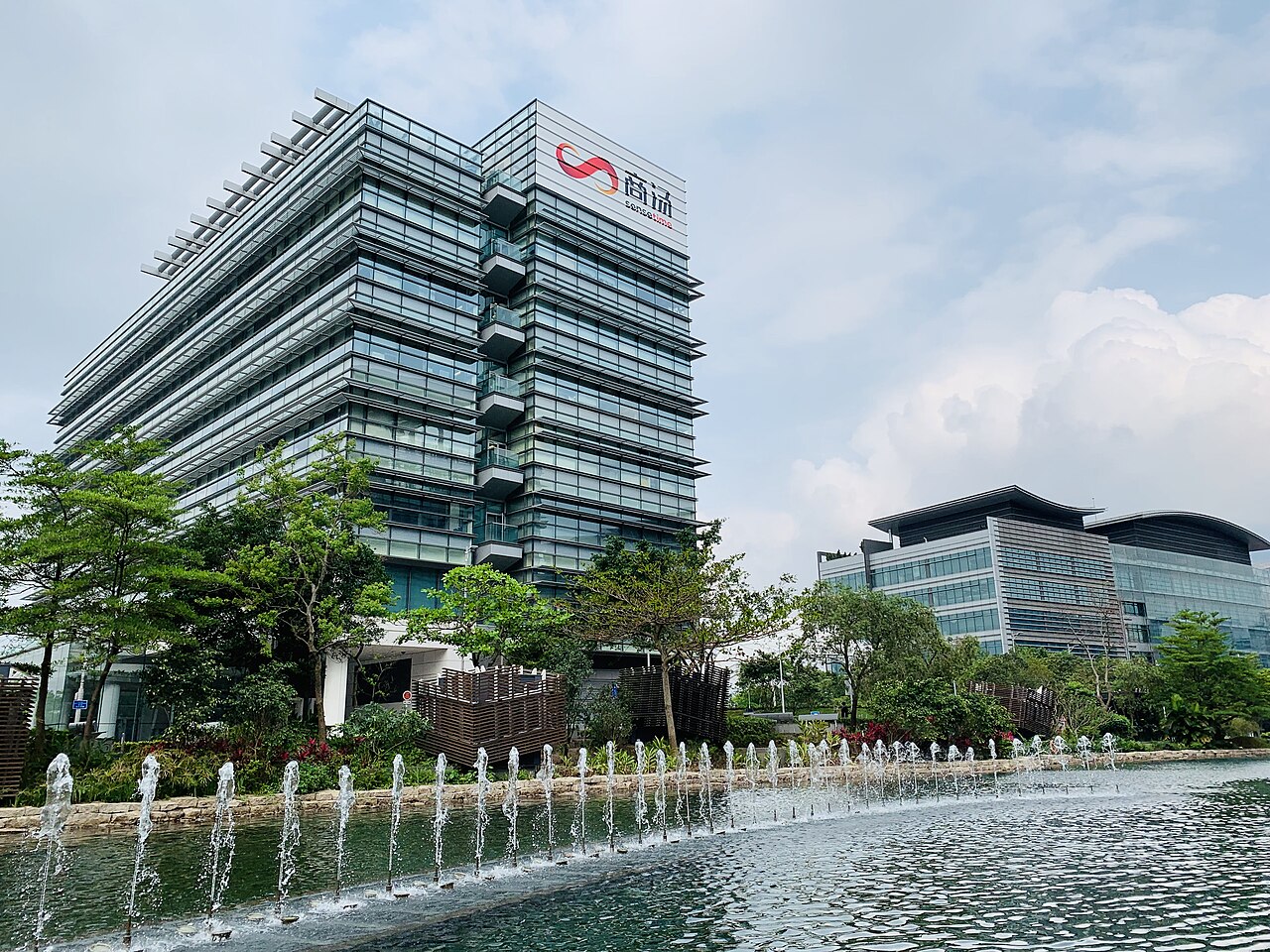
Image context: the cover uses a real Wikimedia Commons photograph of SenseTime's Hong Kong headquarters at Hong Kong Science Park. It works here because the article is about a company trying to turn a research argument into a deployable product surface, not about a standalone art-demo reel or an abstract architecture chart.[6]
The release cadence is the first tell
The repository timeline matters more than one isolated launch headline. In the public README, SenseTime marks the initial release of SenseNova-U1-8B-MoT-SFT, SenseNova-U1-8B-MoT, and the inference code on April 27, 2026.[2] It then adds an 8-step preview model on April 30, an 8-step LoRA on May 6, GGUF quantized checkpoints and layer-offload VRAM modes on May 8, and then a technical report plus A3B-MoT-SFT and A3B-MoT weights on May 10.[2][7]
That sequence is revealing because it does not behave like a lab dropping a single paper artifact and moving on. It behaves like a team trying to broaden the usable envelope quickly: base weights for early adopters, faster distilled variants for shorter generation loops, quantized community paths for constrained hardware, and then a second model configuration plus report once the first release has landed.[2][7] My inference from that pacing is that SenseTime wants U1 to become easier to test in real workflows before the category hardens around better-known image and multimodal incumbents.
The official launch note points in the same direction. SenseTime describes the current open-source release as a SenseNova U1 Lite series in two configurations and says the models are aimed at high-quality infographic creation, continuous image-text creation, and later online access through Office Raccoon.[1] That is already a more application-facing story than a conventional "new benchmark, new architecture" announcement.
Why this looks like a workflow surface rather than a model slogan
The strongest evidence sits in the example structure. The public examples are split across text-to-image, image editing, interleaved text+image generation, and visual understanding / VQA.[3] That task spread matters. A lot of multimodal releases still separate understanding models from generation models in the developer experience even when the company narrative says they are converging. U1 is trying to make the convergence legible in the interface itself.
The infographic emphasis is especially revealing. The README and launch note both highlight dense layout rendering, poster- and slide-like outputs, and continuous image-text generation rather than only generic beauty shots.[1][2][3] The example prompts even include infographic-oriented JSONL samples, prompt enhancement for infographic generation, and a "think mode" in which the model can emit a reasoning phase before image generation begins.[3] That is not the posture of a pure image model. It is the posture of a system being aimed at practical document-like and office-like outputs.
This is where the NEO-unify blog becomes useful as a boundary check. SenseTime frames the underlying architecture as an encoder-free, end-to-end path that removes the traditional visual encoder and VAE split, letting the model work directly across pixels and words.[5] That helps explain why the company keeps stressing unified understanding and generation. But benchmark claims around that architecture should still be treated as directional, not universal. The public comparisons highlighted in the repo center on understanding-plus-generation and infographic-oriented tasks, not on every possible agent or multimodal workload.[2][5] So the stronger takeaway is not "U1 is now the best at everything." It is that SenseTime is pushing a specific product thesis: one model family should be able to cross more of the office-document-visual loop without being stitched together from visibly separate tools.
The operating signal is even more interesting than the model signal
The most important document may actually be the serving note. In docs/inference_infra.md, SenseTime says U1 is exposed as one unified multimodal model, but its understanding and generation paths still prefer different scheduling policies, parallelization strategies, and resource ratios in production.[4] The solution is not a fully fused runtime. It is a disaggregated architecture: LightLLM handles understanding, text streaming, and control flow, while LightX2V handles image generation, with state passed through shared memory and transfer kernels.[4]
That is a serious field signal. Publicly, "unified multimodal" is the model story. Operationally, the serving stack still decouples the pathways so each can be scaled and tuned independently.[4] In other words, the unification is real at the model and interface level, but the production answer is still modular where hardware economics demand it.
That does not weaken the release. It clarifies it. The China AI market is increasingly full of products that want to present one coherent application surface while hiding heterogeneous routing, hardware, and inference behavior underneath. U1 fits that pattern cleanly. The company is effectively saying that developers should experience one multimodal system even if the backend keeps separate optimal paths for text-heavy and image-heavy traffic.[4]
What to watch next
Three follow-up questions now matter more than one more benchmark screenshot.
First, watch whether Office Raccoon actually exposes U1-style interleaved and infographic workflows in a product surface people can use, rather than keeping those strengths inside repo showcases.[1][3]
Second, watch whether the project ships the still-missing training code and keeps widening the community portability path through quantization, offload modes, and third-party runtimes.[2]
Third, watch whether larger-scale U1 variants preserve the same developer story. If future releases keep the public interface unified while broadening production packaging, then this release will look less like a one-off multimodal experiment and more like a durable China AI pattern: one model surface, split serving internals, and workflow-oriented outputs as the commercial wedge.[2][4][5]
That is why SenseNova U1 deserves attention. The real signal is not that SenseTime found a new way to say "multimodal." The signal is that it is trying to make unified multimodality usable enough to enter office software, document workflows, and agent-style application surfaces without making the seams too visible.[1][2][3][4]
Sources
- SenseTime, "SenseTime Fully Open-Sources SenseNova U1: A Unified Model for Understanding and Generation" (April 29, 2026; official launch note covering the U1 Lite release, continuous image-text creation, infographic positioning, and planned Office Raccoon access).
- OpenSenseNova, "SenseNova-U1" GitHub repository README (release timeline, model variants, benchmark framing, interleaved generation, and low-VRAM packaging notes).
- OpenSenseNova, "examples/README.md" (task folders for text-to-image, editing, interleaved generation, VQA, reasoning mode, infographic prompts, and deployment options).
- OpenSenseNova, "docs/inference_infra.md" (disaggregated LightLLM + LightX2V serving design, separate vs colocate deployment, and production-scaling rationale).
- SenseNova on Hugging Face, "NEO-unify: Building Native Multimodal Unified Models End to End" (March 5, 2026; architectural framing for encoder-free unified multimodal learning and its stated direction).
- Wikimedia Commons, "File:SenseTime Hong Kong HQ.jpg" (source page for the article's cover photograph).
- OpenSenseNova, "SenseNOVA_U1.pdf" technical report (linked from the official repository's May 10, 2026 update).