As of 2026-05-04 UTC, Baidu's more revealing AI-China move is no longer another model launch by itself. The sharper signal is that Qianfan is starting to subsidize the distribution layer for agents. Baidu's own Agent Development Platform page says that if a builder publishes an application into Baidu Search, the web version, App Square, or WeChat mini-programs, the builder can enable a free distribution configuration under which the platform bears the eligible model-resource consumption instead of charging that usage back to the builder.[1] That is not a small pricing footnote. It is a statement about where Baidu thinks the next competitive moat sits.
Once a platform is willing to spend money so that developers place agents inside its preferred channels, the product logic changes. The center of gravity moves away from "whose base model is strongest this week?" and toward "which platform can make deployment, discovery, and repeat usage cheapest?" My inference from Baidu's public documentation is that the company wants Qianfan to become more than a place where agents are built. It wants Qianfan to become a place where agents are routed into traffic.[1][2][3][4]
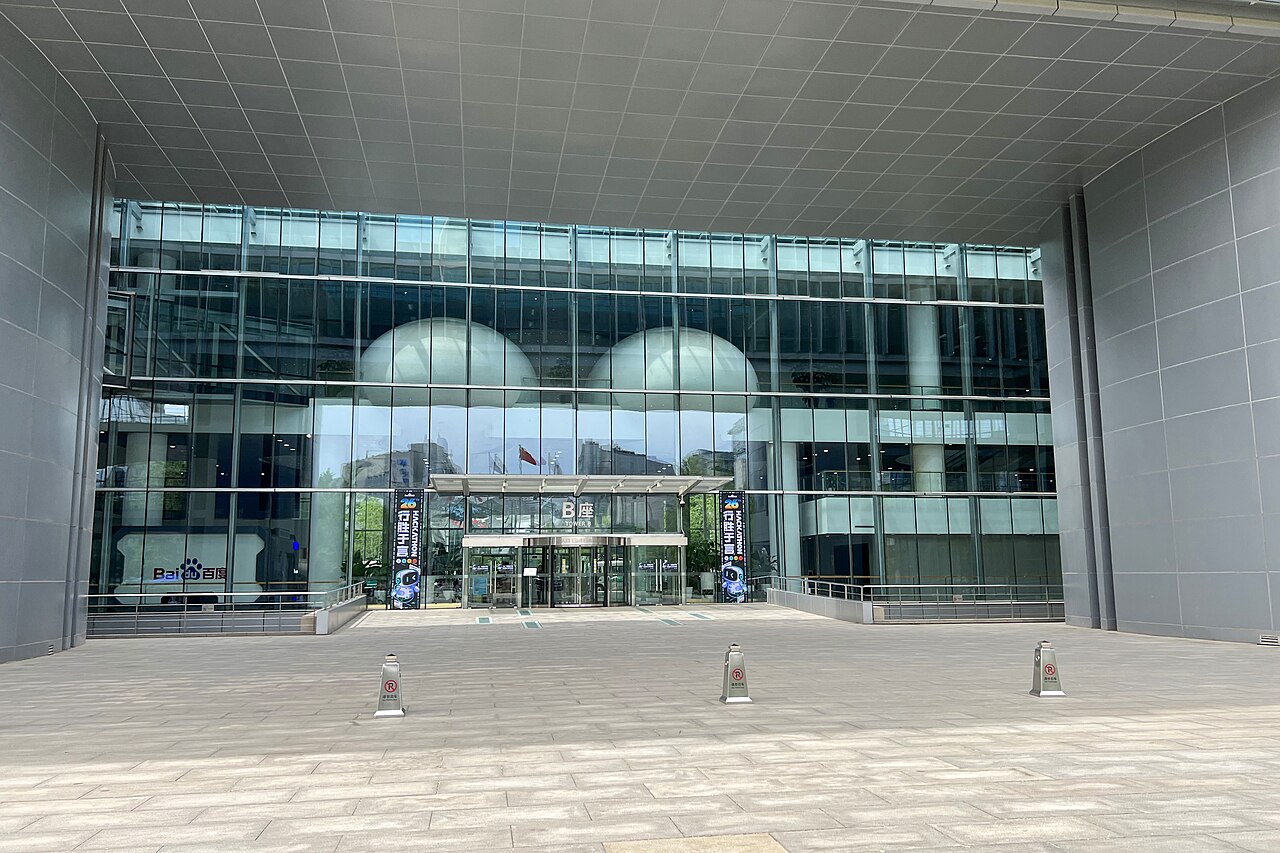
Image context: the cover uses a real Wikimedia Commons photograph of Baidu's Shangdi headquarters in Beijing. That is the right visual here because the argument is about institutional channel control and subsidy design, not about a floating chatbot abstraction.[5]
The subsidy matters because it changes what Baidu is buying
The strongest clue is the wording on the Agent Development Platform page itself. Baidu does not say only that these channels are available. It says that for certain channels it provides a time-limited free distribution benefit, and that after the builder turns on that configuration, the application's model-resource consumption is borne by the platform rather than deducted from the builder's own model resources.[1] The same page immediately adds a boundary: shared platform resources do not guarantee QPS, and only part of the preset model catalog is eligible.[1] That boundary is important because it shows this is a deliberate commercial instrument, not a vague marketing promise.
In plain product terms, Baidu is spending money to make certain publication routes feel cheaper than others. That usually means the company values what happens after publication more than the marginal revenue of each early model call. Search entry, web entry, marketplace exposure, and mini-program presence are being treated as higher-order strategic surfaces.[1]
That interpretation fits the current shape of Chinese agent competition. Models are getting cheaper, more interchangeable, and easier to wrap behind familiar APIs. Distribution, by contrast, remains stubbornly local. If Baidu can make one Qianfan-built agent easier to place inside Baidu Search and adjacent Baidu-controlled entry points, then the relevant asset is no longer only the model. It is the channel bundle around the model.[1][2]
Publish once, then fan out across multiple surfaces
The second clue is that Baidu's application-publishing path is already built as a fan-out system rather than a single chat endpoint.
The overview page for multi-agent collaboration says that once configuration and testing are done, the application can be published through three channels: web, App Square, and A2A.[2] Baidu then defines what each of those actually means. The web route gives the builder a directly accessible conversation page plus a share link. App Square lets the builder classify the application so users can discover it inside the marketplace. The A2A route packages the application under the A2A protocol, provides an SSE URL, and requires an API key so outside users or systems can connect to it beyond Baidu's own interface.[2]
That is a useful architecture clue. Baidu is not forcing a choice between "consumer-facing app" and "machine-callable service." The same application can become both. One route aims at traffic and discovery. Another route aims at platform-native catalog presence. A third route exposes the agent as a callable surface outside the platform boundary.[2]
This is why the subsidy is strategically interesting. A subsidy is more powerful when there is already a defined set of distribution rails waiting for it. Baidu is not offering free distribution into a void. It is attaching free distribution to a publication system that already knows how to produce share links, marketplace listings, and A2A endpoints.[1][2]
The official-agent lane is getting standardized
The update log makes the distribution thesis stronger because it shows Baidu repeatedly shortening the distance between agent creation and published use.
On 2026-02-13, Baidu said its autonomous planning Agent could be published with one click as a Miaoda plugin, turning the build into an interactive application such as a website or mini-program and describing that move explicitly as an end-to-end path from agent development to application landing.[3] On the same date, Baidu said the OpenClaw quick-experience flow had gone live, supporting one-click configuration of Qianfan models and official Skills.[3] Earlier, on 2025-12-12, Baidu had already announced official agents, including Deep Research, Browser Use, and a Code Interpreter agent, each framed as a practical solution rather than as a raw research demo.[3]
What ties those updates together is not merely "more features." It is packaging discipline. Baidu keeps moving reusable agent behaviors into named, publishable, and channel-aware forms. The plugin path pushes an agent into public-facing application surfaces.[3] The OpenClaw flow lowers the setup friction for agent shells on Baidu rails.[3] The official-agent lineup gives the platform a stable menu of pre-shaped workloads that can be routed, published, and reused.[3]
That pattern matters because it reduces the custom work required before distribution begins. A platform that wants to own distribution cannot rely only on beautiful demos; it has to make deployment shapes legible enough that ordinary builders can reuse them. Baidu's update cadence suggests that this is exactly what Qianfan is trying to do.[3]
The API surface shows Baidu wants agents to stay callable after publication
The fourth clue sits in the API docs. Baidu's conversation-creation interface for official agents exposes specific agent_code values including code_interpreter, browser_use, deepresearch, and ai_assistant.[4] When the builder uses the deepresearch route, the docs say an agent_id is required, and that the user should first create, configure, and publish the agent in the Qianfan console before returning to copy the ID.[4] The API then returns a new conversation_id for the created session.[4]
That sequence is revealing. Publication is not the end of the life cycle; publication is part of how the agent becomes operationally addressable. In other words, Baidu is teaching developers to think in one chain: create the agent, publish it, copy the ID, and call it through a formal interface.[2][4] That is a different posture from treating agents as one-off UI toys. It treats them as deployable objects with both user-facing and programmable lives.
This is also where the A2A route and the official-agent API start to rhyme. One route packages an application for external protocol-based use with an SSE URL and API key.[2] Another route exposes official agent conversations as API objects after the relevant agent has been created and published.[4] Put together, the picture is not "Baidu has a few agent demos." The picture is "Baidu is standardizing how agent artifacts travel from build surface to channel surface to callable surface."[2][4]
Why this is the more durable Baidu signal
Baidu may still ship stronger or weaker model cycles from quarter to quarter. That is not the narrow point here. The narrower point is that the company is now showing where it is willing to pay, where it wants builders to publish, and how it expects agents to remain callable after they are shipped.[1][2][3][4]
That combination creates a more durable AI-China signal than one benchmark table. Subsidized distribution says Baidu values channel occupancy. Multi-route publishing says Baidu wants one agent to reach both users and other systems. Official-agent and API surfaces say Baidu wants those deployments to stay standardized enough for reuse.[1][2][3][4]
The boundary is clear too. The free-distribution lane is limited, QPS is not guaranteed on shared resources, and not every model qualifies.[1] So this is not a claim that Baidu has solved monetization or enterprise adoption. It is a narrower claim that Baidu has started to treat distribution economics as a first-class control surface for agent competition.
That is why the relevant thing to watch next is not only the next ERNIE or Qianfan model update. It is whether more Baidu agents get shaped into this same pattern: subsidized publication into favored channels, easy fan-out into web and marketplace discovery, and a stable route into A2A or agent APIs once the application is live. If that pattern keeps thickening, Baidu's stronger 2026Q2 edge will sit one layer above the model. It will sit in the decision to make distribution itself cheaper, stickier, and more programmable.
Sources
- 百度智能云文档中心,《Agent开发平台》(免费分发规则、百度搜索/网页版/应用广场/微信小程序渠道,以及平台承担部分模型资源消耗的说明)。
- 百度智能云文档中心,《概述》 for 多智能体协同Agent(网页版、应用广场、A2A 三种发布渠道,分享链接、分类上架、SSE URL 与 API Key 的发布路径)。
- 百度智能云文档中心,《更新动态》 for 百度千帆·大模型服务及Agent开发平台(官方 Agent、Deep Research、OpenClaw 快速体验,以及自主规划 Agent 一键发布到秒哒插件等更新)。
- 百度智能云文档中心,《对话创建》 for 千帆AI应用开发者中心 API(
code_interpreter、browser_use、deepresearch、ai_assistant等 agentcode,以及发布后复制 agentid 的调用流程)。 - Wikimedia Commons, "File:Entrance of Baidu headquarters at Shangdi (20220509112334).jpg"(本文题图来源页)。