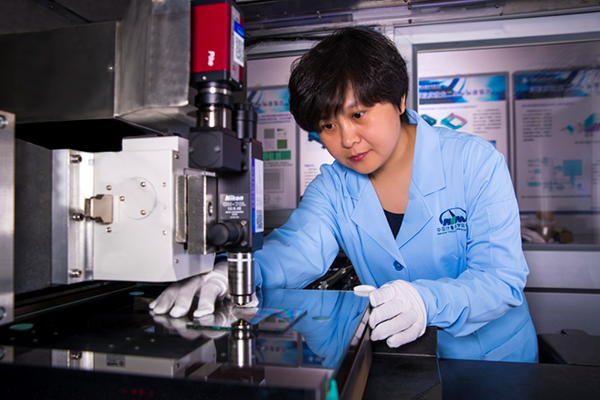
A technician bends over a glass plate while a red Nikon measurement head hangs a few centimetres above her hands. The instrument belongs to a two-dimensional line-grating laboratory at China's National Institute of Metrology. Its source page describes a 300 × 300 millimetre measurement range and uncertainty down to 100 nanometres.[6] A quantity has been defined; an apparatus follows a procedure; the result travels with a statement of uncertainty. That is what mature metrology looks like.
Now place that photograph beside China's newest AI policy. On May 28, 2026, the State Administration for Market Regulation and the National Development and Reform Commission announced a national guide for artificial-intelligence metrology. It calls for measurement across algorithms and models, computing efficiency, and data quality; for reference and test datasets; for technical specifications and measurement instruments; and for application in 14 sectors, including manufacturing, health care, and transport.[1]
As of July 21, 2026, the market significance is larger than another standards document but narrower than a national certification regime. China is trying to build the institutional layer through which an AI claim can become comparable, auditable, and eventually buyable. The guide could create demand for test laboratories, reference-data custodians, evaluation software, sector specialists, and assurance services. Yet the hard part is not opening centres or publishing scorecards. It is deciding what the “quantity” is when an AI system changes with its prompt, data, model version, tools, users, and deployment setting.
An administrative category becomes an economic layer
The official summary organizes the plan into six areas: foundational support, general technologies, core technologies, metrology specifications, services to industry, and the use of AI inside metrology itself.[1] Its language is deliberately infrastructural. AI performance should become measurable, comparable, and traceable; reference resources should include high-metrological-quality datasets, standard reference datasets, and test datasets; national research-and-application centres should connect laboratory work to sector deployments.[1]
Those ambitions matter because an enterprise purchase rarely turns on a public leaderboard alone. A hospital wants to know how a diagnostic model performs on its scanners and patient mix. A factory cares whether a vision system holds its error rate under new lighting, materials, and line speeds. A transport operator needs a failure envelope, not an average demo score. Shared test procedures and reference artifacts can reduce the cost of asking those questions repeatedly—if buyers, vendors, laboratories, and regulators accept the answers.
The guide itself does not make one benchmark mandatory, certify a named model, or create a licensing rule. It is a capacity-building plan. Treating it as completed regulation would confuse institutional intent with market practice. The economic signal is that Beijing has named AI measurement as an infrastructure category and assigned public bodies to build it.[1]
Policy can finance the plumbing
The May guide sits on top of an implementation mechanism published a year earlier. A 2025–2030 action plan from the market regulator and the Ministry of Industry and Information Technology called for cross-domain AI metrology platforms, algorithm-performance assessment, model and platform security testing, evaluation of intelligent equipment, and a risk-grading test system.[2] Across ten priority industries—not AI alone—the plan provides for a national project pool, roughly ten priority projects each year, quarterly supervision, and year-end evaluation.[2]
That mechanism can move AI metrology from a concept into funded work: project calls, lead institutions, test platforms, technical methods, and demonstrators. It also creates a predictable danger. A project count measures administrative throughput, not measurement quality. Ten funded efforts can produce ten incompatible definitions of reliability just as easily as one shared reference chain.
China is not starting without institutions. In a January 2026 briefing, the market regulator said the broader national metrology system had approved 32 national industry metrology test centres and 16 national metrology data construction-and-application centres, issued 652 national metrology technical specifications, and had more than 2,000 internationally recognized calibration and measurement capabilities.[3] Those figures cover metrology broadly, not AI specifically. Their relevance is organizational: China already has laboratories, data bodies, specification processes, and comparison channels that an AI program can recruit. Their existence does not show that an LLM's truthfulness or an autonomous system's safety can yet be traced like voltage or length.
AI does not come with a metre stick
The word metrology raises the quality bar because it demands more than repeatable software. It asks what is being measured, how sensitive the instrument is, how much uncertainty surrounds the result, and whether another competent laboratory can reproduce it.
AI benchmarks often leave those questions implicit. A 2019 paper by Chris Welty, Praveen Paritosh, and Lora Aroyo argued that a benchmark dataset should be treated as an instrument whose precision, sensitivity, annotation variation, and intended use need characterization.[5] A score difference smaller than the instrument can reliably resolve should not support a grand claim about which system is better.
NIST's February 2026 work makes the issue concrete for current language models. Its researchers evaluated 22 frontier models on three benchmarks and separated two targets that a single accuracy score can blur: performance on the fixed questions actually asked, and generalized performance on the wider population of similar questions. The targets require different statistical treatment and different uncertainty estimates.[4] Neither is universally correct; the evaluation goal determines which answer is meaningful.
That is the boundary China's program must cross. A reference dataset is not automatically a reference measurement. A hospital dataset may omit the population on which a system will be used. A safety test can be sensitive to prompt templates or judge models. Compute-efficiency results can change with batching, quantization, hardware, latency targets, and utilization. Data-quality scores depend on which errors matter for the downstream task. Traceability therefore cannot mean tracing every AI result to one universal number. It has to mean tracing a stated claim through versions, conditions, procedures, reference artifacts, and uncertainty.
The buyer is where metrology becomes a market
If the program works, its first commercial effect will be a change in the evidence attached to a purchase. A credible test report could state the model and software version, hardware and runtime, dataset provenance, sampling frame, prompt protocol, human-annotation process, uncertainty interval, known exclusions, and the conditions under which the result should not travel. That package is more valuable than a seal with no visible method.
This implies—not yet proves—a service market with several layers. National institutes can develop reference methods and run inter-laboratory comparisons. Sector laboratories can translate them into clinical, industrial, transport, and regulatory tests. Dataset custodians can maintain versioned reference material. Software vendors can automate evaluation while preserving an audit trail. Independent assessors can verify that a deployment matches the tested configuration. Buyers can write those artifacts into tenders and acceptance tests.
The strongest macro case is reduced transaction friction. When every buyer invents a test, smaller vendors face repeated integration costs and large incumbents can substitute reputation for evidence. A trusted measurement layer can make claims portable enough for procurement and financing. The counterweight is compliance theatre: overlapping badges, pay-to-test reports, and local standards that cannot be compared outside the issuing institution. That outcome would add cost while protecting neither buyers nor users.
The first receipts
Five artifacts will show whether the 2026 guide is becoming metrology rather than branding.
First, centre charters should define narrow measurands and sectors instead of promising to measure “AI quality” in the abstract. Second, reference datasets should publish provenance, version history, sampling boundaries, annotation processes, and known blind spots. Third, technical specifications should require uncertainty and deployment conditions alongside point scores. Fourth, inter-laboratory comparisons should show whether two institutions can obtain compatible results on the same system. Fifth, tenders or sector pilots should begin asking for these artifacts rather than merely naming an approved laboratory.
The thesis has a clear falsifier. If the next wave produces many centres and specifications but no reproducible cross-lab results, no visible uncertainty statements, and no change in how AI systems are accepted into real workflows, China will have expanded its evaluation bureaucracy without creating a metrology market.
The line-grating photograph is useful precisely because it keeps the ambition honest. Physical metrology earned trust through defined quantities, reference chains, instruments, and comparison—not through the word measurement. China's AI program is now building the institutions that could make model and data claims travel. The decisive count will not be how many rulers it announces, but how often two careful laboratories can use them and agree.
Sources
- State Administration for Market Regulation, “SAMR and NDRC jointly issue the Guidelines for AI Metrology System and Capacity Building” (2026-05-28; official summary of the six-part framework, reference datasets, national centres, and 14 application sectors).
- State Administration for Market Regulation and Ministry of Industry and Information Technology, “Action Plan for Metrology to Support the Development of New Quality Productive Forces, 2025–2030” (official policy text covering AI testing platforms, project selection, supervision, and translation into industry).
- State Administration for Market Regulation, “Press conference on advancing the construction of a quality powerhouse” (2026-01; official briefing on China's existing metrology centres, data institutions, technical specifications, and internationally recognized capabilities).
- National Institute of Standards and Technology, Expanding the AI Evaluation Toolbox with Statistical Models (NIST AI 800-3, 2026; benchmark versus generalized accuracy, statistical assumptions, and uncertainty).
- Chris Welty, Praveen Paritosh, and Lora Aroyo, “Metrology for AI: From Benchmarks to Instruments” (2019; research paper on characterizing datasets as measurement instruments).
- National Institute of Metrology, China, “Two-Dimensional Line-Grating Working Standard Laboratory” (institutional page and source of the documentary laboratory photograph used above).