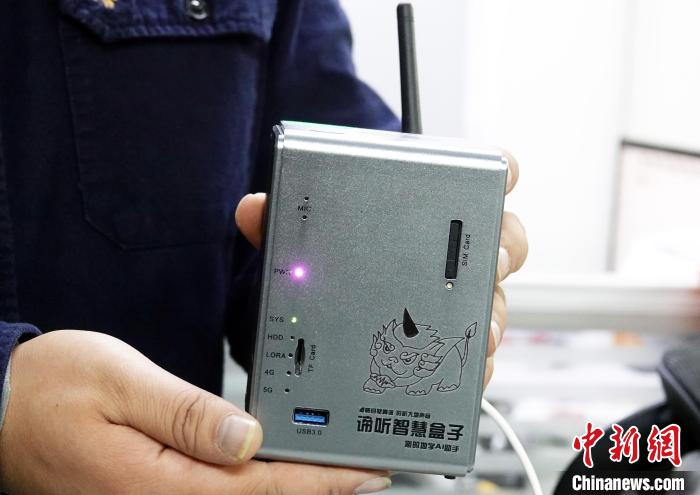
The most revealing object in China's DiTing earthquake-AI program fits between two hands. It is a silver metal box with an antenna, a few status lights, and ports along its face. There is no wall of glowing maps and no humanoid robot. The point is to place useful computation near a seismic station, where a continuous stream of ground motion first becomes evidence.[5]
A seismometer does not deliver a neat announcement that an earthquake has occurred. It records three components of motion. A monitoring workflow must detect a possible event, mark the first arrivals of the faster P wave and the later S wave, decide which picks from different stations belong together, and then estimate properties such as location and magnitude. DiTing targets that early chain: a national waveform archive supplies labeled examples; neural networks learn to make phase picks; lightweight hardware can begin processing at the edge; cloud modules and people handle the consequential handoffs.[1][3][5]
That makes DiTing a useful AI-China case because its value is measurable without pretending that it predicts the next earthquake. The system begins interpreting a quake after its waves reach instruments. Faster, denser analysis can improve monitoring, aftershock catalogs, and the inputs to early-warning or emergency products. It cannot turn phase picking into advance knowledge of when a fault will rupture.
The hidden asset is an old catalog
DiTing's first important release was data, not a model. On January 14, 2022, China's National Earthquake Science Data Center described a dataset built from China Earthquake Networks Center phase reports and archived event waveforms spanning 2013 to 2020. After cleaning and desensitization, it contained 2,734,748 three-component traces from 787,010 regional events, with P- and S-arrival labels and 641,025 labels for P-wave first-motion polarity.[1]
The accompanying paper fixes the evaluation envelope more precisely. The traces came mainly from broadband and short-period seismometers, were sampled at 50 hertz, and were cut into 180-second windows. Event magnitudes ranged from 0 to 7.7 and epicentral distances from 0 to 330 kilometres.[2] Those details matter because they define where evidence can travel. A model trained on these windows has learned from a large, geographically relevant archive; it has not thereby learned every sensor, noise regime, station condition, or tectonic setting.
The archive also captures human labor. Arrival labels originate in years of cataloging reports, so the model's apparent speed rests on analysts who previously decided where phases began. DiTing converts that accumulated judgment into reusable training material. Its strategic advantage is therefore institutional as much as algorithmic: a nationwide monitoring network and a sustained cataloging practice can produce local labels at a scale that a new model team cannot simply download from anywhere.[1][2]
One national picker was not enough
Localization became the next lesson. Researchers behind USTC-Pickers, published in 2023, reported that widely used deep-learning pickers such as PhaseNet and EQTransformer lost performance on Chinese data. They trained a common U-Net-style base model on DiTing, then fine-tuned five versions for major tectonic blocks, 33 for provincial-level regions, and two special versions for the capital area and the China Seismic Experimental Site.[3]
This is more revealing than a single nationwide score. The shape and noise of a waveform depend on instruments, crustal structure, station siting, distance, and the local event population. Regional tuning says that deployment is a map of distributions, not one model endpoint. It also creates an operational burden: teams need to know which picker is active, what regional data refined it, and whether a changing station network has moved beyond its training envelope.
A separate comparison placed seven neural phase pickers on the same DiTing benchmark and measured both accuracy and computing cost. Recurrent models and EQTransformer led the reported F1 comparison, while the lightweight LPPN family was fastest; the authors' practical conclusion was that users should choose for their application rather than expect one architecture to dominate every constraint.[4] These are benchmark results on specified data and CPU/GPU setups, not proof of live-network reliability. Their useful signal is the trade-off: the model best suited to a research server may not be the one that belongs in a small, low-power station box.
The box redraws the data route
The DiTing Smart Box turns that trade-off into hardware. In a January 2024 report, the project team described a three-year effort combining the labeled dataset, lightweight phase picking, rapid phase association, and a software-hardware system. The reported functions include detecting events in continuous waveforms, estimating magnitude, marking P- and S-arrival times, identifying first-motion polarity, and estimating station-to-event direction. The team said these tasks could be completed within seconds and cited analysis of the 2022 magnitude-6.8 Luding earthquake sequence as a research application.[5]
The placement matters. When phase detection and preliminary feature extraction happen near the station, the network does not have to treat every raw sample as equally urgent before any interpretation begins. The project's edge-cloud design leaves multi-station association, automatic location, and source-parameter calculation to downstream modules.[5] In other words, the box is not a self-contained earthquake authority. It is the first computational relay in a longer chain.
By April 2025, the Beijing Earthquake Administration said DiTing boxes had been installed at monitoring stations in multiple regions and were being used for intelligent monitoring, operational consultation, and public education.[6] That is credible evidence of distribution, but it is not a public deployment audit. The page does not enumerate the sites, report continuous-stream false alarms, publish end-to-end latency, or compare analyst workload before and after installation. Those missing measurements are exactly what should separate a product sighting from an operational result.
A phase pick is a proposal
The project's own reported experience supplies the strongest caution. The 2024 account says an early lightweight picker began around 60 percent accuracy and only reached above 85 percent after the team rebuilt its process with China Earthquake Networks Center data over nearly two years. The same report says AI cannot fully replace human work, points to uneven data quality and model opacity, and presents human checking as a response to false detections.[5]
That is not a footnote to the use case; it is the use case. A phase pick is a machine proposal about where meaningful energy begins. Picks from several stations still have to form a physically coherent event. A location has to fit travel times. Magnitude and mechanism estimates need their own validation. An alert or emergency product adds another layer of latency, thresholds, and responsibility. Improving the first proposal can make every downstream step faster, but confidence cannot be inherited automatically along the chain.
The evaluation that matters now has four parts. First, measure recall and timing error on continuous station streams, where noise dominates, not only on event windows. Second, stratify results by region, sensor type, magnitude, distance, and signal-to-noise ratio so an average does not hide the hard stations. Third, publish false-event and missed-event rates after multi-station association, not phase-picker scores alone. Fourth, measure the entire handoff: sensor to pick, pick to location, location to analyst review, and review to any outward-facing product.
In February 2026, a China Earthquake Administration roundup said a larger, hundred-million-parameter DiTing waveform model had been opened for use with fine-tuning and inference workflows after a test version was applied to data from the 2025 Dingri magnitude-6.8 earthquake.[7] That expansion may improve transfer across tasks, but parameter count does not remove the edge system's central discipline. Every result still has a sensor, a timestamp, a model version, a geographic context, and a downstream decision that can fail.
DiTing's strongest contribution is therefore easy to overlook. It gives China's long seismic record a route back into the stations that produced it: catalog labels become regional pickers; regional pickers fit inside small hardware; edge results meet cloud association and human judgment. The box in the photograph is modest because the valuable change is not theatrical. It is the shortening of the distance between a vibration in the ground and the first reviewable account of what happened.
Sources
- National Earthquake Science Data Center, “National Earthquake Science Data Center releases the DiTing seismology training dataset” (2022-01-14; official Chinese release, provenance, coverage, labels, and instrument types).
- Ming Zhao et al., “DiTing: A large-scale Chinese seismic benchmark dataset for artificial intelligence in seismology,” Earthquake Science 36(2), 2023 (dataset construction and evaluation envelope).
- Jun Zhu, Zefeng Li, and Lihua Fang, “USTC-Pickers: a Unified Set of seismic phase pickers Transfer learned for China,” Earthquake Science 36(2), 2023 (national base picker and regional fine-tuning).
- Ziye Yu, Weitao Wang, and Yini Chen, “Benchmark on the accuracy and efficiency of several neural network based phase pickers using datasets from China Seismic Network,” Earthquake Science 36(2), 2023 (shared-data comparison of seven picker architectures).
- China News Service, “How can artificial intelligence serve earthquake monitoring?” (2024-01-23; team interviews, deployment limits, Luding application, and source of the DiTing Smart Box photograph).
- Beijing Earthquake Administration, “Turning professional instruments into science-education helpers: the DiTing Smart Box makes its first appearance in Haidian earthquake outreach” (2025-04-03; official deployment-status note).
- China News Service, “Earthquake early warning and a seismic-wave foundation model selected among the public's top disaster-prevention advances” (2026-02-28; official-roundup reporting on the DiTing model's test use and open workflows).