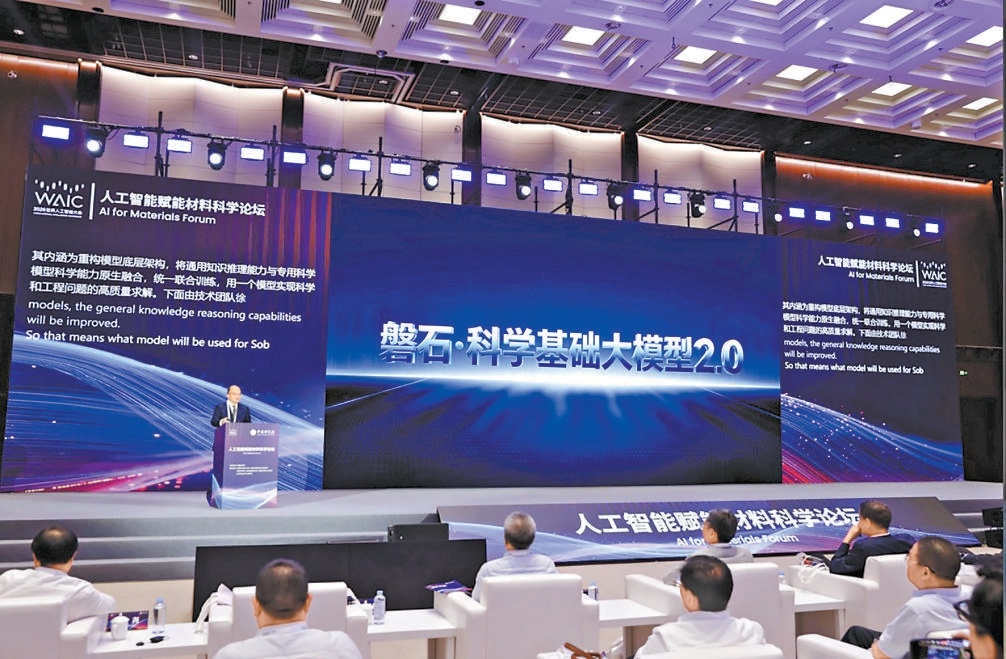
On a conference floor, a foundation model is easy to frame: one name, one screen, one release number. Panshi 2.0, unveiled at the World Artificial Intelligence Conference in Shanghai on July 17, 2026, is harder to understand once the display is out of view. The Chinese Academy of Sciences (CAS) is not presenting only a larger scientific chatbot. It is presenting a switchboard meant to connect scientific data, general reasoning, domain models, software tools, simulation hardware, and task-specific agents.[1]
That is the important release delta. In April, the Panshi 100 system was organized around a 1.5pro foundation model, specialist models for wave, spectrum, and field data, and more than 2,000 research tools. Three months later, the 2.0 announcement described a three-stage architecture, 8 million scientific-reasoning records, more than 8,000 tools and skills, and a heterogeneous compute layer for model training, conventional simulation, and specialized molecular dynamics.[1][2]
The numbers make the platform look four times larger at the tool layer. They do not, by themselves, show that a scientist can complete four times as much useful work. Panshi 2.0's strongest claim is architectural: it tries to make the handoffs between reading, reasoning, calculation, and domain execution into one product. Its weakest public layer is evaluation. CAS reports results across more than 60 specialist tasks, but the launch material does not publish the task list, splits, model versions, prompts, hardware, runtime, or result tables needed to reproduce those comparisons.[1] For now, the performance headline is directional; the platform design is the more inspectable story.
The release moves from model family to research route
The April Panshi 100 release already separated a common foundation from a branching family of disciplinary models and agents. Its 1.5pro model used 6.5 million scientific-reasoning records and three scientific-modality bases: one for wave-like signals, one for spectra, and one for physical fields. The same announcement described a tool-and-agent factory with more than 2,000 tools across over 10 research domains.[2]
Panshi 2.0 gives that collection a clearer route. CAS describes three successive layers: unified encoding of scientific data, alignment with knowledge about the natural world, and domain-task decoding.[1] The wording matters. A spectrum, a seismogram, a protein site, and a pressure field are not merely pictures with unusual colors. Each has its own units, invariances, noise sources, and admissible transformations. A general visual-language model may describe the surface; a scientific system must preserve enough structure to pass the representation to an appropriate predictor, solver, or instrument workflow.
The domain decoder is therefore more consequential than a wider chat interface. It is the point where a shared representation must become a chemically valid property estimate, a candidate molecular structure, a protein-site prediction, or another bounded output. Panshi's design says that common encoding and knowledge can be shared while the last mile stays specialized. That is a sensible answer to the tension between a universal assistant and a narrow scientific model: do not force one component to impersonate the entire laboratory.
The reported data change should be read carefully. The April release cited 6.5 million high-quality scientific-reasoning records; the July release cited 8 million records covering more than 200 research tasks.[1][2] The nominal increase is 1.5 million, or about 23 percent. Neither announcement provides a shared schema, deduplication method, provenance breakdown, or version manifest, so the two figures are not yet a clean growth series. More records are useful only if their evidence chains, task definitions, and contamination controls survive inspection.
One part of the data layer is genuinely open
Panshi's public data work gives a useful example of what artifact-level disclosure can look like. The team's S1-MMAlign dataset contains more than 15.5 million scientific image-text pairs drawn from 2.5 million open-access papers. Its authors describe an enhancement pipeline that uses a paper's abstract and the contexts that cite a figure to produce richer image descriptions, then test the resulting data on alignment and downstream scientific-vision tasks.[3]
This is not the same thing as the 8 million reasoning records announced for Panshi 2.0. It is a distinct multimodal corpus, and treating the two counts as interchangeable would blur both provenance and purpose. But S1-MMAlign is inspectable in ways the 2.0 launch metrics are not: the dataset has a paper, a public repository, a stated CC BY-NC 4.0 license, versioned files, and a browsable sample surface.[3][4]
That contrast identifies the next useful release artifact. Panshi 2.0 needs a model card and data manifest that map each public claim to a versioned component: which encoders and decoders are available, which weights or APIs expose them, which reasoning-data categories feed them, what licenses apply, and which evaluation set tests each capability. The July announcement links no 2.0 checkpoint, code repository, or task-level evaluation packet.[1] That does not mean the system is closed internally; it means an outside researcher cannot yet reconstruct the advertised release from the launch page.
Eight thousand tools are inventory, not orchestration
The jump from more than 2,000 tools in April to more than 8,000 tools and skills in July is the most visible platform expansion.[1][2] It is also the number most likely to be misunderstood. A tool catalog becomes a research system only when the model can choose a valid tool, satisfy its input contract, carry units and uncertainty across the call, detect failure, preserve the trace, and hand the result to the next stage without silently changing its meaning.
A molecular-dynamics package, a literature index, and a protein-site predictor may all be callable, but they do not share a natural interface. Their useful outputs depend on software versions, databases, boundary conditions, convergence criteria, and scientific assumptions. Counting them answers, “How much could the platform reach?” It does not answer, “How often did the platform assemble a correct route?”
Panshi's original 2025 release makes the ambition clearer. CAS described a heterogeneous mixture-of-experts architecture customized for science, combined with specialist systems such as AlphaFold and MatterGen, plus agents for literature and tool scheduling.[5] Panshi 2.0 turns that earlier composition into a more explicit product layer. The engineering proof should now move from catalog size to completed workflow traces: task, plan, tool versions, inputs, intermediate outputs, error recovery, expert review, and final result.
That trace is not bureaucratic overhead. In science, it is the difference between a fluent answer and an auditable procedure. A failed tool call should not disappear into a polished paragraph; a unit conversion should not be implicit; a literature claim should retain its source; and an agent should know when a specialist output lies outside its calibration range.
The compute stack mirrors the workflow
Panshi 2.0's “supercomputing + intelligent computing + accelerated computing” formulation can sound like a procurement slogan. Underneath it is a practical division of labor. CAS assigns conventional scientific computation and high-throughput simulation to supercomputing, model training and inference to AI clusters, and long-duration, high-precision tasks such as molecular dynamics to specialized accelerators including Tianqiong 3D hardware. The stack is also reported as adapted to Ascend and Hygon chips.[1]
This matters because AI for science rarely ends at token generation. A model may propose a candidate or choose a solver, but the expensive proof can still be a simulation, an instrument run, or a wet-lab experiment. Putting several compute classes behind one planner could reduce handoff friction and let an agent route each stage to the right machine.
It also creates a new evaluation obligation. A platform result should report more than model accuracy: queue time, compute time, accelerator type, solver tolerance, energy or resource cost where available, failure rate, and the human labor required to approve or repair the route. Without those measures, “minutes instead of hours” can mix gains from a learned surrogate, faster hardware, a looser approximation, and a changed task.
Beijing Daily offers one concrete but still incomplete example: a Panshi 2.0 astronomy agent reportedly improved rare-object identification accuracy by about 50 percent over the previous best method and reduced parameter simulation from hours to minutes for work linked to the LAMOST telescope.[6] The report does not provide the dataset, denominator, error bars, compute setup, or definition of the earlier baseline. The result is promising enough to investigate, not specific enough to reproduce.
The scorecard must follow the handoffs
CAS says Panshi 2.0 exceeded general flagship models on most of more than 60 professional tasks and led domain models on selected chemistry, spectrum-to-structure, and protein-site problems.[1] Because the release does not identify the exact tests and comparators, those claims should not be collapsed into a universal “better at science” ranking. A system with many specialist decoders can reasonably outperform one general model on chosen domain tasks; the important question is whether the comparisons use the same information, tools, compute budget, and review rules.
Four disclosures would turn the headline into a usable scorecard.
First, publish a versioned task matrix: dataset and split, domain, metric, baseline version, prompt or tool policy, hardware, runtime, and uncertainty. Second, separate component tests from end-to-end tests. An encoder can classify a spectrum correctly while an agent still selects the wrong downstream tool. Third, include abstention, tool failure, and expert-correction rates. A scientific assistant's safety lies partly in recognizing when its route has broken. Fourth, expose several complete traces from real deployments, including unsuccessful ones, so outside readers can see where Panshi hands control to a specialist model, simulator, or scientist.
Adoption counts need the same discipline. The July release reports use at more than 50 CAS institutes, more than 30 external universities, research organizations, and state-owned enterprises, with international outreach through UNESCO and the Alliance of International Science Organizations.[1] Those figures show distribution. They do not reveal active researchers, repeat workflows, validated discoveries, or how many installations use the full 2.0 stack rather than one service. Usage cohorts and outcome audits would make the deployment claim commensurable over time.
Panshi 2.0 is most interesting where it refuses the fiction that scientific intelligence lives in one set of weights. Data, specialist representations, tools, simulators, accelerators, agents, and researchers all sit on the route. CAS has now described that route with unusual breadth. The next release should make it possible to retrace a journey through it.
Sources
- Chinese Academy of Sciences, “磐石·科学基础大模型2.0发布” (July 21, 2026; official release architecture, data, evaluation, tool, compute, and deployment claims).
- Institute of Automation, Chinese Academy of Sciences, “中国科学院‘磐石100’模型体系发布:AI引擎驱动科学创新” (April 28, 2026; 1.5pro baseline, scientific modality models, reasoning data, tool inventory, and deployment context).
- He Wang et al., “S1-MMAlign: A Large-Scale, Multi-Disciplinary Dataset for Scientific Figure-Text Understanding,” arXiv:2601.00264v2 (May 6, 2026; corpus construction, scale, alignment method, and validation).
- ScienceOne-AI, “S1-MMAlign” dataset repository (accessed August 3, 2026; public files, version history, sample viewer, and CC BY-NC 4.0 license).
- Institute of Automation, Chinese Academy of Sciences, “‘磐石·科学基础大模型’正式发布 赋能科研范式重塑” (July 26, 2025; initial architecture, specialist-model integration, agents, and platform framing).
- Beijing Daily via the Beijing municipal government portal, “大模型产品持续创纪录 人工智能融资全国占比超四成 北京加快打造人工智能万亿级产业集群” (July 21, 2026; Panshi 2.0 application claims and source page for the article photograph).