As of 2026-07-06T01:35:07Z UTC, the useful way to read Seed2.1 is not as a claim that ByteDance has won a universal model leaderboard. The stronger AI-China signal is narrower and more operational: ByteDance is trying to turn the agent story into a delivery layer, with two named productivity models, stronger multi-step task completion, end-to-end coding claims, multimodal understanding, and access paths through Doubao and Volcano Engine users.[1][2]
That distinction matters because China's model cycle has become crowded with familiar release language: better reasoning, stronger coding, longer context, lower cost, more agentic behavior. Seed2.1 is interesting because the official launch text repeatedly returns to a less glamorous word: delivery. ByteDance is arguing that the model should carry work from source material to usable output across tools, files, code repositories, visual inputs, and validation steps.[2] The thesis is not "one prompt, one answer." It is "the model stays inside the work long enough to finish something."
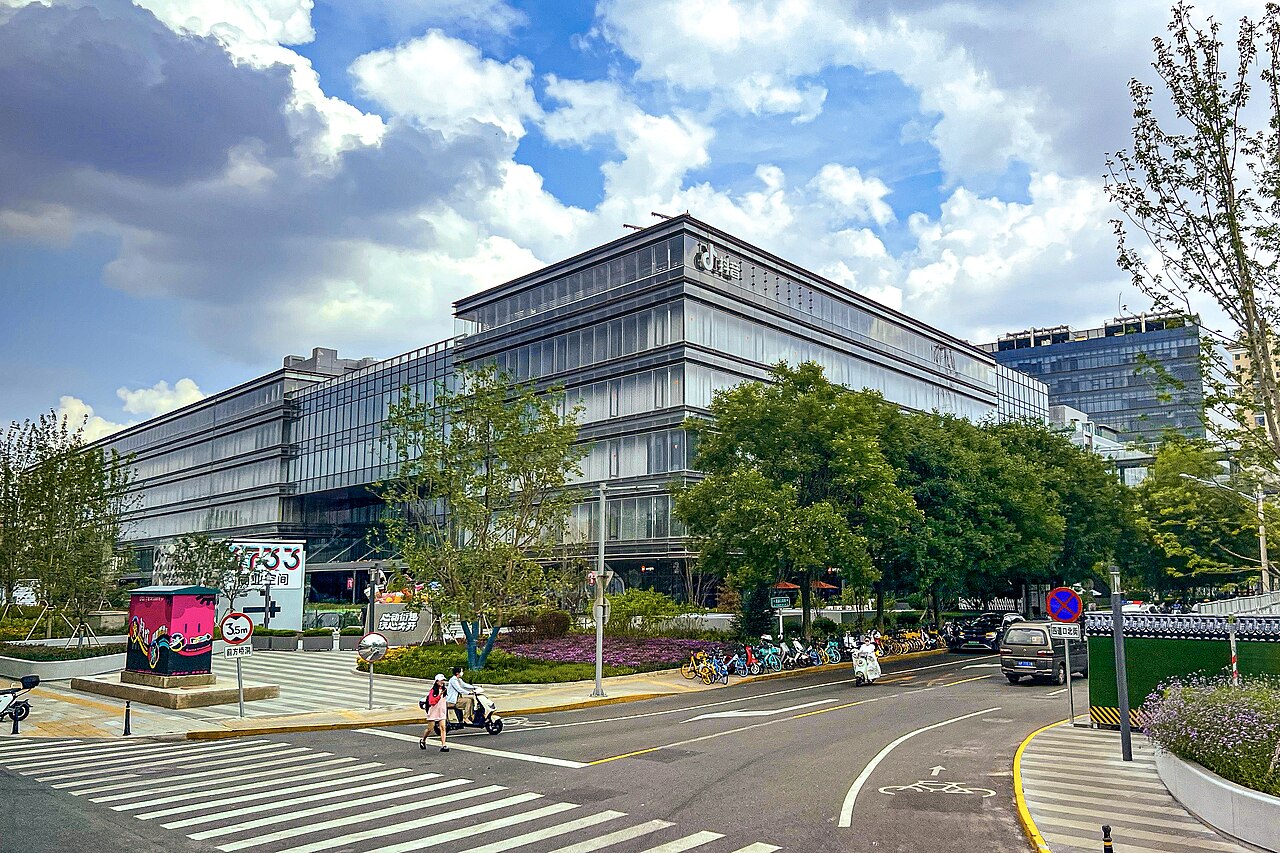
The cover image is a real Wikimedia Commons photograph of ByteDance's 1733 Commercial Space office complex in Haidian, Beijing, taken on July 31, 2024.[5] It is intentionally documentary. Seed2.1 is not a visual model spectacle; it is a company-stack story about how ByteDance packages model progress into office work, coding work, and cloud-distributed agent workflows.
The Signal
The official Seed2.1 page frames the family around Pro and Turbo, two AI productivity models rather than a wide catalog of small variants.[1] ByteDance says the family improves general agents, code engineering, knowledge and reasoning, multimodal understanding, and video understanding. Those categories are broad, but the examples are revealing: lesson-plan slides, complex spreadsheets, industry reports, RTL design, cross-tool agents, frontend generation from floor plans or design mockups, and long movies turned into narrated shorts.[1]
This is a field signal because it shows where ByteDance thinks the next enterprise buyer test sits. The buyer is not asking whether a chatbot can explain a topic. The buyer is asking whether a model can read messy inputs, choose a path, use tools, write or edit artifacts, debug when the first pass fails, and return a result that can survive human review. Seed2.1's launch copy is therefore full of work words: planning, file processing, requirement understanding, environment setup, result validation, and cross-environment task delivery.[1][2]
That also explains the two-lane shape. A Pro/Turbo split gives ByteDance a clean story for routing work by difficulty and production volume. The official page does not make pricing economics the center of the English model card; it makes task class the center. Pro is the capability signal, Turbo is the deployment signal, and both sit under the same agent productivity banner.[1]
What Changed Since Seed2.0
Seed2.0, launched on February 14, 2026, was already framed as a production-deployment model series. ByteDance described it as three general-purpose agent models of different sizes - Pro, Lite, and Mini - plus a dedicated Code model, with availability through the Doubao App, TRAE, and Volcano Engine.[3] The Seed2.0 post also identified real-world usage pressure: heavy reading, unstructured documents, charts, long content, visual reasoning, multi-step instructions, and long-chain workflows.[3]
Seed2.1 keeps that direction but tightens the promise. The June 23, 2026 release blog says the company tracked user feedback after Seed2.0 and saw growing expectations for more reliable responses and more consistent model delivery.[2] That is a subtle but important delta. The problem being solved is not just benchmark headroom. It is variance: whether an agent can stay useful when the task spans several stages, multiple artifacts, and tool calls that may expose earlier mistakes.
In coding, the release language moves from "can write code" toward full-cycle delivery. ByteDance points to requirement analysis, feature implementation, bug fixing, environment setup, and result validation.[2] That is the right boundary for an engineering agent. The failure mode for coding models is rarely that they cannot produce text that looks like code. The failure mode is that they misunderstand the repo, skip a setup assumption, fail to run the test, patch the wrong layer, or leave the human to discover integration breakage.
The Evaluation Boundary
Seed2.1's benchmark table is useful, but only if treated as a map of intended workloads rather than as a universal verdict. The official page reports comparative results across knowledge, reasoning, workplace tasks, coding, terminal use, debugging, multimodal STEM, visual puzzles, long-context multimodal tasks, and video understanding.[1] The release blog also names Workspace Bench, Agent Startup Bench, GDPVal, Agents' Last Exam, xDailyBench, Doubao Multi-Turn Bench, Toolathlon, and ClawBench as task families for judging agent behavior.[2]
Those names tell us what ByteDance wants measured: not only static question answering, but task completion with economic value, source-material handling, cross-tool execution, and multi-turn reliability. That is the right direction. Still, the benchmark claims should remain directional unless a reader has the exact setup: model version, prompts, tool availability, runtime limits, scoring rubrics, human-review rules, and whether the comparison systems used equivalent harnesses.
The practical boundary is simple. If Seed2.1 can reduce the number of human interventions needed to turn documents, specs, images, code, and validation feedback into a finished artifact, then the launch is meaningful even if a few leaderboard rows are contested. If the benchmark gains disappear once the model is placed in ordinary enterprise workflows with messy permissions, stale files, long repositories, brittle tools, and human approval steps, then the launch is mostly a positioning exercise.
Why This Is A ByteDance Move
ByteDance's advantage is not only the model. It is the product loop around the model. The Seed model index shows a wide family: foundation models, video and image generation, speech, UI agents, AI-for-science work, and robotics research.[4] That breadth matters because agent reliability depends on more than one language model. A real workflow may need visual understanding, document parsing, speech, video comprehension, code execution, search, interface control, and domain-specific tools.
Seed2.1 sits in the middle of that portfolio as the general productivity and reasoning layer. Seedance and Seedream are media surfaces. Seeduplex is a speech surface. UI-TARS is a GUI-agent surface. Protenix and the robotics entries point toward scientific and embodied use cases.[4] The pattern is not that one model does everything. The pattern is that ByteDance is building many specialized surfaces and needs a capable agent core to coordinate work across them.
This is why the Doubao and Volcano Engine access note matters.[2] Consumer distribution gives ByteDance feedback volume. Cloud distribution gives enterprises and developers an integration path. The same company can watch real prompts, product complaints, coding-agent use, multimodal tasks, and tool-handoff failures, then use those signals to tune the next release. That does not guarantee quality, but it shortens the loop between model research and usage pressure.
What To Watch
The first watch item is the Pro/Turbo routing boundary. If Turbo handles routine work cheaply while Pro is reserved for high-uncertainty tasks, Seed2.1 becomes easier to deploy as a tiered workflow system. If users cannot predict which lane will finish a job reliably, the naming becomes less useful than it looks.
The second watch item is coding validation. ByteDance's most important coding claim is not that the model can produce code; it is that the model can move through requirement analysis, implementation, bug fixing, environment setup, and validation.[2] Independent users should test whether Seed2.1 actually runs the loop or merely describes it.
The third watch item is multimodal task carryover. The model page emphasizes complex visual inputs, spatial reasoning, long-context processing, and video understanding.[1] The question is whether those inputs remain useful when a task crosses modalities: a screenshot becomes a frontend patch, a spreadsheet becomes an analysis memo, a video becomes an operational summary, or a floor plan becomes an interactive page.
The falsifier is visible. If Seed2.1's strongest examples stay inside demos, if benchmark claims fail to reproduce under equivalent harnesses, if coding output still requires heavy human cleanup, or if cross-tool tasks stall at permissions and validation, then the release is a stronger marketing signal than an agent-delivery shift. But if ByteDance can make Pro and Turbo reliable enough for real work routing, Seed2.1 will mark a meaningful move in China AI: away from the pure leaderboard race and toward models judged by whether they finish the job.
Sources
- ByteDance Seed, "Seed2.1" official model page (model-family overview, Pro/Turbo framing, agent, coding, multimodal, video-understanding, showcase, and benchmark claims).
- ByteDance Seed, "Seed2.1 Officially Released: Advancing AI Productivity" (June 23, 2026; official release blog on agent delivery, coding reliability, multimodal improvements, Doubao and Volcano Engine access, and Seed-for-Seed workflow use).
- ByteDance Seed, "Seed 2.0 Official Launch" (February 14, 2026; prior baseline for Seed2.0 model lanes, production-deployment framing, multimodal upgrades, long-horizon task claims, and Doubao/TRAE/Volcano Engine availability).
- ByteDance Seed, "Seed Models" index (current official map of Seed foundation, gen-media, speech, UI-agent, science, and robotics model lines).
- Wikimedia Commons, "File:ByteDance 1733 Commercial Space (20240731145554).jpg" (source page for the real photograph used as this article's cover image).