As of 2026-07-07 UTC, Meitu is best read less as a legacy beauty-app company and more as a test case for China's consumer-facing agent economy. The company is not only adding image generation to retouching apps. It is trying to turn photo, video, design, e-commerce, and creator services into a coordinated "AI visual team" that can accept a goal, break it into tasks, and charge by subscription, credits, or done-for-you output.[1][2]
That makes Meitu a useful company dossier because its starting point is not the usual China LLM story. Alibaba, Baidu, ByteDance, Zhipu, and Moonshot often frame progress through base-model capability, cloud distribution, or developer APIs. Meitu starts from a different asset: hundreds of millions of image-sensitive users, a long memory of aesthetic preferences, and paid habits around visual self-presentation. The question is whether those assets can be reorganized into agent workflows before generic multimodal assistants absorb the same use cases.
Baseline: a retouching habit becomes a workflow surface
Meitu's 2025 annual results show why the company has room to attempt the shift. Revenue from continuing operations reached RMB 3.86 billion in 2025, up 28.8% year over year, while adjusted net profit attributable to owners reached RMB 965 million, up 64.7%. The photo, video, and design segment produced RMB 2.95 billion, or 76.6% of total revenue. Global monthly active users reached 276 million at year-end, with more than 100 million outside mainland China.[3]
Those numbers matter because agent products need repeated intent, not just one-off novelty. A user who opens a camera or editing app weekly already has a context window of preferences: face shape, skin texture, wardrobe taste, color tolerance, platform format, brand constraints, or e-commerce listing style. Meitu's bet is that this behavior can be made explicit enough for agents to act on it. The company says its agents analyze user intent, decompose it into actionable tasks, and combine generative AI, workflows, and traditional editing tools to produce finished outputs.[3]
The company is also pushing beyond leisure editing. In 2025, productivity tools accounted for 19% of revenue from photo, video, and design products. Productivity monthly active users reached 24 million, while paying subscribers reached 2.16 million, up 67.4%. That is still smaller than Meitu's consumer base, but it points to a higher-value lane: merchants, creators, marketers, designers, and small teams that judge AI by whether it ships usable visual work rather than by whether it produces an impressive demo image.[3]
The 2026 product map: eight doors into one stack
The clearest 2026 signal came at the Meitu Multimedia Festival in Xiamen on June 17, where the company introduced four new products - Picchi, Artflo, MVLAND, and MeituHub - alongside upgrades to Zcool, DesignKit, Kaipai, and RoboNeo. Meitu's own framing is explicit: the eight offerings are meant to move AI applications from delivering features to delivering outcomes.[1]
The product roles are revealing. Picchi is a portrait-retouching agent built around "Style DNA" and "Creator DNA," which means the retouching task is no longer just slider control; it is an attempt to encode aesthetic preference as reusable identity. Artflo handles inspiration management and conceptual visual creation, giving early-stage visual thinking a product home. MVLAND uses multi-agent collaboration for music visuals. MeituHub is the technical layer, connecting models, tools, and workflows as a visual production pipeline.[1]
The older products then become distribution and specialization channels. Meitu, BeautyCam, Kumoo, and Picchi cover photo. Wink, Kaipai, RoboNeo, MVLAND, and Artflo cover video. DesignKit and WHEE cover design. Zcool supplies community and asset-library gravity. MeituHub becomes the open technology platform. Underneath, Miraclevision is the large model layer. This is a company trying to avoid a pile of isolated apps by making each app a task surface in the same visual operating system.[1]
RoboNeo is the most direct sign of the agent direction. In Q1 2026, Meitu said RoboNeo introduced "Agent Teams," with role-based collaboration among multiple AI agents for end-to-end use cases such as AI short dramas, social media content creation, and e-commerce content production. DesignKit added an Expert Mode Agent, one-click replication of promotional videos, and overnight batch image generation. Those details are more important than the product names: Meitu is optimizing for multi-step creative throughput, not only for prompt-to-image generation.[2]
Model layer and monetization: Miraclevision plus credits
Meitu's model story is also vertically tied to product usage. At the June 2026 festival, the company launched Miraclevision V6, a Mixture-of-Experts model supporting text, image, video, and audio inputs. Meitu says Miraclevision handled an average 96.3% of calls to generative AI features across its photo and video products from January to May 2026. Vendor-reported model claims should be treated as directional unless independently reproduced, but that usage share is still a strong internal-stack signal: the model is not sitting in a lab brochure; it is wired into a large product portfolio.[1]
The monetization layer is changing with it. In Q1 2026, Meitu reported more than 17.90 million global paying subscribers, up 30.2% year over year. Photo, video, and design revenue reached RMB 852 million in the quarter, up 34.3%. For AI-driven productivity applications, Meitu disclosed approximately RMB 580 million in annual recurring revenue and 2.34 million paying subscribers. Most importantly, AI credits consumed in March 2026 rose 59% from December 2025, with the biggest increases coming from Kaipai, RoboNeo, DesignKit, and Vmake.[2]
This is the commercial hinge. Subscriptions monetize access and habit. Credits monetize intensity. Done-for-you creator services monetize reluctance: users who want finished designs or videos but do not want to learn the tool. Meitu now has all three pricing grammars in play. The strongest version of the thesis is that agent teams create enough incremental work to make credits and services additive rather than cannibalistic. The weak version is that users treat credits as a tax on features they expected inside subscriptions.
Why this is a China AI signal
Meitu's shift is not only a company pivot. It illustrates a broader China AI pattern: the most interesting productization may come from companies with dense application surfaces rather than from model labs alone. Meitu has a consumer beauty base, overseas app distribution, e-commerce merchant workflows, design tools, a model layer, and now an agent-team vocabulary. That bundle is harder to copy than a single image model, but easier to erode if general assistants become the default place where users start visual tasks.
The global market context makes the timing sharper. Andreessen Horowitz's 2026 consumer generative-AI ranking argues that the old divide between AI-native products and legacy consumer software is breaking down, with image, video, design, and productivity products increasingly judged by how deeply AI is part of the core experience. It also notes bundling pressure in creative tools: as large platforms improve native image and video features, standalone products need opinionated workflows or specialized communities to hold attention.[5]
That is exactly the lane Meitu is trying to occupy. Its advantage is not that it can out-generalize every model platform. Its advantage, if it holds, is aesthetic memory plus domain workflow: portraits, product images, short-form video, music visuals, e-commerce listing assets, and design batches that already sit near monetizable user intent.
The OpenClaw tie-in is another signal. In March 2026, Meitu launched a CLI tool and listed its first batch of Meitu AI Skills on ClawHub in the OpenClaw ecosystem. The initial modules include video motion transfer, image editing, image generation and design, image upscaling, AI Wardrobe, image-to-video, AI Resize, and AI Cutout. The company describes the skills as composable, reusable modules that can produce complete workflows from a single instruction, such as turning one product image into a Taobao-ready e-commerce image set.[4]
That matters because it pulls Meitu beyond consumer-app UI. A CLI and skills layer gives technical users, e-commerce teams, and content operators a way to call Meitu capabilities inside broader automation flows. It is not a full developer-platform proof yet, but it is a meaningful bridge from app buttons to agent tooling.
Boundary conditions and watchlist
The first boundary is benchmark opacity. Miraclevision V6 may be technically stronger than prior versions, but public claims about visual decision-making, multimodal interpretation, and task decomposition need external evaluation before they can be compared cleanly with Qwen, Doubao, Gemini, GPT, or specialist creative models. For now, the stronger evidence is product integration and credit consumption, not leaderboard dominance.[1][2]
The second boundary is user trust. Beauty and portrait tools touch identity, likeness, body presentation, and social pressure. Agentic retouching raises the stakes because the system may infer and reuse preferences across sessions. "Creator DNA" is commercially clever, but it also makes preference memory a product claim that users must understand and control.
The third boundary is organizational complexity. A company can announce agent teams faster than it can simplify cross-product experience. Picchi, Artflo, MVLAND, MeituHub, DesignKit, Kaipai, RoboNeo, WHEE, Zcool, Wink, BeautyCam, and the core Meitu app are a broad surface. The risk is that the portfolio becomes a naming maze unless MeituHub, accounts, credits, assets, and workflow history make the suite feel like one system.
Falsifier for this dossier's thesis: If Meitu's AI credit growth stalls while paid subscribers keep rising, or if RoboNeo, DesignKit, Kaipai, and MeituHub remain separate tools rather than shared workflows, then the "visual agent team" story weakens. In that case, Meitu would still be a strong visual-app company, but not yet an agent-stack company.
Watch items for the next two quarters:
- Whether Q2 and first-half 2026 disclosures show AI credits expanding beyond launch-period curiosity into sustained usage.
- Whether MeituHub becomes a real workflow platform with reusable assets, team permissions, and external integrations, or remains a launch label.
- Whether RoboNeo Agent Teams produce repeatable business workflows in short drama, social content, and e-commerce rather than demo sequences.
- Whether privacy, likeness, and preference-memory controls become visible in product UX as Meitu leans harder into Style DNA and creator identity.
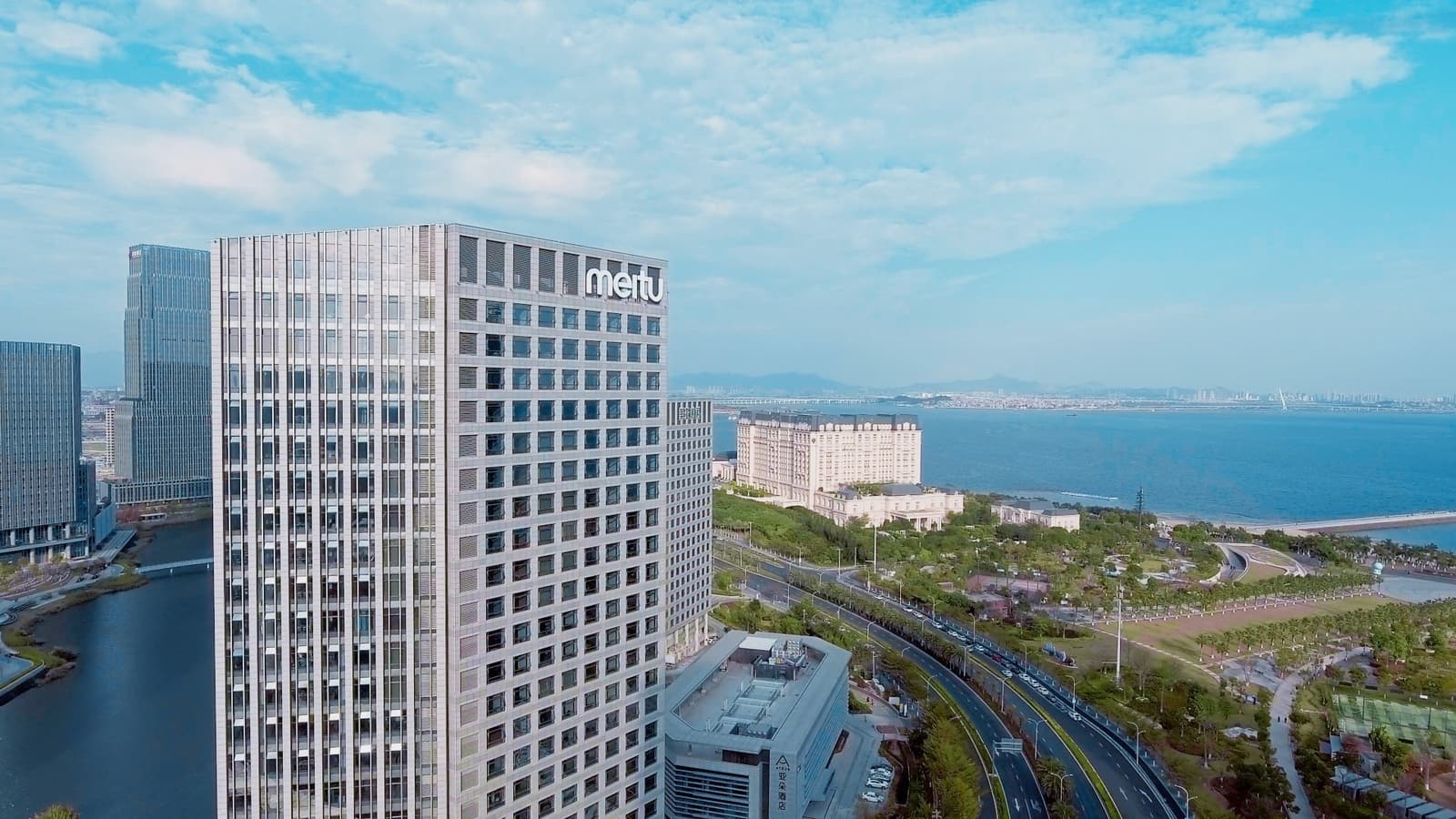
The headquarters photograph used for this article is deliberately mundane: a real Meitu building in Xiamen, not a model-card chart or a synthetic AI collage.[6] That is the point. The live question is not whether AI image generation can produce spectacle. It is whether a company with existing consumer habits can turn visual taste into a coordinated, paid, agentic production stack.
Sources
- Meitu, "2026 Meitu Multimedia Festival Unveils 8 Products - Your AI Visual Team Is Ready" (June 17, 2026) - product launches, Miraclevision V6, AI credits, and incubation fund.
- Meitu, "Meitu Reports Record 17.9M+ Global Paying Subscribers in Q1 2026, Up 30.2% YoY" (May 6, 2026) - subscriber, revenue, productivity ARR, Agent Teams, and AI credit consumption data.
- Meitu, "Meitu Inc. Releases 2025 Annual Results: AI Transformation Drives Growth, Net Profit Up 64.7% YoY to 965 Million" (March 27, 2026) - annual revenue, user base, productivity products, and AI-agent strategy.
- Meitu, "Meitu AI Skills Officially Joins the OpenClaw Ecosystem - Eight AI Imaging Capabilities Now Available Globally" (March 24, 2026) - CLI, ClawHub, AI Skills, and workflow examples.
- Andreessen Horowitz, "The Top 100 Gen AI Consumer Apps - 6th Edition" (March 9, 2026) - consumer generative-AI ranking and creative-tool market context.
- Meitu corporate visual asset - aerial photograph of Meitu's Xiamen headquarters used as the article image.