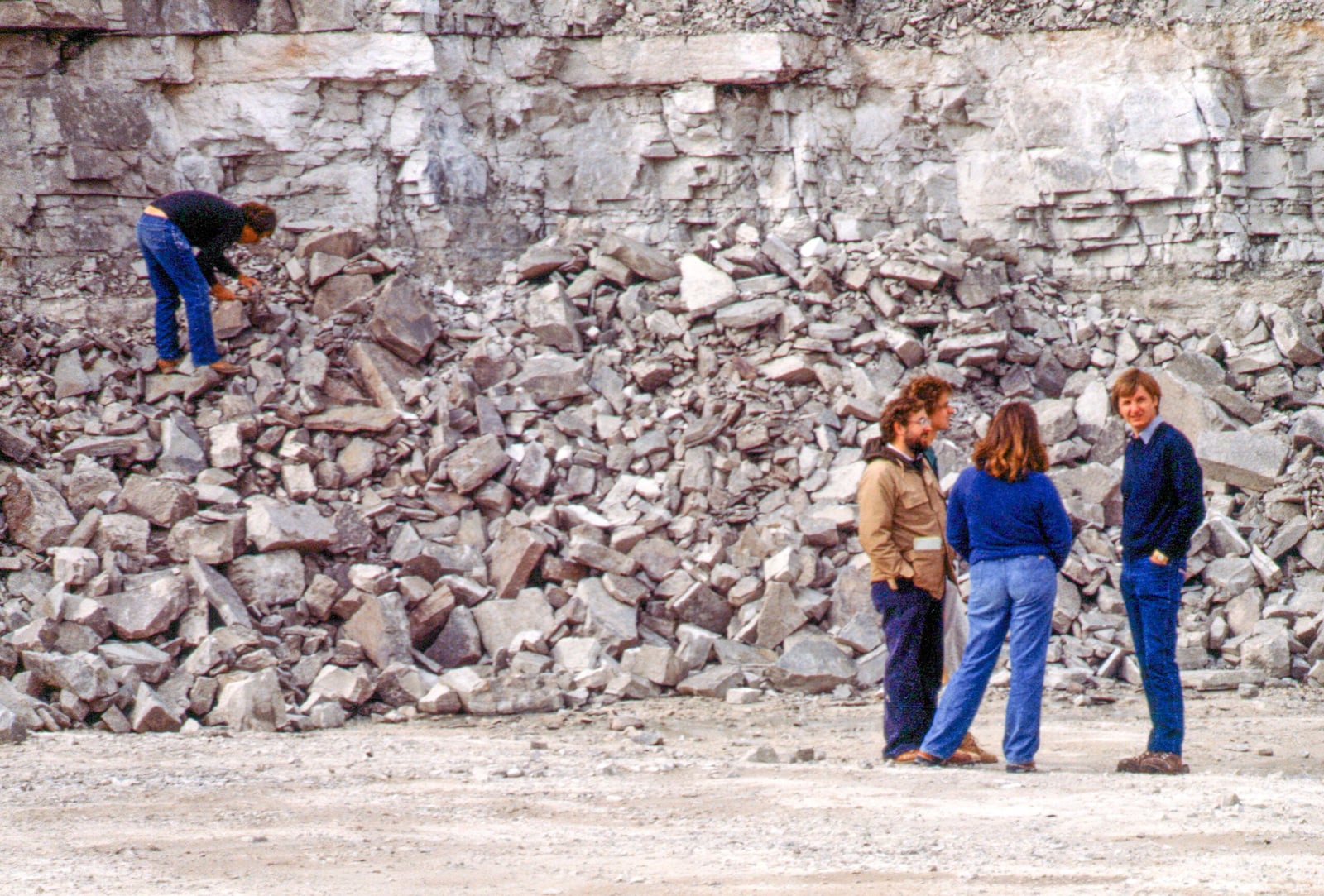
An archival photograph from the Waukesha quarry shows a collecting team beneath a wall of layered rock. Around them lie pale slabs and rubble. There is no towering skeleton to announce the importance of the work: the photograph records the patient collecting behind a much smaller kind of discovery.[1]
The fossils came from an early Silurian sea, roughly 435 million years ago. Much of the research has concentrated on a bed just 12 centimeters thick in Wisconsin's Brandon Bridge Formation. It preserved animals whose delicate bodies rarely survive fossilization.[2][3]
That thin bed changed what could be seen. It also posed a field question that remains essential when reading an exceptional fossil deposit: did these animals live together here, or did this particular place gather and preserve their remains?
The rock has a fine print
Waukesha's fossil-bearing mudstone contains closely spaced layers, with little disturbance by burrowing organisms. Carolin Haug and colleagues, describing specimens from the site in 2014, treated that combination as evidence for an oxygen-poor setting with restricted water circulation. They allowed that the water might have been brackish; the rock does not supply a direct salinity reading.[3]
The distinction between observation and interpretation matters. Fine lamination is visible. Low oxygen is an explanation for why animals did so little mixing of the sediment. The setting must be reconstructed from several clues, rather than supplied by the extraordinary appearance of a fossil alone.
The fossil inventory is equally unusual. Arthropods dominate, often represented by shed outer coverings. Shelly fossils are scarce and commonly have lost their calcium carbonate. This is a selective record even by the standards of a site famous for preserving fragile things.[3]
A beautifully preserved body can make that selectivity easy to forget. Detail answers questions about anatomy; it does not automatically tell us how representative the specimen is of the surrounding sea.
A second quarry tests the first
In a 1996 conference abstract, Joanne Kluessendorf and Donald Mikulic reported another occurrence of the Waukesha biota, 25 kilometers from the original site. Both deposits occupied sediment traps associated with irregular, dissolved bedrock near the ancient shoreline. Both favored arthropods and other remains with little chance of surviving in ordinary deposits.[4]
The researchers had deliberately searched for the combination of rock setting and preservation conditions recognized at the first locality. Finding the second made the explanation useful in the field: it helped identify where to look next.[4]
Their comparison also challenged the idea of a community buried exactly where it lived. Shed coverings outnumbered carcasses, while attached, bottom-dwelling shelly animals were conspicuously absent. Kluessendorf and Mikulic interpreted the assemblages as transported debris accumulated in unusually favorable places for preservation. The proportions of different animals varied between the two sites.[4]
That changes how a reader should imagine the scene. A reconstruction placing every fossil species shoulder to shoulder on one seabed would imply more than the deposit establishes. The fossils demonstrate that these organisms existed in the region; their final resting place need not be their shared address in life.
What a drawer can still reveal
The value of collecting those thin slabs becomes clearer when a familiar fragment acquires its missing context.
Conodonts were early vertebrates whose mineralized feeding elements are much more commonly found than their bodies. In 2021, Duncan Murdock and Paul Smith redescribed a Waukesha specimen of Panderodus with an almost complete feeding apparatus and preserved soft tissues. The elements formed paired rows, giving researchers evidence of their arrangement inside an animal instead of leaving them to assemble isolated pieces.[5]
The specimen also preserved supports for those elements and traces of the body's musculature. Its trunk remained poorly preserved, so this was not a complete anatomical portrait. Nevertheless, the authors interpreted the feeding apparatus as evidence for taking relatively large food items: a glimpse of early vertebrate predation.[5]
The gain is practical. Finding another isolated element might refine a description of its shape. Finding elements together with bodily remains tests how the parts fitted and worked. Exceptional preservation changes the question that can be answered.
Another drawer yielded the animal long nicknamed the “butterfly animal.” In a 2025 study, Evan Anderson and colleagues named it Papiliomaris kluessendorfae, honoring Kluessendorf.[2]
Across the specimens, preservation varied. Delicate head limbs survived better where the animal's shield covered them during burial; exposed structures fared worse. The authors proposed that the covering helped maintain a local chemical environment favorable to mineral preservation.[2]
A missing limb can therefore have two explanations: the animal lacked it, or the conditions that preserved its neighbors failed to preserve that particular part. Comparing specimens helps separate those possibilities.[2][3] Naming an unfamiliar animal is only one result of the work; learning how its body became a fossil is another.
The fieldwork continues indoors
The University of Wisconsin Geology Museum maintains a major Waukesha collection and provides access for qualified researchers.[6] The 2025 Papiliomaris study notes that the original exposure supplying its specimens is no longer accessible.[2] Collection and interpretation now operate on different schedules: the opportunity to retrieve a slab may be brief, while the questions asked of it can keep changing.
This is the lasting force of the quarry photograph. Its subject is the work that made later comparisons possible. The preserved remains did not arrive in museum drawers with their relationships, diets and burial histories already explained.
Waukesha enlarges the Silurian world by letting delicate animals enter the record. Reading that world well requires keeping the sediment trap in view, too. The same circumstances that saved these fossils also decided which pieces of the sea reached us.
Sources
- Wisconsin Public Radio, “A portal into underwater, prehistoric Wisconsin found in the heart of Waukesha County” (13 October 2025)—archival fieldwork photograph and Ronald C. Meyer credit.
- Evan P. Anderson and colleagues, “The ‘butterfly animal,’ Papiliomaris kluessendorfae …,” Journal of Paleontology (2025)—geologic setting, specimens and preservation beneath the shield.
- Carolin Haug and colleagues, “The implications of a Silurian and other thylacocephalan crustaceans …,” BMC Evolutionary Biology 14, 159 (2014)—age, sediment, restricted circulation and composition of the Waukesha assemblage.
- Joanne Kluessendorf and Donald G. Mikulic, “Discovery of a New Deposit …” (1996 conference abstract)—locality comparison and search strategy.
- Duncan Murdock and Paul Smith, Panderodus study (2021)—authors’ Dryad record, containing the research abstract, supporting data and a link to the Papers in Palaeontology article.
- University of Wisconsin Geology Museum, “Collections”—Waukesha holdings and research access.