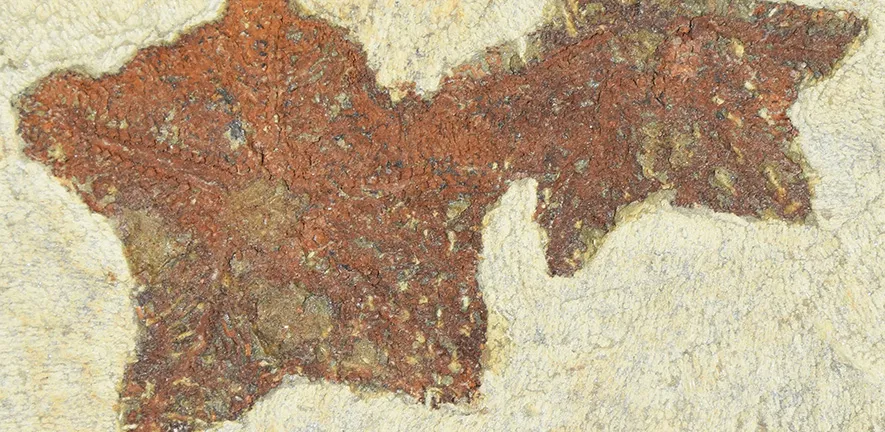
Five rays spread across the rock, recognizable before their anatomy is understood. These animals lived roughly 480 million years ago, in the Early Ordovician sea whose sediments became Morocco's Fezouata Shale. Published in 2021 as Cantabrigiaster fezouataensis, they seemed to offer an unusually direct view of the beginnings of the starfish family.[1]
The crucial detail lay along the arms. Had this animal lived before a particular border of skeletal pieces evolved? Or was that border present, but difficult to recognize? Following the argument through subsequent studies changes what the fossil can tell us about ancestry. It also gives its small, repeated skeletal elements a significance that the familiar outline conceals.
A star built from many pieces
Starfish and brittle stars belong to the Asterozoa. Their early fossil history also includes the extinct somasteroids, animals whose broad rays contained repeated rows of small skeletal elements. All three groups appear within a relatively short interval of the Early Ordovician. That crowded entrance complicates attempts to arrange them into a simple procession of ancestors and descendants.[2]
Preservation adds another difficulty. An asterozoan skeleton consists of numerous separate pieces, called ossicles, held together in life by soft tissues. Once those connections decay, the skeleton can fall apart. A recognizable body therefore represents a selective sample of ancient life: conditions had to preserve relationships between pieces as well as the pieces themselves. The oldest complete-looking specimen need not capture the earliest evolutionary condition.[2]
In Cantabrigiaster, paired rows of ossicles ran along each arm. From them, chains of rodlike elements called virgals extended sideways. Imagine following the arm from its central axis toward its outer edge: the arrangement changes from lengthwise rows to transverse chains. This architecture made the animal a somasteroid, while allowing comparisons with other early echinoderms.[3]
The missing border
Aaron Hunter and Javier Ortega-Hernández's 2021 description interpreted Cantabrigiaster as lacking the additional skeletal series that defined the arm margins in other early asterozoans. Their evolutionary analysis placed it on the earliest-diverging branch of the asterozoan stem group: among extinct relatives outside the group formed by living starfish, brittle stars and their last common ancestor.[3]
The proposed sequence was compelling. First came an arm with the central rows and sideways chains; a more differentiated margin appeared later. The authors compared 38 taxa using 74 anatomical characters, with different analytical methods yielding similar placements. The result depended, however, on both the observations and decisions about which skeletal structures were equivalent across animals.[3]
In 2022, Daniel Blake and Frederick Hotchkiss challenged the observation at the heart of that sequence. They identified a marginal framework in the holotype—the specimen that anchors the species name—and in other specimens from the original material. They also questioned the anatomical comparisons underlying the evolutionary analysis. On their reading, the supposed absence could no longer distinguish the genus, and they reassigned the species to Villebrunaster.[4]
This was more consequential than correcting a label. A feature scored as absent had helped place the animal near the beginning of a lineage. Identifying that feature changes the evidence for the placement. Even agreement between analytical methods cannot independently verify an anatomical observation when both methods begin with the same interpretation.
The name returns, with different anatomy
The story took another turn in 2025. Blake and Bertrand Lefebvre recognized Cantabrigiaster as a distinct genus again. They emphasized its stout, rectangular skeletal elements and the way neighboring transverse chains fitted tightly together into a substantial platform. Those features separated it from other somasteroids.[5]
Their description nevertheless retained the marginal framework: small, overlapping ossicles formed a continuous boundary around the body and arm tips. The genus returned without the absence that had originally made it seem such a revealing evolutionary intermediate.[5]
That distinction is the most useful outcome of the revision. Naming a genus asks whether a set of fossils has a sufficiently distinctive combination of features. Placing that genus near a lineage's origin asks how those features evolved relative to those of other animals. A fossil can remain distinctive after the argument for its original evolutionary position changes. The restored name should not be read as a restoration of every claim once attached to it.
An edge can disappear, too
A further comparison arrived in 2026, when Blake and Lefebvre described Degeneraster spenceri, an asteroid from the Late Ordovician of Morocco. Assigned to a basal asteroid group, it combined early skeletal features with others associated with more derived forms. It lacked an ambital framework—the skeletal border under discussion—and the authors interpreted that absence as evolutionary loss. Their paper also continued to recognize Cantabrigiaster.[6]
The comparison suggests a caution about evolutionary sequences. An absent structure can be consistent with an early condition, but absence alone cannot establish one. The rest of the skeleton must help distinguish a feature that had yet to evolve from one that was reduced or lost. Two animals can arrive at a similar-looking edge through different histories.
The Fezouata fossils still offer something extraordinary: rows of tiny elements remain close enough to their living arrangement to sustain an argument across half a billion years. Their value grows when that arrangement can be revisited. Look again at the broad rays, then follow them outward. The outline identifies a familiar kind of animal; the uncertain border opens the harder question of how its family came to be.
Sources
- University of Cambridge, “New starfish-like fossil reveals evolution in action” (2021)—discovery context, approximate age and the photograph credited to the Collection of Yale University.
- Christopher L. Mah and Daniel B. Blake, “Global Diversity and Phylogeny of the Asteroidea (Echinodermata),” PLOS ONE (2012)—early asterozoan diversity and the preservation biases of articulated skeletons.
- Aaron W. Hunter and Javier Ortega-Hernández, “A new somasteroid from the Fezouata Lagerstätte in Morocco and the Early Ordovician origin of Asterozoa,” Biology Letters (2021)—original description, specimen information and evolutionary analysis.
- Daniel B. Blake and Frederick H. C. Hotchkiss, “Origin of the subphylum Asterozoa and redescription of a Moroccan Ordovician somasteroid,” Geobios (2022)—institutional record and abstract documenting the marginal framework and reassignment to Villebrunaster.
- Daniel B. Blake and Bertrand Lefebvre, “The class Somasteroidea and its significance among early Asterozoa (Echinodermata),” Comptes Rendus Palevol (2025)—archived taxonomic treatment, pp. 466–469, restoring Cantabrigiaster while retaining its marginal framework.
- Daniel B. Blake and Bertrand Lefebvre, “Degeneraster spenceri n. gen., n. sp. (Asteroidea; Ordovician) and interpretating the early history of the Asterozoa,” Comptes Rendus Palevol (2026)—primary paper archived on Zenodo.