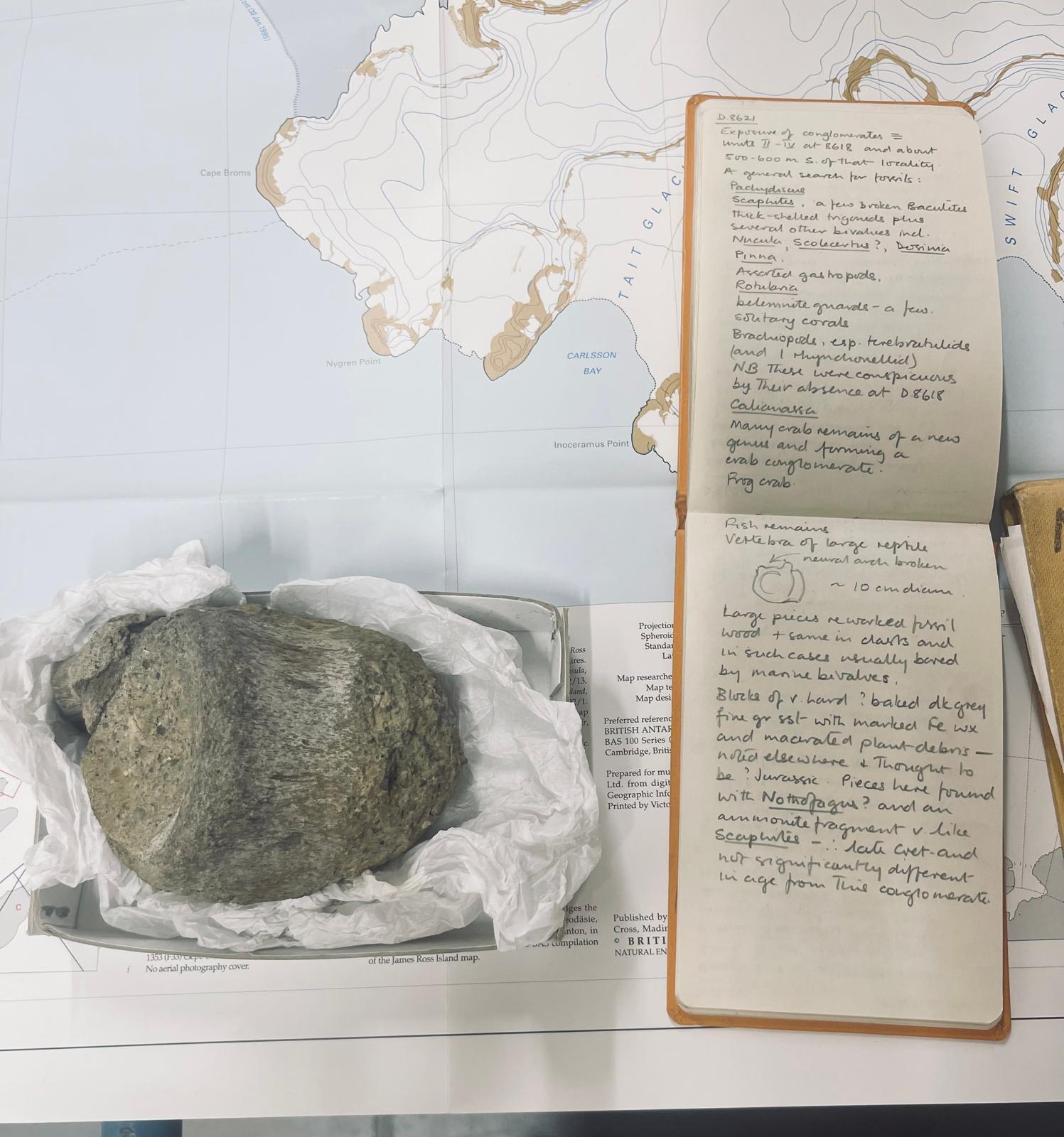
On 9 December 1985, geologists Michael Thomson and Reinhard Förster collected a battered vertebra at Abernethy Flats on James Ross Island. Their work was stratigraphic: map the rock succession, gather its fossils, and make the exposed layers usable to later expeditions. Surrounded by marine remains, Thomson recorded the object as a large reptile. It entered the British Antarctic Survey collection as BAS D.8621.25 and stopped attracting attention.[1][2]
On 29 June 2026, eight researchers formally described it as a tail vertebra from a titanosaurian sauropod. The identification rearranges a familiar piece of Antarctic history. A dinosaur skeleton found in 1986 had long held the title of the continent's first dinosaur discovery; this overlooked bone had come out of the ground one year earlier.[1]
That does not make the vertebra a new species, the oldest Antarctic dinosaur in geologic time, or even the first Antarctic sauropod reported by scientists. It makes it the first dinosaur bone collected from Antarctica to be recognized as such. The distinction is more interesting than a record-book correction. It shows that a field discovery can remain unfinished for decades, suspended between an exact place in rock and an imprecise name in a drawer.
Image context: the cover photograph places the fossil beside Thomson's open 1985 field notebook on a map of the Antarctic Peninsula. It is an archival collection photograph published by the British Antarctic Survey. The notebook is not decoration: without its locality and stratigraphic context, the bone would carry far less scientific information.[1][2]
One bone, three different “firsts”
Discovery has several clocks. There is the day a fossil is collected, the day its anatomy is recognized, and the day that recognition enters the literature. BAS D.8621.25 leads only on the first clock.
The specimen was collected in 1985. The partial skeleton later named Antarctopelta oliveroi was found in 1986 and became the earliest recognized non-avian dinosaur discovery from the continent. A different titanosaur tail vertebra from James Ross Island was published in 2012 as Antarctica's first sauropod record.[1][4] The newly studied bone now sits between those histories: collected first, identified last.
It also carries three narrower claims that should not be merged. It is the first non-avian dinosaur fossil known to have been recovered from Antarctica, only the second sauropod body fossil known from the continent, and the first dinosaur fossil identified from the Santa Marta Formation.[1] None of those statements licenses a species name. The authors conservatively classify it as Eutitanosauria indeterminate.
Nor does “first collected” mean “oldest.” An indeterminate theropod shin bone from the older, Coniacian-aged Hidden Lake Formation predates it in the rocks. The new specimen is instead the second-oldest Cretaceous dinosaur body fossil yet reported from Antarctica in stratigraphic terms.[1] Collection chronology and deep time answer different questions.
The sea dated a land animal
The locality makes the find initially look misplaced. BAS Locality D.8621 lies on the Ulu Peninsula of northwestern James Ross Island, at about 63.88° south. The vertebra came from the Beta Member of the Santa Marta Formation, a lower Campanian unit deposited in a marine basin. The same collecting station yielded bony-fish scales, invertebrates, and plant material.[1]
James Ross Basin preserves more than seven kilometres of sediment spanning much of the Cretaceous into the Eocene. By Santa Marta time, its succession included prolific shallow-water marine faunas at a high southern latitude.[5] A sauropod did not live on that sea floor. Its vertebra had to leave the terrestrial landscape and enter the basin before burial—perhaps carried by a river and floated offshore in a carcass, as the research team suggests.[1][3]
“Perhaps” matters. The marine setting is observed in the sediments and associated fossils. The route taken by this individual body is a taphonomic inference. One tail bone cannot reveal the river, distance, or duration of transport.
The surrounding marine record is nevertheless an advantage for dating. Ammonite assemblages place the horizon in the early Campanian. A correlated section roughly half a kilometre away includes a bed dated to 82.6 ± 0.5 million years, reinforcing that placement.[1] The fossil's age therefore comes not from the appearance of the bone alone but from its position within a mapped, fossil-rich rock sequence—the very context Thomson's expedition set out to establish.
How a broken tail bone becomes a titanosaur
The specimen is modest: a complete vertebral centrum with only the bases of its neural arch remaining. The centrum measures 89 millimetres from front to back when its rear condyle is included, and 59 millimetres without it. Its front articular face is shallowly concave while the back is strongly convex, a ball-and-socket arrangement called procoely.[1]
Procoely alone does not finish the identification. The team compared the placement and forward lean of the neural arch, the shape of the centrum, the position of the rear condyle, and the internal bone fabric with tail vertebrae across sauropods. CT imaging—reconstructed at a voxel size of roughly 0.063 millimetres—showed dense, non-pneumatic trabecular bone inside and helped distinguish breakage from a possible open growth suture.[1]
Together, those features place the bone within Eutitanosauria and outside Saltasaurinae. Some details resemble vertebrae assigned to rinconsaurians and aeolosaurines from South America. But those groups remain difficult to separate, the relevant family tree is in flux, and most of this specimen's neural arch is gone. The paper therefore stops where the preserved anatomy stops. It does not assign the fossil to Muyelensaurus, invent an Antarctic genus, or turn resemblance into identity.[1]
This boundary is the central technical achievement. A fragment can be diagnostic at one scale and mute at the next: strong enough to identify a branch of titanosaurs, too incomplete to name a species.
Small is an observation before it is a life history
The public estimate gives the animal a length of roughly six to seven metres—small beside the largest titanosaurs.[2][3] The vertebra is about 60% the size of the corresponding element in Baurutitan and about 75% that in the already small Neuquensaurus. It is comparable to the dwarf titanosaur Magyarosaurus.[1]
Those comparisons do not reveal whether the James Ross animal was young. Fusion around the neural arch is difficult to interpret because the relevant surfaces are damaged, CT evidence suggests at least some apparent separation is breakage, and vertebral fusion does not follow a simple, universal schedule in sauropods. Adult titanosaurs could also be genuinely small.[1]
The responsible conclusion therefore has two branches: this was either an immature individual or a small-bodied adult. A complete limb bone, growth histology, or associated skeleton might narrow the choice. One centrum cannot. The fossil preserves body size more directly than it preserves life stage.
A possible route is not a traced migration
The second Antarctic sauropod fossil gives the new bone a larger geographic role. The vertebra described in 2012 came from the younger Snow Hill Island Formation, also on James Ross Island, and was identified as a titanosaur.[4] The 2026 study re-examined that specimen and likewise retained it within non-saltasaurine Eutitanosauria. Two tail bones now show that more derived titanosaurs reached the Antarctic Peninsula, while other sauropod lineages occurred in Cretaceous Patagonia and Australia.[1]
This matters because Late Cretaceous land geography placed the Antarctic Peninsula between southern South America and Zealandia. A strongly procoelous vertebra from New Zealand has also been interpreted as a likely eutitanosaur, whereas eutitanosaurs remain unknown from Cretaceous Australia. The authors therefore identify the Antarctic Peninsula as a plausible route from South America toward Zealandia.[1]
Climate models make parts of that scenario ecologically possible, not historically proven. Sauropods occupied warmer climatic niches than other major dinosaur groups, and modelled suitable habitat was more available across southern continents during parts of the Late Cretaceous.[6] That broad pattern cannot tell us which population crossed which land connection, or when.
The route hypothesis is consequently a line drawn through large gaps: two Antarctic vertebrae, one New Zealand vertebra, changing continental connections, and a climate envelope. More well-dated fossils on either side of those gaps could reinforce or redraw it. The present bone establishes presence. It does not record a journey.
The expedition continued inside the collection
Nothing about this story requires the 1985 identification to become a blunder. Thomson and Förster were working in difficult field conditions, at a marine site rich in large reptiles, while building a regional rock framework. “Large reptile” kept the category broad. More importantly, the specimen, field notebook, and locality data were retained together.[1][2]
Decades later, BAS collection manager and palaeontologist Mark Evans noticed that the bone looked dinosaurian. Comparative anatomy, surface scanning, and CT imaging then gave a larger team the evidence to identify it more precisely.[1][2] The recognition depended equally on new attention and old curation.
That is why the photograph of bone, notebook, and map is the right image for this field report. Antarctica's first-collected dinosaur fossil is not a spectacular skeleton emerging from ice. It is a small, worn object whose significance survived because someone recorded where it came from and someone else looked again.
The result changes a sentence in discovery history, but its deeper lesson is methodological. A collection label can be provisional without being useless. A fragment can support a clade without supporting a species. A fossil can make a migration route plausible without proving that route. Four decades after the field season, BAS D.8621.25 has become valuable not because every uncertainty disappeared, but because each uncertainty now has the right boundary.
Sources
- Paul M. Barrett et al., “A titanosaurian sauropod dinosaur from the Upper Cretaceous of Antarctica,” Acta Palaeontologica Polonica 71 (2026) — primary description, field history, stratigraphy, CT methods, anatomy, and biogeographic interpretation.
- British Antarctic Survey, “Antarctica's first dinosaur fossil confirmed from 1985 Antarctic expedition” (29 June 2026) — collection history, researcher comments, and source page for the archival cover photograph.
- Natural History Museum, London, “First ever dinosaur fossil discovered on Antarctica identified as a titanosaur” (29 June 2026) — specimen-scale estimate, marine-deposition context, and interviews with the study team.
- Ignacio A. Cerda et al., “The first record of a sauropod dinosaur from Antarctica,” Naturwissenschaften 99 (2012) — primary description of the previously published James Ross Island titanosaur vertebra.
- J.A. Crame, “Paleobiological significance of the James Ross Basin,” Advances in Polar Science 30 (2019) — institutional record and synthesis of basin thickness, age span, marine environments, and high-latitude context.
- Alfio Alessandro Chiarenza et al., “Climatic constraints on the biogeographic history of Mesozoic dinosaurs,” Current Biology 32 (2022) — fossil, climate-model, and habitat-suitability analysis of dinosaur distributions.