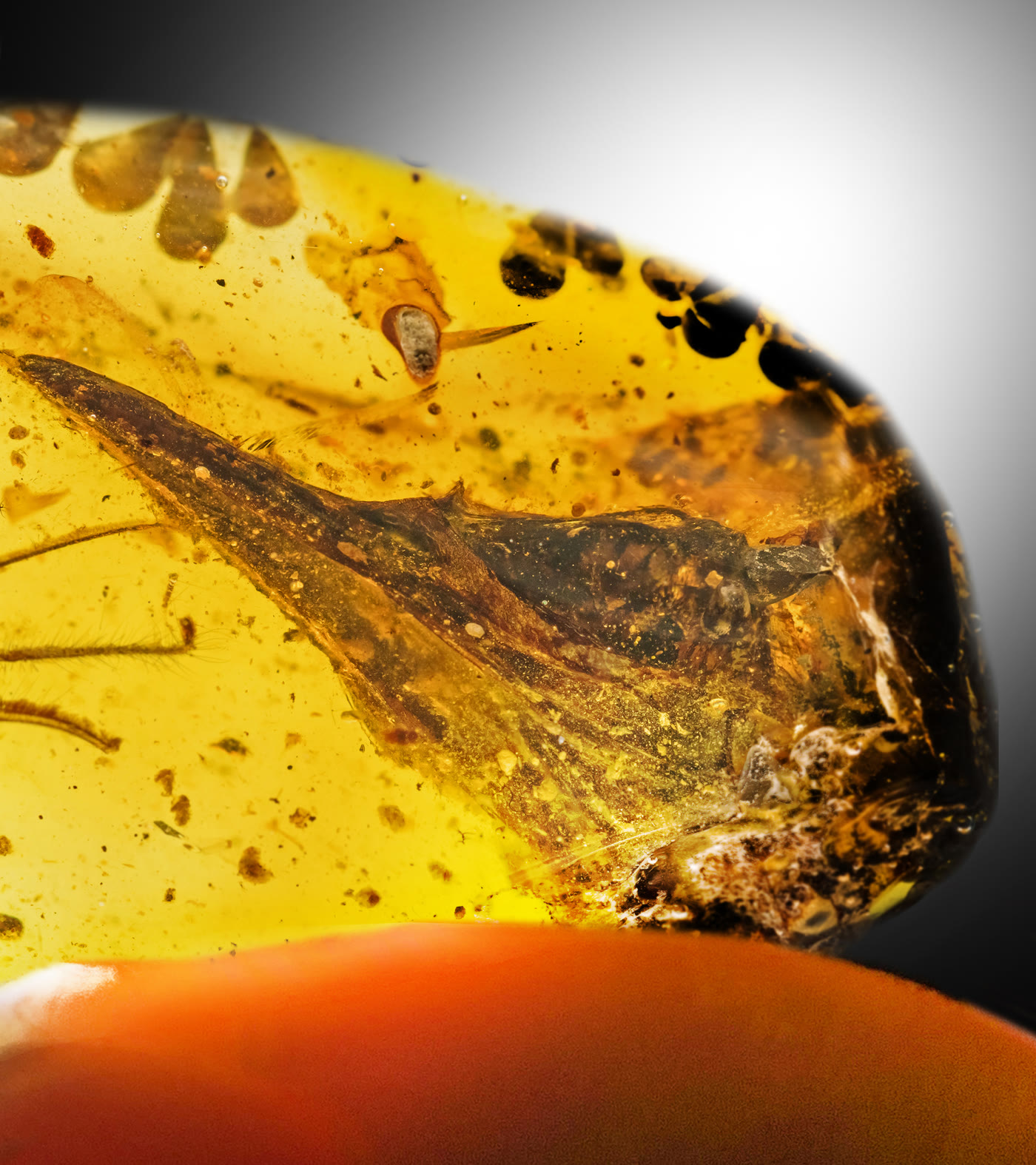
Amber makes confidence look easy. It seals a body inside a clear, jewel-like border, apparently sparing the viewer the usual work of assembling an animal from scattered bone. In the photograph above, the skull of Oculudentavis khaungraae is a dark sliver in honey-colored resin. A tapering snout, a huge eye socket, and a crowded jaw can be seen at a scale ordinarily denied to the vertebrate fossil record. The fingertip beneath it makes the animal look almost impossibly small.
In March 2020, that silhouette carried Oculudentavis into Nature as a hummingbird-sized avialan: the smallest known dinosaur of the Mesozoic. Four months later, the authors retracted the paper after a second specimen cast doubt on the family-tree placement.[1][2] The episode is often compressed into a punchline—scientists called a lizard a bird—but the fossils reward a slower reading. The first skull was not fabricated, and the correction did not come from simply looking at it again until it seemed more lizard-like. It came from changing which anatomical signals were allowed to lead.
Image context: the lead photograph shows the original amber specimen as a physical object, not a life reconstruction. That matters here because the article is about what the preserved skull can support, what compression changed, and what a second specimen added.[8]
Proportions wrote the first bird story
The original holotype, HPG-15-3, comes from roughly 99-million-year-old amber in northern Myanmar. Its long rostrum, vaulted braincase, short region behind the eye, and enormous orbit produced a strikingly bird-like profile. The original analysis placed it among stem birds, just crownward of Archaeopteryx, and treated the conical ring of bones supporting the eye as evidence for a small pupil and daytime activity.[1]
That reading was not conjured from nothing. Birds are dinosaurs, so a genuinely minute ancient bird would also be a minute dinosaur. Amber is unusually good at preserving the fragile animals that ordinary sedimentary deposits tend to erase. The skull therefore seemed to open a rare window onto how small Mesozoic avialans could become.[1]
But a profile is not a pedigree. The same paper noted features with a lizard-like cast, especially around the eye. More importantly, a phylogenetic result depends on the comparative matrix into which a specimen is entered. If a strange skull is scored chiefly against Mesozoic birds, its bird-like proportions can loom larger than structures that would become diagnostic in a broader reptile comparison. The fossil looked coherent as a bird because several conspicuous shapes told the same visual story. Its smaller joints and tooth attachments were telling another one.
The teeth moved it before the shoulders arrived
Later in 2020, Li Zhi-Heng and colleagues reanalyzed the original CT data in a matrix sampling birds, lizards, and other diapsid reptiles. They emphasized three features that resist the avialan placement: marginal teeth attached on the inner side of the jaw in lizard-like fashion, teeth on the palate, and a temporal opening pattern inconsistent with the original bird interpretation. Their analysis recovered HPG-15-3 within Squamata—the group containing living lizards and snakes—not within Avialae.[3]
This is the central evidentiary turn. A long snout and a large round orbit are proportions; unrelated lineages can arrive at them independently, and burial can exaggerate them. Tooth implantation and the detailed construction of skull openings and articulations are relational characters. They record how one bone meets another and how replacement teeth enter the jaw. Those relationships are harder to explain away as a shared small-body silhouette.
The July 2020 retraction note preserved that distinction with unusual clarity. It said the anatomical description remained accurate, but a new, then-unpublished specimen cast doubt on the phylogenetic hypothesis.[2] Retraction withdrew the avialan claim as the paper’s supported conclusion; it did not dissolve the amber or make every observation false. It also did not erase the scientific name. Under zoological nomenclature, retracting a paper has no automatic effect on a name made available within it, so Oculudentavis khaungraae remained the type species even after “bird” stopped describing its lineage.[4]
The second piece of amber kept the comparison honest
The new specimen, GRS-Ref-28627, was published in 2021 as Oculudentavis naga. It came from the same Aung Bar mine and the same mid-Cretaceous amber deposit as the first fossil. Its skull measures 14.2 millimeters; the later team measured the O. khaungraae skull at 17.3 millimeters. Crucially, O. naga preserves more than a head. Resin kept part of the neck and shoulder region, including eight cervical vertebrae, clavicles, a T-shaped interclavicle, a scapulocoracoid, part of the sternum, and the upper end of a humerus. Granular scales remain over the head and body.[4]
None of that is a complete lizard. The pelvis, distal limbs, and tail are still missing, and the two known fossils may differ because of species, sex, individual variation, deformation, or some mixture of all four. The authors placed them in separate species provisionally, using differences in the palate and bones behind the orbit while acknowledging that more specimens could change the decision.[4]
Yet the partial body changed the test. The second fossil did not merely repeat the first skull at a new angle. Its shoulder girdle has a squamate construction, and its skull supplies the same family of lizard-type characters: pleurodont tooth attachment and replacement, a lizard-type quadrate suspension, a characteristic squamosal, and braincase details unlike those of archosaurs. At the same time, a distinctive ring-shaped lacrimal bone and other shared cranial traits tie the two amber specimens together as close relatives.[4] The result is stronger than “specimen two looks like a lizard.” The body corroborates the skull, while the shared oddities show that the new fossil is relevant to the old one.
Compression had edited the silhouette
Amber preserved both skulls three-dimensionally, but it did not preserve them neutrally. Each was compressed in a different way. In HPG-15-3, the rostrum was squeezed laterally; teeth on one side were pushed through the maxilla, and the jaw outline twisted. In O. naga, more deformation concentrated around the skull roof. The 2021 team used digital retrodeformation—guided by left-right asymmetries and visible damage—to estimate how those shapes had changed after burial.[4]
When the first skull was corrected, its especially bird-like face became less extreme. This did not manufacture the lizard placement: tooth implantation, palatal anatomy, braincase construction, and the shoulder girdle already carried that case. Instead, retrodeformation explained why the wrong first impression had been so compelling. The avian resemblance lived largely in overall proportions—a long narrow face, vaulted roof, and large orbit—and compression had pushed those proportions farther in the same direction.[4]
That makes Oculudentavis a useful warning against treating a polished digital model as an untouched animal. CT data can reveal bone hidden by amber, but segmentation still follows damaged surfaces. Retrofitting symmetry can test distortion, but it cannot recover every missing boundary. A luminous three-dimensional render may be more inspectable than the raw fossil and still remain a model of a compressed object.
“Lizard” is firm; the street address is not
The broad correction has held. The 2021 analyses consistently grouped the two specimens together and placed the genus among squamates, while an independent 2022 study of early lizard evolution found confident support for Oculudentavis on the squamate stem.[4][5] Calling it a bird is no longer a live, equally weighted alternative.
Its finer placement is less settled. Different versions of the 2021 analysis put Oculudentavis near dibamids, elsewhere on the squamate stem, or near mosasaurs, depending on the character treatment and whether molecular data from living animals were included.[4] Those positions are not interchangeable, but their spread draws a clean confidence boundary: the fossils preserve a bizarre lizard-line reptile; they do not yet provide a stable address within that lineage.
Ecology deserves the same restraint. Large eyes and the form of the scleral ring support daytime vision. Long shallow jaws, many sharp teeth, and mechanics favoring quick opening over a powerful bite make snapping at small, mobile prey plausible. Entombment in tree resin makes an arboreal life tempting to infer. None of those statements is equal to direct stomach contents, a trackway, or a preserved perch. Vision is comparatively grounded; insect hunting is a functional inference; tree-dwelling remains more speculative.[1][4]
The amber has a human provenance too
A close reading cannot stop at the animal. Both specimens came from Myanmar amber, a trade entangled with armed conflict, human-rights concerns, commercial collecting, and questions about whether type fossils will remain accessible. The 2021 paper states that both pieces were recovered before fighting escalated in the mining area in late 2017 and provides a detailed acquisition and export account for O. naga.[4] Those statements are part of the specimens’ research record, not administrative scenery.
They also sit inside a wider problem. A later review of Myanmar amber research found that only 9 of 222 papers published from June 2020 through June 2022 mentioned legal or ethical issues at all, and only two supplied detailed acquisition documentation.[7] The Society of Vertebrate Paleontology now maintains specific researcher and peer-review guidelines plus a due-diligence provenance checklist for Myanmar amber.[6] In this context, “where was it found?” must include the mine, acquisition date, chain of custody, legal export, repository, and long-term access—not only the Cretaceous forest.
That does not change the tooth attachment or shoulder anatomy. It changes whether other researchers can verify those claims and whether scientific value is being built on a defensible chain of possession. Fossil provenance has two clocks: the geological route into amber and the modern route into a collection.
What the tiny skull actually changed
Oculudentavis is often offered as a comforting slogan about science correcting itself. The real lesson is more demanding. Correction worked because researchers could revisit CT data, widen the comparison beyond birds, inspect a second specimen, separate proportions from anatomical relationships, model deformation, and keep uncertainty visible at the narrower taxonomic scale.[2][3][4][5]
The order of evidence matters. The first fossil supplied a spectacular silhouette. Reanalysis promoted teeth, palate, and skull joints over resemblance. The second fossil added neck, shoulder, and skin while making deformation comparative rather than hypothetical. Later phylogenetic work reinforced the squamate stem without pretending the genus had acquired a final address.[3][4][5]
The amber animal did not turn from a dinosaur into a lizard in 2020. It had one anatomy all along. What changed branches was our map—and it changed because a second tiny body preserved just enough beyond the skull to show which landmarks deserved trust.
Sources
- Lida Xing et al., “Hummingbird-sized dinosaur from the Cretaceous period of Myanmar,” Nature 579 (2020) — the original, subsequently retracted description of HPG-15-3 and its avialan interpretation.
- Lida Xing et al., “Retraction Note: Hummingbird-sized dinosaur from the Cretaceous period of Myanmar,” Nature 584 (2020) — the authors’ statement separating the anatomical description from the withdrawn phylogenetic hypothesis.
- Li Zhi-Heng et al., “Reanalysis of Oculudentavis shows it is a lizard,” Vertebrata PalAsiatica 59 (2021; published online 2020) — official journal page for the CT reanalysis.
- Arnau Bolet et al., “Unusual morphology in the mid-Cretaceous lizard Oculudentavis,” Current Biology 31 (2021) — open UCL-hosted paper on O. naga, comparative anatomy, phylogeny, deformation, and specimen history.
- Mateusz Tałanda et al., “Synchrotron tomography of a stem lizard elucidates early squamate anatomy,” Nature 611 (2022) — independent phylogenetic support for stem-squamate affinities of Oculudentavis.
- Society of Vertebrate Paleontology, “Governance Documents” — current Myanmar amber research guidelines, peer-review guidance, and due-diligence provenance checklist.
- Emma M. Dunne et al., “Ethics, law, and politics in palaeontological research: The case of Myanmar amber,” Communications Biology 5 (2022) — review of acquisition, access, legal, and conflict concerns.
- Natural History Museum of Los Angeles County, “A Tiny Dinosaur and a Big Discovery” — official specimen photograph used for the lead image and an updated account of the correction.