
A mounted dinosaur begins with a fortunate kind of visibility. Its bones are large enough to notice, excavate, jacket, and recognize. An ancient pond or floodplain was never populated only by animals that fossilized at display scale, however. It also held fish, amphibians, lizards, small mammals, hatchlings, and the small anatomical parts of larger animals. Their record may survive as isolated teeth, scales, armor, shell, and jaw fragments dispersed through what looks like ordinary sediment.
Recovering that record requires a different collecting unit: not one conspicuous skeleton, but a measured quantity of fossil-bearing matrix. In this context, “microvertebrate” usually describes a recovery problem rather than a miniature body. A tooth a few millimeters wide may have belonged to a substantial animal; what matters is that the specimen is easy to overlook in the field and hard to separate from thousands of similar grains.
The two museum videos in this collection follow that problem from opposite directions. The Royal Tyrrell Museum of Palaeontology asks how to process large amounts of matrix with inexpensive equipment.[1] The Smithsonian's National Museum of Natural History asks what tiny remains add to an ecosystem—and shows why the recovery procedure itself must be treated as evidence.[2][4] Together they make a useful correction: a bucket of rock is not yet an ecosystem sample. It becomes one through a documented sequence of soaking, screening, drying, picking, and identification, with a possible loss at every transition.
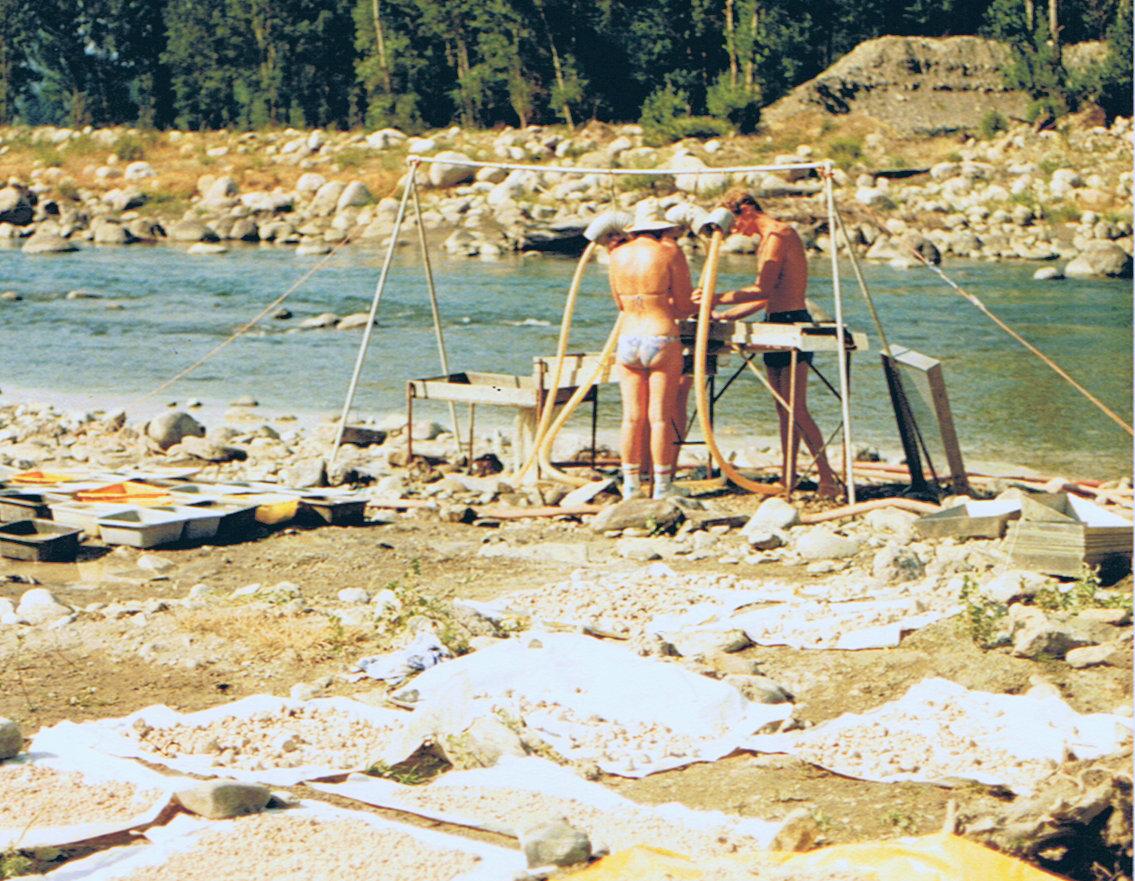
Image context: the 1986 field photograph above shows an earlier wash-sieving system doing the same conceptual work as the modern setups in the videos. Basins loosen silt and clay; water carries finer material through a succession of screens; retained fractions dry for later examination. The apparatus is not a diagram of an ideal process but an archival photograph of the process being negotiated outdoors, with people, hoses, samples, and finite workspace all in view.[3]
1. Scale is part of the method
Patricia Ralrick's Royal Tyrrell presentation is refreshingly uninterested in heroic hardware. Its screening complex is built from plastic milk crates, wire mesh, lumber, and livestock watering troughs. That practicality is the video's scientific point. A bulk-sampling program needs enough stations, enough water, and enough repeatable handling capacity to turn tonnes of matrix into dry concentrate without losing the connection between each batch and its locality.[1][5]
The figures behind the talk reveal what “quick” means at research scale. Over six months, 72 science-camp participants helped process about 2,400 kilograms of matrix from the Maastrichtian Pisces Point locality. After the camp ended, washing, sorting, and identification continued for another 259 volunteer hours; the reported result was about 8,200 identified fossil specimens.[5] The impressive number is not only the fossil yield. It is the conversion of a huge, visually unpromising mass into material that people can inspect one grain at a time.
That conversion depends on controlled reduction. Water disaggregates suitable sediment, agitation encourages small mineral particles to pass through the mesh, and the residue remains behind. The National Park Service describes screenwashing as soaking sediment in a screen box and gently agitating it underwater, followed in the broader workflow by microscope picking.[6] Neither step is universal. Some matrix will not break down safely, and some fossils may not tolerate immersion. The first scientific decision is therefore whether the material and expected specimens are compatible with the method at all.
The Royal Tyrrell design also shows why low cost is not the same as low rigor. Separate trough and crate identifiers help prevent material from different localities from becoming mixed; supported screens keep their aperture stable under load; a scalable arrangement makes it possible to process enough sediment for rare components of a fauna to appear.[5] What looks like workshop improvisation is really experimental infrastructure. If the starting mass, locality, screen aperture, and retained fractions stay traceable, the milk crate is doing the work of a sampling instrument.
Throughput has a cost, and the abstract makes it visible: screening did not end when the last crate dried. Concentrate still had to be sorted and specimens identified.[5] A washing complex can shrink the rock problem dramatically, but it cannot automate recognition. The output is not a box of fossils. It is a smaller box in which fossils have become findable.
2. The finest screen is not the final filter
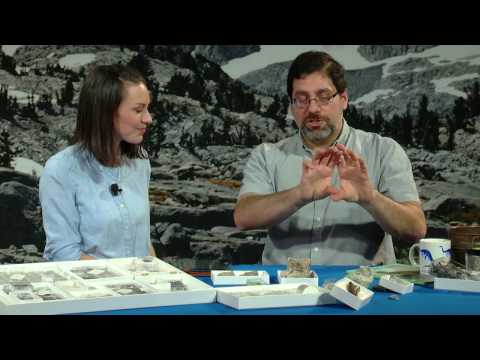
The Smithsonian video begins with the ecological payoff—small remains can populate the apparent empty space around famous dinosaurs—but its most valuable sequence is methodological. Around 17:00, curator Matthew Carrano moves from spotting small teeth and turtle shell at an outcrop to collecting the entire productive layer in bags. The team weighs the material and transports tonnes of it because isolated surface finds indicate that much more evidence may still be enclosed in the matrix.[2][4]
At roughly 17:30, Carrano identifies the sharpest lesson in the collection: his team once washed matrix in the field, then realized that the procedure was carrying some fossils away. They now bring the material back for controlled laboratory processing.[4] The change is easy to misread as a small logistical refinement. It is actually a correction to the sample. A method that makes collecting faster but preferentially discards the smallest material can change the fauna that later appears in a table.
The following demonstration makes each boundary tangible. Matrix is soaked until it returns to loose sediment, loaded into nested sieves, and dunked slowly enough that fossils do not grind against one another. After drying, the coarser tray contains readily visible pieces such as a gar scale. The finer fraction holds dark flecks too small to judge with unaided eyes, so it is bagged for examination under microscopes.[2][4] Water and mesh have separated by physical size; they have not separated fossil from non-fossil.
That is why picking should be understood as a second sieve. A person must distinguish enamel, bone, scale, or shell from mineral grains, then route a possible specimen toward identification. The effective recovery threshold is therefore not only the smallest mesh opening. It also includes how much residue remains, how long people examine it, what size fractions receive equal attention, and what features the sorters have learned to recognize. These are not reasons to distrust microvertebrate collections. They are reasons to document how each one was made.
The payoff in the Smithsonian example is large. Carrano describes Cloverly Formation sites yielding thousands of specimens and an inventory of roughly 50 to 55 species where fewer than a dozen had been recognized previously. Fish, crocodylian armor, and tiny amphibian jaws move dinosaurs out of the center of every ecological count.[2][4] The new census is richer, but the video's workflow prevents a naive conclusion. Those animals did not suddenly appear in the Cretaceous ecosystem; a recovery system made more of their surviving record visible.
A screen produces a conditional census
“Use the finest possible mesh” sounds like the obvious moral, but it is not a complete sampling strategy. Brooke Haiar's comparison of screenwashing materials describes traditional nested boxes with openings of about 1.0 and 0.6 millimeters, while a paint sieve with openings near 0.16 millimeters can retain material below 0.5 millimeters. The finer sieve also retains more non-fossil matrix, increasing the amount that must be picked.[7] Smaller aperture can improve recovery at one boundary while consuming the labor needed to search the resulting concentrate.
Comparability matters as much as maximal retention. In a study of a Cretaceous microvertebrate locality in Utah, researchers size-sorted concentrate through 4, 2, 1, and 0.5 millimeter apertures. They explicitly compared their smallest opening with the approximately 0.59 millimeter mesh used at twelve other assemblages before treating the samples as broadly comparable by specimen size.[8] Mesh was not relegated to a supply list; it was part of the argument linking one fossil census to another.
A defensible bulk sample should therefore travel with more than a locality label. The amount and lithology of the starting matrix, its degree of breakdown, every mesh aperture, the handling of each fraction, and the scope of microscope picking all help define what an absence means. A missing taxon may have been absent from the living community, absent from the deposit, destroyed before burial, smaller than the recovery threshold, or simply missed during sorting. Screenwashing cannot remove those filters. It can make some of them measurable.
Watched together, the two videos give scale and control equal weight. The Royal Tyrrell complex shows how ordinary materials can produce the throughput needed to find a hidden fauna.[1][5] The Smithsonian sequence shows why throughput without careful retention can quietly erase the very evidence being sought.[2][4] The smallest fossils do arrive by the bucket. But the scientifically useful result is not the fullest tray or the biggest specimen count. It is a census whose screens, losses, and human effort remain visible beside the fossils.
Sources
- Royal Tyrrell Museum of Palaeontology, “A Quick and Inexpensive Microvertebrate Screening Complex,” YouTube video.
- Smithsonian's National Museum of Natural History, “What Tiny Fossils Explain about Big Dinosaur Ecosystems with Dr. Matthew Carrano,” YouTube video.
- PePeEfe, “Freudenthal washing-sieving system,” 1986 field photograph, Wikimedia Commons, CC BY-SA 4.0.
- Smithsonian's National Museum of Natural History, transcript for “What Tiny Fossils Explain about Big Dinosaur Ecosystems.”
- Patricia E. Ralrick, “Plastic milk crates and livestock watering troughs: a quick and inexpensive microvertebrate screening complex,” in the 2013 Royal Tyrrell Museum Fossil Preparation & Collections Symposium abstract volume, archived copy.
- National Park Service, Hagerman Fossil Beds National Monument, “What is Paleontology?” — definitions of dry sieving, screenwashing, microscope picking, and field data collection.
- Brooke K. Haiar, “Examination of nontraditional materials for microvertebrate fossil screenwashing,” Acta Palaeontologica Polonica 67, no. 1 (2022).
- Haviv M. Avrahami et al., “A new microvertebrate assemblage from the Mussentuchit Member, Cedar Mountain Formation,” PeerJ 6:e5883 (2018), via Europe PMC.