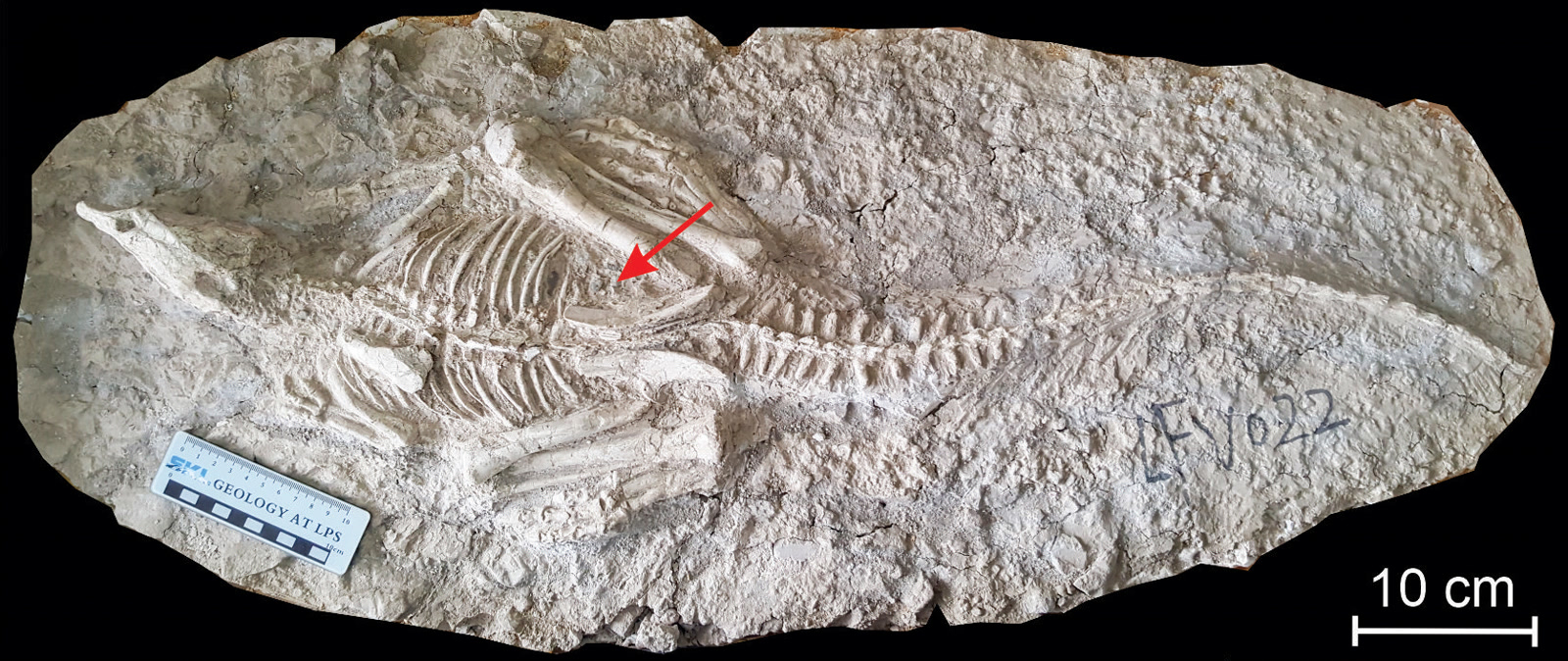
Changmiania liaoningensis lies with its legs folded under the body and its tail drawn straight behind. In the holotype, the trunk bends gently to one side and the head settles on the right hand. Its name comes from the Chinese for “eternal sleep,” which tells you how difficult the pose is to see neutrally.[1]
But a fossil is not a stopped film. It preserves no closed eyelid, last breath, or intact wall around a sleeping chamber. “Resting,” “burrowing,” and “burrow collapse” belong to three different layers of inference: what the joints are doing, what the living body may have been able to do, and what the sediment did after life ended. The value of Changmiania is not that all three layers click into certainty. It is that two unusually complete skeletons let us watch the layers meet—and refuse to let one substitute for another.[1]
Image context: the cover is a real overhead specimen photograph of PMOL LFV022, the second of the two known skeletons. Its nearly uninterrupted backbone, paired folded limbs, and straight tail make the article’s evidentiary problem visible before any reconstruction begins. The red arrow belongs to the published plate and identifies a gastrolith cluster, not the proposed outline of a burrow.[1][7]
Two bodies repeat the stillness
The 2020 description was based on a nearly complete holotype, PMOL AD00114, and a second nearly complete referred specimen, PMOL LFV022. Both were reported to come from the Lower Cretaceous Lujiatun Beds of the Yixian Formation in western Liaoning, China, and both remained three-dimensional and articulated rather than flattened into the dark slabs familiar from many other Jehol fossils.[1]
That repetition matters. A single skeleton can be pulled into an orderly pose by decay, current, compression, or preparation. Two anatomically matching animals preserved with limbs arranged symmetrically make random rearrangement a less satisfying explanation. Neither skeleton shows the usual long interval of exposure: the bones stayed together, and the describing team reported no weathering or scavenging traces. Whatever happened, burial interrupted the ordinary sequence in which a carcass is opened, scattered, and edited by the surface.[1]
The second animal does not simply duplicate the first. PMOL LFV022 presents the body from above with the hindlimbs folded beneath it, the forelimbs close to the trunk, and the tail extended backward. In the holotype, the head and torso curve farther to the side until the head rests on the right hand. The differences make the shared geometry more persuasive: these are not two fossils mechanically arranged into one identical museum pose. They are two individuals whose joints preserve variations on a compact, undisturbed posture.[1]
Even the name should therefore be read carefully. “Eternal sleep” is an apt description of appearance. It is not a measurement of behavior. The bones support stillness at rapid burial; the word sleep asks us to infer what the animal was doing immediately before that stillness became permanent.
Resting is visible; sleep is comparative
The classic comparison is Mei long, the small troodontid described in 2004 with its feet tucked beneath the body, forelimbs folded alongside it, neck curved back, and head nestled between an elbow and the trunk. That arrangement resembles the heat-conserving tuck of living birds closely enough that the original paper treated it as an avian-like sleeping posture.[6]
Changmiania cannot make the same shape. Its tail remains almost straight behind both known individuals, whereas Mei curls its tail forward around the body. The 2020 authors connected that difference to anatomy: overlapping joints and large transverse processes would have made the tail relatively stiff. Its neck was also short—only six cervical vertebrae—so the head could not sweep backward into a Mei-style tuck. The holotype instead rests its head on a hand. Same broad act, different available hardware.[1]
This is why posture is stronger as a claim about rest than about sleep. Symmetrically folded limbs and a supported head are compatible with an animal that had settled rather than one thrown violently after death. They do not distinguish sleep from quiet wakefulness, hiding, illness, or the first moments of entrapment. Nor does a peaceful-looking pose by itself identify a cause of death. Paleontology can compare a skeleton with repeatable postures in other animals; it cannot recover the animal’s state of awareness.
The right conclusion is therefore narrower than the nickname and more interesting than skepticism for its own sake. Changmiania preserves a credible life-like resting geometry. “Died asleep” remains a possible scene within that geometry, not a fact visible in the bones.
A body that could dig without becoming a mole
The burrow interpretation does not rest on posture alone. Several parts of the skeleton look compatible with moving soil or bracing against it. The paired premaxillae at the tip of the snout are fused, and the upper snout is broad enough that the describing authors compared it with head-assisted digging. The neck is shortened. The radius is only about 70 percent as long as the humerus, the hands are short, and the fused scapulocoracoid offers a large, reinforced shoulder surface. Along the pelvis, the neural spines of the sacral vertebrae fuse into a continuous bar, while the paired ilia lean inward over the sacrum. Together these features could help transmit the high forces created when forelimbs loosen earth and hindlimbs brace the body.[1]
None is an anatomical confession. Fused skull bones can serve more than digging; muscle attachment area shows capacity, not a recorded action; reinforcement can answer several mechanical demands. The original authors repeatedly described the fossorial reading as tentative, and the rest of the body gives that caution a positive reason. The hindlimb is roughly twice the length of the forelimb, and the tibia is longer than the femur—proportions of an efficient runner. Skull and forelimb modifications remain modest beside those of an animal specialized to live underground.[1]
The describing team therefore favored facultative digger: an animal able to excavate or enlarge shelter without surrendering a mobile life above ground. This is not an awkward compromise invented to rescue the burrow story. Living runners dig, and another small ornithopod provides a much firmer fossil comparator.[1]
Oryctodromeus shows what direct burrow evidence looks like
In Montana’s mid-Cretaceous Blackleaf Formation, an adult Oryctodromeus cubicularis and two juveniles were found inside the expanded terminal chamber of a sediment-filled tunnel. The dimensions of the adult fit the passage, while the skeleton carries its own package of digging-compatible features in the snout, shoulder, and pelvis without losing cursorial hindlimb proportions.[5]
That association raises the standard for interpreting Changmiania. Oryctodromeus joins trace and body: there is a preserved structure, animals inside it, a size match, and anatomy consistent with making or using it. Changmiania has the body and the pose, but not a documented tunnel. Similar anatomy makes dinosaur digging biologically plausible; it does not transfer the Montana burrow into the Liaoning blocks.[1][5]
The comparison also changes the question. We do not need to ask whether any non-avian dinosaur could dig—Oryctodromeus makes that answer unusually secure. We need to ask whether these two particular Changmiania individuals occupied burrows, whether they dug those shelters themselves, and whether collapse caused their deaths. Those are specimen-level and sediment-level questions, and the original excavation record cannot answer them cleanly.
The lost field context is part of the fossil
Both Changmiania specimens were acquired by the Paleontological Museum of Liaoning from local farmers, who reported finding them near Lujiatun Village. They were already partly prepared, and museum staff subsequently completed careful preparation of the holotype. The research team used close examination and X-rays to check authenticity. They found ordinary repairs—glued breaks and cemented fragile pieces—but no sign that unrelated animals had been assembled into false skeletons.[1]
That secures anatomy better than taphonomy. Preparation removed too much surrounding material for direct sedimentological work, and the exact discovery circumstances were not recorded by a scientific field team. No surviving field record maps a chamber around either animal, samples matrix at controlled distances through the block, or documents a structure enclosing the skeleton. The original authors were unusually explicit about the consequence: a collapsed underground burrow was a hypothesis, while specific stories about how a debris flow or unstable volcanic sediment might have triggered it were speculation.[1]
This is not administrative trivia. Provenance determines which claims remain testable. The two skeletons can still support anatomy, articulation, and posture. Their lost in-situ context means the mechanism of entombment must borrow evidence from elsewhere in Lujiatun—and borrowed evidence has to keep its address attached.
New sediment made the burrow case stronger, then opened a debate
A 2024 study revisited the Lujiatun Member with drill cores, outcrops, geochronology, petrography, and matrix from two articulated Psittacosaurus blocks. It rejected the popular idea that the three-dimensional animals were all swept into place by Pompeii-like airborne ash or violent lahars. In the sampled blocks, sediment outside the skeletons was three to six times coarser than material close to the bones. The authors interpreted that gradient as a “burrow sieve”: collapsed walls retained coarse grains while fine sediment filtered around still-fleshed bodies as they decayed.[2]
The wider geology also contained reworked volcanic material mixed with older grains, soil development, and fluvial or alluvial signatures. On that evidence, the team proposed ordinary attrition and sudden burrow collapse as a more economical explanation for articulated animals in normal-looking poses. A volcanic landscape remained part of the setting, but a catastrophic eruption was no longer required for each burial.[2]
That is meaningful independent support for the mechanism proposed in 2020. It is not a test of either Changmiania block. The sampled skeletons were Psittacosaurus, and the new observations operate at member scale across other localities and specimens. They make collapsed burrows more plausible within the Lujiatun Member; they cannot restore the missing sediment around PMOL AD00114 or PMOL LFV022.[1][2]
The interpretation was challenged almost immediately. Meaghan Emery-Wetherell argued that fine sediment around an intact carcass is not unique to a burrow, that remobilized volcanic material does not exclude a gentle flood or lahar, and that some Lujiatun body arrangements imply postmortem movement. She proposed another viable sequence: volcanic carbon dioxide kills animals without a violent struggle, then a low-force sediment event buries them.[3]
The original study team replied that transported skeletons should show more disorientation, that juvenile huddles and entangled combat fossils need not record current-driven alignment, and that the sampled beds lack the coarse volcanic clasts expected from lahars. They allowed that carbon dioxide could have killed some animals—even inside burrows—but maintained that burial by lahar does not fit the most complete skeletons. Crucially, their reply ends at the remaining evidentiary limit: newly excavated, in-situ fossils with intact sedimentary context are needed.[4]
The exchange prevents an easy verdict, but it improves the reading. Fine-grain gradients, articulated bodies, posture, and reworked volcanic sediment now have competing causal stories. A future in-situ skeleton with independently documented burrow architecture, or a controlled grain-size transect through an untouched Changmiania block, would change the balance far more than another confident reconstruction.
The strongest scene keeps its uncertainty
What, then, survives close reading? Two nearly complete animals were buried quickly enough to preserve compact, symmetrical poses before scavenging and disarticulation. Their anatomy is compatible with facultative digging while retaining the proportions of runners. A directly preserved burrowing ornithopod elsewhere shows that this combination is real. New work on the Lujiatun Member gives collapsed burrows a sedimentary mechanism, but that work sampled different dinosaurs and now sits inside an active debate separating possible death by collapse or gas from burial by collapse, flood, or lahar.[1][2][3][4][5]
The famous scene—two small herbivores asleep underground when the roof came down—is therefore coherent. It is not uniquely compelled. “Resting posture” is stronger than “sleep”; “capable of digging” is stronger than “dug this chamber”; “rapid burial” is stronger than “collapse killed it.” Each phrase occupies a different rung on the evidence ladder.
That restraint does not drain the fossil of life. It returns attention to what is genuinely rare: not a bedtime tableau preserved with perfect narration, but two bodies still orderly enough for scientists to test how behavior, anatomy, sediment, and missing provenance fit together. Changmiania looks asleep. The burrow remains an argument—and that is exactly why the fossils are worth waking up to.
Sources
- Yuqing Yang, Wenhao Wu, Paul-Emile Dieudonné, and Pascal Godefroit, “A new basal ornithopod dinosaur from the Lower Cretaceous of China,” PeerJ 8 (2020) — original description, specimen history, posture, anatomy, and the explicitly tentative burrow interpretation.
- Scott A. MacLennan et al., “Extremely rapid, yet noncatastrophic, preservation of the flattened-feathered and 3D dinosaurs of the Early Cretaceous of China,” PNAS 121 (2024) — Lujiatun geochronology, sedimentology, Psittacosaurus matrix analysis, and the broader collapsed-burrow model.
- Meaghan M. Emery-Wetherell, “Burrow collapse is not the only explanation for rapid, noncatastrophic preservation of 3D dinosaurs,” PNAS 122 (2025) — critique proposing that gentle sediment transport and volcanic gas remain viable alternatives.
- Paul E. Olsen et al., “Reply to Emery-Wetherell: Taphonomy of Lujiatun 3D dinosaurs is inconsistent with death and burial by lahars,” PNAS 122 (2025) — defense of the burrow model and statement of the evidence still needed.
- David J. Varricchio, Anthony J. Martin, and Yoshihiro Katsura, “First trace and body fossil evidence of a burrowing, denning dinosaur,” Proceedings of the Royal Society B 274 (2007) — adult and juvenile Oryctodromeus remains within a sediment-filled burrow.
- Xing Xu and Mark A. Norell, “A new troodontid dinosaur from China with avian-like sleeping posture,” Nature 431 (2004) — PubMed record for the Mei long description used as the posture comparison.
- Yuqing Yang, Wenhao Wu, Paul-Emile Dieudonné, and Pascal Godefroit, “Changmiania specimen PMOL LFV022.png” — source page for the real cover photograph, shared via Wikimedia Commons under CC BY 4.0.