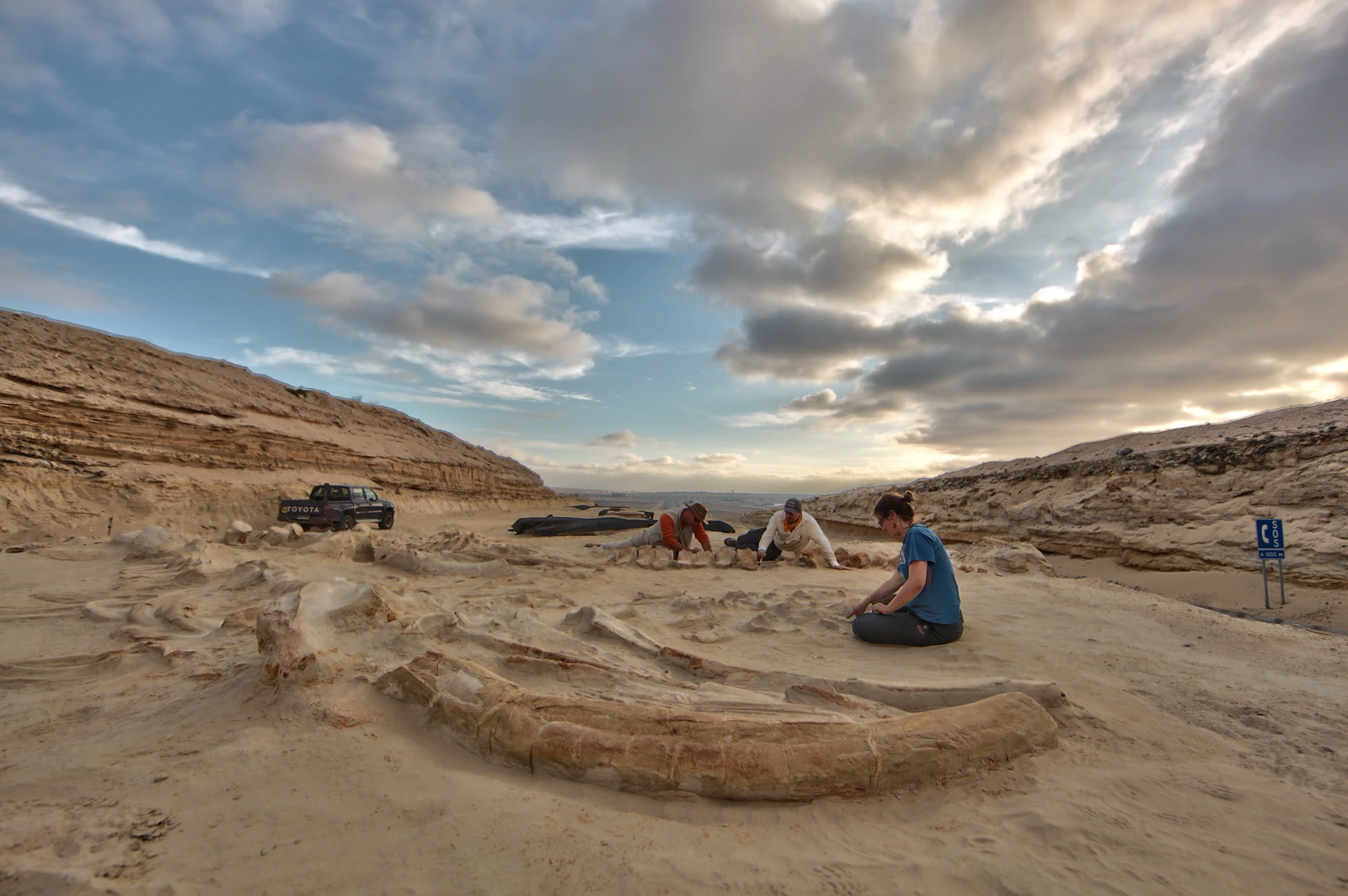
The first impression is not a graveyard. It is a traffic problem. Pale sediment has been cut into a long bench beside the Pan-American Highway north of Caldera, Chile, and whale backbones run through the exposed ground where a new lane is supposed to go. In the 2011 photograph, researchers kneel among several skeletons at once; the road, the desert, and the fossils all occupy the same narrow frame.[4]
Only after the eye adjusts does Cerro Ballena become stranger. This is not one unlucky pod stranded on one Miocene beach. More than 40 complete or partial marine-mammal skeletons emerged from a quarry opened during highway expansion, and the articulated remains were distributed through four separate bone-bearing horizons within roughly eight metres of the Bahía Inglesa Formation.[1] What looks from above like a crowd is, in section, a sequence.
That stack is the site's essential fact. It turns “whale graveyard” from a spectacle into a field question: what could kill large marine animals repeatedly, gather their carcasses in the same coastal trap, and bury them fast enough for whole skeletons to survive?
The road cut opened a column of time
Construction between 2010 and 2012 exposed a quarry about 20 metres wide and 250 metres long. Chilean teams, joined by Smithsonian researchers and digitization specialists, had to record the fossils while the road project paused around them.[1][4][5] The rescue conditions were severe, but the cut supplied something a loose museum skeleton cannot: vertical order. Bone Levels 1 through 4 showed that the carcasses did not all accumulate in one instant.
The original 2014 study bracketed the fossil-bearing unit between about 9.03 and 6.45 million years ago, using the overlapping ranges of an aquatic sloth and a shark also known from dated Peruvian strata.[1] A 2025 chronostratigraphic study then combined field sedimentology with uranium-lead ages from zircon and phosphate. Its revised framework places rapid deposition of the articulated Cerro Ballena cetaceans at roughly 6.1 million years ago, near the end of the Miocene, in a barrier-protected shoreface setting.[2] The tighter age does not replace the four horizons with a single day. It locates the recurring events more securely inside a changing Pacific margin.
The 2014 team estimated that the sampled sediment represented on the order of 10,000 to 16,000 years. That estimate depends on comparison with sedimentation rates on modern tidal flats, so it is not a stopwatch.[1] Its value is scale: four carcass concentrations recur within a geologically short interval, but not as one simultaneous mass death.
The bodies arrived as evidence
Rorquals—the baleen-whale family that includes living blue, fin, and humpback whales—dominate the assemblage. The researchers counted a minimum of 31 rorqual individuals, probably belonging to one species, ranging from calves to mature animals. The same beds also yielded two kinds of seals, a sperm whale, the tusked whale Odobenocetops, the aquatic sloth Thalassocnus natans, billfishes, and shark teeth.[1] That mix matters more than a long species list. A cause restricted to one social whale species cannot easily explain it.
The skeletons preserve a second line of evidence: what happened between death and burial. Many rorquals remained complete or nearly complete. Their bones generally had not scattered farther than one body length. Across the measured levels, about three quarters lay belly-up, and their long axes tended to sit across the inferred current rather than pointing with it.[1] Those patterns resemble floating carcasses that rolled, grounded, and came to rest under hydraulic control. They do not resemble whales living, feeding, and dying one by one on a dry flat.
Nor do they look heavily worked over. The study found no skeletal trauma that could unify the deaths and little sign of vertebrate scavenging, although crab feeding traces occur on at least one skull.[1] Large, intact bodies therefore reached the depositional site quickly—probably already dead or dying—before decay, surf, and scavengers could dismantle them.
A shoreline trap did a different job from the killer
It helps to separate three mechanisms that “graveyard” compresses into one. Something killed the animals at sea. Water then concentrated their floating bodies. Sediment finally preserved them.
For the second step, the original reconstruction proposed a south-facing embayment sheltered from ordinary Pacific waves by a barrier bar and basement rocks. Storm surges or high spring tides could float carcasses onto a shallow supratidal flat, orient them, and leave them beyond the reach of large marine scavengers. Fine sediment then covered the bodies with limited disturbance.[1] The 2025 work substantively revises that setting to a low-energy, barrier-protected shoreface with punctuated storm deposition, and it emphasizes rapid burial amid volcanic ash and abundant diatoms.[2] The shoreline model has changed, not merely its label. What persists is the important physical result: protection and fast deposition in a shallow coastal setting, not prolonged exposure on an open coast.
That distinction prevents a common taphonomic mistake. A concentration site need not be the place of death. Cerro Ballena's sediments explain how carcasses gathered and survived; they do not, by themselves, identify what stopped the animals' hearts.
The bloom is the best fit, not a recovered toxin
The 2014 study proposed harmful algal blooms as the recurring killer. The case is comparative. In modern oceans, algal toxins can move through food webs and kill multiple kinds of large vertebrates over broad stretches of coast. At Cerro Ballena, a fast cause at sea must account for whales of several ages, unrelated marine mammals, and predatory fish; it must recur four times; and it must leave little trauma.[1]
Alternative explanations lose pieces of that pattern. Herding or navigation errors are too taxon-specific. A tsunami should leave high-energy sedimentary evidence and a less size-selective jumble. A recurring epidemic would have to cross distant branches of the marine-vertebrate tree. None is impossible in the abstract, but none explains the full stack as economically as repeated poisoning followed by shoreline transport.[1]
Still, no one extracted a Miocene toxin from these bones. The original team found iron-stained structures resembling algal mats and tiny phosphate grains that might represent replaced non-siliceous algae, but it explicitly could not confirm that the grains were biological or establish when they formed.[1] “Harmful algal bloom” is therefore a supported causal hypothesis, not a chemical diagnosis. The taphonomic evidence strongly supports repeated, rapid rorqual deaths at sea and a broader multispecies death assemblage more firmly than it establishes the exact toxin or organism; some shark teeth and aquatic-sloth material could instead be incidental input.[1]
Volcanic ash enlarges the scene
Two newer studies make the bloom mechanism more plausible without turning it into direct proof. The 2025 analysis dated the Cerro Ballena deposition to about 6.1 million years ago and placed the articulated whales in beds associated with substantial volcanic ash and diatom accumulation. It proposed a correlation among intensified Andean volcanism, nutrient delivery, marine productivity, and harmful blooms along northern Chile.[2]
In 2026, Barbara Carrapa and colleagues tested that wider chain with ash-dispersion and Earth-system models. Central Andean eruptions could supply iron, phosphorus, and silicon—nutrients capable of fertilizing surface waters—to the Pacific nearby and to oceans farther east. In their short-term experiments, ash-derived nutrient pulses produced more than a twofold increase in simulated surface diatom chlorophyll during the first two years; their longer runs supported enhanced carbon export and a possible contribution to Late Miocene cooling.[3]
The model changes the scale of the argument. Cerro Ballena may sit inside an interval when explosive volcanism repeatedly primed marine productivity, rather than beside a bloom generated by a purely local accident. But a model of ash transport and ocean fertilization cannot assign a particular eruption, algal species, or toxin to any one whale horizon. It supplies a feasible environmental engine. The bodies and beds still carry the site-specific case.[2][3]
The quarry survived as context
The northbound highway now covers much of the excavated strip, while the recovered fossils remain in Chilean collections. Before paving, the team used photography, photogrammetry, and laser scanning to capture skeletons and their positions at sub-centimetre resolution. The resulting open digital collection preserves complete excavation surfaces and individual specimens in three dimensions.[1][4] This was not a technological flourish. Once a skeleton is lifted, its posture relative to current direction, neighboring bodies, and bone level cannot be packed into the same crate.
Cerro Ballena's achievement is therefore larger than a count of fossil whales. Four layers separate repetition from catastrophe. Articulation separates rapid burial from a reworked bonebed. Orientation separates a coastal trap from an offshore death. A diverse fauna narrows the range of plausible killers. Volcanic ash and diatoms supply a mechanism worth testing, while the absence of a preserved toxin keeps the conclusion honest.
The highway cut offered only a brief look at that causal chain. The fieldwork made the look durable—and turned a spectacular pile of bones into four episodes that can still be argued with.
Sources
- Nicholas D. Pyenson et al., “Repeated mass strandings of Miocene marine mammals from Atacama Region of Chile point to sudden death at sea,” Proceedings of the Royal Society B 281 (2014) — original site description, taphonomy, four horizons, and harmful-bloom hypothesis.
- Priscilla R. Martinez et al., “Controls on late Miocene marine vertebrate bonebed genesis in northern Chile,” Palaeogeography, Palaeoclimatology, Palaeoecology 659 (2025) — revised age, depositional setting, ash, and diatom context.
- Barbara Carrapa et al., “Andean volcanism, ocean fertilization, marine ecosystem turnover, and global cooling in the Late Miocene,” Communications Earth & Environment 7 (2026) — ash-dispersion and Earth-system modeling.
- Smithsonian Ocean, “The Digsite at Cerro Ballena” — Adam Metallo's 2011 documentary photograph used as the article image and an institutional note on the 3D rescue.
- Museo Nacional de Historia Natural de Chile, “Registro paleontológico sin precedentes en Chile” — Chilean institutional account of the rescue and 3D documentation partnership.