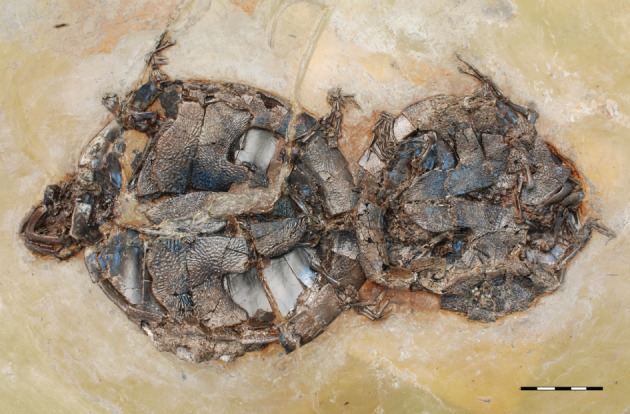
Two shells meet near their rear edges. The turtles face away from one another, an arrangement that takes a moment to decipher. The photograph preserves the intimacy of a pair without immediately explaining it: where should we look to decide what these animals were doing?[2]
Start with the place. Messel, near Darmstadt in Germany, preserves a middle Eocene environment approximately 47–48 million years old. Its oil shale contains articulated skeletons alongside extraordinary traces of soft anatomy, including feathers, skin and stomach contents. This is a deposit in which the relationships between small body parts can survive long enough to become evidence.[3]
The turtles belong to Allaeochelys crassesculpta, a relative of the living pig-nosed turtle. Its bony shell lacked the familiar covering of horny scutes; the Messel site's account describes a leathery covering and limbs shaped for swimming.[1] Reading the paired fossils requires following those bodies beyond the conspicuous outlines of their shells.
The decisive evidence is at the tail
Walter Joyce and colleagues examined nine pairs for their 2012 study. Each contained a male and a female. Males had proportionally longer tails, extending beyond the shell margin, while females had shorter tails. Females also showed a joint arrangement permitting movement in the rear part of the plastron, the shell's underside.[2]
Seven pairs touched at the backs of their shells. In two especially revealing specimens, the male's tail curved beneath the female's shell and aligned with hers. Combined with the sex differences, that positioning supported the interpretation that the turtles died while mating.[2]
The distinction matters. Two neighboring skeletons alone would leave many possible explanations. Here, several anatomical observations converge on the same activity. The researchers could make a behavioral argument from identifiable structures, rather than simply treating proximity as a frozen relationship.
That also explains why the photograph needs a close reading. The shells draw the eye; the evidence that makes the encounter intelligible lies around their margins.
A pair once divided into two species
The turtles' differences had previously encouraged a different interpretation. In his 2014 review, Joyce revisited material described by Harrassowitz in 1922. Larger, more coarsely sculptured specimens were originally named Anosteira crassesculpta, while smaller specimens were called Anosteira gracilis. Researchers later united them under what became Allaeochelys crassesculpta; the distinction between males and females helped explain the original split.[4]
There was an unusually pointed illustration of the problem. Two specimens associated with the original named forms had been found together and, Joyce argued, represented another mating pair. The differences used to separate species had, in this case, separated the partners on paper.[4]
His review also identified additional pairs in earlier publications, bringing the total he recognized to at least eleven. The nine pairs in the 2012 study are therefore a dated research sample, not a permanent census of every such fossil.[4]
Reexamining a collection can change the story without adding a newly excavated animal. A shell difference may acquire a new meaning when a tail, a partner and an old description are read together.
Reconstructing the descent
The proposed death scene begins above the lake floor. In the interpretation presented by the Messel site, the turtles mated in open water and sank while coupled. Deeper water lacked usable oxygen and may have contained toxic compounds produced by decaying organic matter. A skin surface capable of exchanging gases with water could then have become a route of exposure.[1]
That last step involves comparative inference. The 2012 paper inferred skin respiration in these turtles from their relationship and anatomical similarities to softshell turtles; it did not measure the physiology of Allaeochelys.[2]
The sequence is coherent, but each step adds a claim beyond the posture preserved in the fossil. Establishing mating does not automatically establish the depth at which danger began, the chemical responsible, or the time between incapacitation and burial. The animal's final position and its cause of death are different questions, even when one helps frame the other.
A rich fossil bed needs more than one explanation
A 2024 study by Krister Smith, Renate Rabenstein and Joy O'Keefe makes that distinction especially useful. They examined a broader Messel puzzle: whether the abundance of fossil bats required an unusually lethal lake. Their comparison drew on modern swimming-pool drownings, carcass-decay experiments and estimates of how frequently bat fossils accumulated at Messel.[5]
They found no evidence that bat mortality exceeded background levels. Ordinary accidents remained a viable explanation; rare vertebrate mass-death layers also weakened the case for repeated wholesale killing. Their analysis retained a deep, stratified lake, so questioning exceptional mortality did not require abandoning the lake's unusual preservation conditions.[5]
This was a study of bats, not an experimental test of the paired turtles' deaths. It leaves the specific toxic-depth scenario open while warning against making one dramatic explanation account for an entire fossil assemblage.[5]
Return to the two shells. Their encounter can be read with considerable confidence because anatomy supplies several mutually supporting clues. The surrounding water is harder to recover. The fascination of these fossils lies partly in that difference: a moment of animal behavior remains sharply legible inside an environment whose hazards still require testing.
Sources
- Welterbe Grube Messel, “Allaeochelys crassesculpta”—institutional species account and proposed death sequence; German-language source.
- Joyce, Micklich, Schaal and Scheyer, “Caught in the act: the first record of copulating fossil vertebrates,” Biology Letters (2012)—nine pairs, anatomical evidence, the proposed physiological mechanism and the specimen photograph in figure 1.
- UNESCO World Heritage Centre, “Messel Pit Fossil Site”—middle Eocene age, oil-shale deposits and exceptional preservation.
- Walter G. Joyce, “A review of the fossil record of turtles of the clade Pan-Carettochelys,” Bulletin of the Peabody Museum of Natural History (2014), “Paleoecology” and the Allaeochelys crassesculpta account—additional pairs and naming history; repository record with full text.
- Smith, Rabenstein and O'Keefe, “Was Palaeolake Messel a death-trap? Insight from modern bat drownings and decay experiments,” Palaeobiodiversity and Palaeoenvironments (2024)—testing background mortality and separating death from preservation.