AudioMoth, BirdNET-Analyzer and OpenSoundscape occupy different places between a microphone in the forest and a species list on a desk. One records sound; another searches recordings for recognizable calls; the third supplies building blocks for a tailored analysis. Their most useful connection is the ability to carry a claim back to the few seconds of audio that produced it.[2][3][5][7]
The field question can be beautifully concrete. In September 2026, NatureLife Cambodia described an AudioMoth pilot at known and suspected White-shouldered Ibis roosts in Lomphat Wildlife Sanctuary. The organization hopes recordings will help identify active locations and make field visits more efficient.[1] Lomphat supplies the question; the software map below examines tools available for work of this kind.
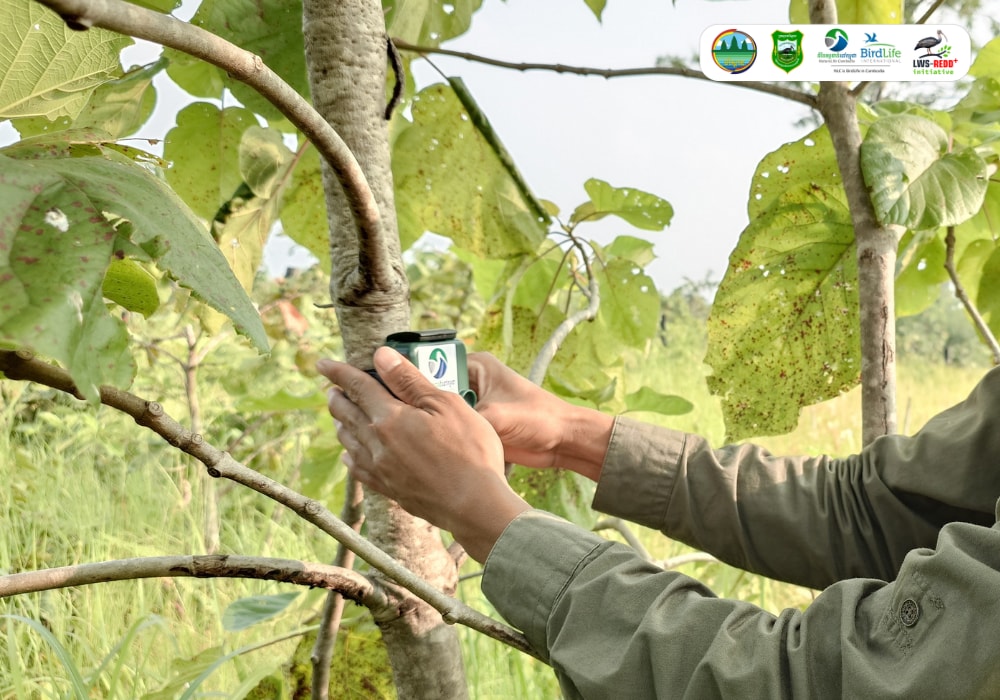
The recorder determines what can be asked later
AudioMoth's contribution begins before any species recognition. It writes uncompressed WAV audio to a microSD card, has an adjustable microphone gain, and keeps an onboard clock in UTC. Its supported sampling rates extend from 8,000 to 384,000 samples per second, spanning different recording needs.[3] The Configuration App sets the clock and recording configuration; the Flash App installs firmware. Open Acoustic Devices publishes its software and firmware under the MIT license.[2]
Those are distinct jobs. Installing new firmware does not by itself establish a survey schedule. Choosing a schedule also chooses the hours available for later analysis. A classifier cannot inspect a dawn chorus that the recorder was never configured to capture.
There is a subtler handoff in triggered recording. AudioMoth's operation manual explains that a T.WAV file can omit the quiet periods between trigger events. It remains playable audio, but playback time no longer represents the full elapsed recording period. The Configuration App includes tools to restore the omitted intervals.[4] Before attaching clock times to detections, an analysis must account for that compression. Restoring intervals preserves the timeline; it does not recover sounds that were never saved.
This is why the first useful archive contains more than an appealing clip. Keep the original file, deployment location, clock information and recording settings together. That recommendation follows from the recorder's behavior: subsequent software needs to know what its seconds refer to.
BirdNET turns files into candidates for listening
BirdNET-Analyzer provides a relatively direct route from a folder of audio to detection tables. In the stable 2.4.0 documentation consulted here, birdnet_analyzer.analyze accepts a file or directory. The --rtype csv option requests CSV results; --min_conf controls the minimum score retained. Location and week-of-year inputs can constrain the candidate species, and optional CSV columns preserve settings including the model and confidence threshold.[5]
For a small conservation team, the attraction is that a batch of recordings can become a tractable listening queue. The settings also become part of the evidence. Two runs with different candidate lists or thresholds have asked different questions, even when they began with identical WAV files.
The next handoff is already built into Analyzer. Its segments tool uses result tables to extract short audio clips into species folders. Its review interface lets a listener play a clip, inspect its spectrogram and mark the detection positive or negative. The stable review guide accepts table, Kaleidoscope and CSV results for segment extraction, while warning that Audacity output lacks required columns.[6] Exporting something called a label file therefore does not guarantee that the next tool can use it.
A confidence score also needs interpretation. BirdNET's guide explicitly distinguishes its scores from probabilities and warns against transferring their meaning freely between species.[6] A score of 0.8 is not, by itself, an established 80 percent chance that the named bird is present. Local listening is how the team begins to learn what that score means for its recordings.
OpenSoundscape gives the analysis room to change
OpenSoundscape belongs alongside this workflow when the question needs more control. It is a Python library maintained by the University of Pittsburgh's Kitzes Lab, with utilities for manipulating audio and spectrograms, training or running classifiers, and working with Raven annotations.[7] That makes it useful to an analyst assembling a reproducible pipeline from components.
The boundary between projects is porous. An OpenSoundscape tutorial demonstrates using BirdNET or Perch as a feature extractor, turning audio into numerical representations called embeddings. A smaller classifier then learns to associate those representations with the user's labels. In that demonstration, the feature extractor's weights stay fixed while the added classifier is trained. The documentation now points new transfer-learning workflows toward SongSpace; this tutorial makes the underlying relationship visible.[8]
The example uses annotated frog recordings. That is a valuable illustration of the relationship: a representation developed for broad sound recognition can become an ingredient in a more focused task. It still needs relevant labeled examples and evaluation. Borrowing the representation does not establish that the new classifier works at a different pond.
This route asks more of a team than running a prepared batch analysis. Someone must maintain the Python environment, the labels, the saved model and the evaluation procedure. A team with an analyst and repeated specialist questions may benefit from that control. A small field group with limited coding support may get further by first making Analyzer's review process dependable. These are workflow judgments, rather than a ranking of the projects.
There is also a practical distinction between software and model permissions. BirdNET-Analyzer's documentation lists MIT licensing for its source code and CC BY-NC-SA 4.0 for its models.[10] An open software interface does not make every component interchangeable on identical terms.
Keep the disagreements useful
Mongabay's early reporting on AudioMoth emphasized affordability and the possibility of covering landscapes with many recorders.[9] That promise explains the ecosystem's appeal, but it also exposes the downstream task: more microphones can produce more sound than people have time to hear.
My recommended bridge between tools is a record that retains the original filename, start and end offsets, proposed label, score, model identity, analysis settings and reviewer decision. Preserve the proposal when someone corrects it. Otherwise, the project loses the evidence needed to understand which mistakes recur.
Review should also reach beyond the selected detections. Listening only to clips the model nominated can reveal false alarms, but cannot show how many relevant calls it missed elsewhere. A separately chosen sample of the original recordings gives the team a way to look for those omissions. This is an evaluation recommendation, not a claim that the tools automatically perform such an audit.
Finally, rows in a detection table need a biological interpretation. Several clips may contain the same calling bird. A quiet recording may reflect silence, distance or recording conditions. Counting accepted labels alone cannot resolve those possibilities.
The reward for keeping these distinctions is a collection that can improve. A new model can revisit an old recording. A listener can challenge an unlikely identification. A field team can return to a promising roost with a precise sound and time to investigate. The species list becomes useful because the forest remains audible behind it.
Sources
- Muth Sreymom, “Lomphat REDD+ Project Uses AudioMoth to Enhance Ibis Monitoring,” NatureLife Cambodia, September 28, 2026 — pilot objectives and field photograph.
- Open Acoustic Devices, “Open Source Policy” and resources — software licensing, Configuration App and Flash App; consulted November 11, 2026.
- Open Acoustic Devices, “AudioMoth” — WAV recording, sample rates, gain and UTC clock; consulted November 11, 2026.
- Open Acoustic Devices, AudioMoth Operation Manual, section 4.5 — triggered recording, T.WAV files and restoration of omitted intervals.
- BirdNET-Analyzer, “Command line interface,” stable 2.4.0 documentation — analysis inputs, result formats, filters and optional metadata columns; consulted November 11, 2026.
- BirdNET-Analyzer, “Segment Review,” stable documentation — supported tables, clip extraction, manual review and confidence-score limitations; consulted November 11, 2026.
- OpenSoundscape, documentation overview — Python analysis components, annotations and project maintainers; consulted November 11, 2026.
- OpenSoundscape, “Train classifiers on BirdNET or Perch embeddings” — documented transfer-learning example using fixed feature extractors and annotated frog recordings; consulted November 11, 2026.
- Mike Gaworecki, “‘AudioMoth’ device aims to deliver low-cost, power-efficient monitoring of remote landscapes,” Mongabay, January 8, 2018 — independent reporting on the project's landscape-monitoring ambition.
- BirdNET-Analyzer, documentation introduction and License section — separate terms for source code and models; consulted November 11, 2026.