TeX looks strange if it is judged by the ordinary open-source signals: rapid releases, visible roadmap, issue velocity, feature flags, and a growing API surface. Its strongest governance signal is almost the opposite. Knuth's original TeX is deliberately frozen, except for rare bug fixes, and the surrounding ecosystem treats that freeze as a compatibility asset rather than as abandonment.[4][5][6]
That makes TeX a useful counterexample for maintainers. Most projects must prove that they are alive. TeX proves that a small, stable core can remain valuable when its owner writes down where change is allowed, where change is forbidden, and how successors should identify themselves. The living work has not stopped. It has moved into distributions, macro packages, formats, fonts, engines such as pdfTeX, XeTeX, and LuaTeX, and the operations of TeX Live. The original engine stays narrow so the rest of the stack can know what it is standing on.[1][5]
The Freeze Is The Contract
CTAN's current TeX package page describes TeX as a sophisticated typesetting engine with a macro processor. It also records a package version of 3.141592653, dated 2021-02-05, with Donald E. Knuth as maintainer and the Knuth License as the license.[1] That version number is not marketing. It is a governance signal.
Knuth explained the model in "The future of TeX and METAFONT": TeX would receive bug corrections but no feature development, and each correction would add another digit so the version tends toward pi.[4] The TeX FAQ summarizes the same policy from the user side: after version 3.0, Knuth declared that he would do no further development, would continue fixing reported bugs, and wanted TeX frozen at version pi after his death.[6] The practical message is blunt: if you need a different language, build a different engine; do not smuggle feature drift into TeX itself.
This is not the same as "no maintenance." It is maintenance with a severely bounded scope. A conventional project says: trust us because we will keep improving this. TeX says: trust this core because improvement has a designated perimeter.
The Source Is A Public Artifact
The source layout reinforces that promise. CTAN's TeX source directory exposes tex.web, texbook.tex, and the TRIP test artifacts, including trip.tex, trip.log, trip.dvi, and related files.[2] That matters because TeX was written in WEB, Knuth's literate programming system, where the program is also a document meant to be read. The implementation is not just a tarball; it is a public specification with test material nearby.
For adoption, this changes the risk profile. A team choosing a dependency usually asks whether the maintainer is active enough to respond to the next platform, language, or security problem. With TeX, the better question is different: do you need the canonical behavior of this engine, or do you need one of its descendants? If you need the canonical behavior, the frozen source, bug-fix ledger, and test suite are strengths. If you need native Unicode, system fonts, direct PDF output, or programmable extension hooks, the canonical engine is intentionally not the right place to ask for them.
The source therefore acts like an anchor, not a backlog. It tells implementers what must remain stable, then pushes new demands into neighboring layers.
The Rename Rule Keeps Honesty
The Knuth License is short and unusually direct. CTAN's license page says unlimited copying and redistribution are permitted if there are no modifications; modifications and redistribution of modifications are also permitted, but only if the resulting package or files are renamed.[3]
That rename rule is the governance mechanism that makes the freeze workable. It does not forbid experimentation. It prevents a modified engine from borrowing the identity of TeX while changing what TeX means. In modern supply-chain language, the license separates provenance from permission. You can study the engine, ship it, patch it under another name, or build on the ideas. What you cannot do is create ambiguity about whether a document is being processed by Knuth's TeX or by a modified system that happens to reuse the name.
That boundary is easy to underrate because most open-source licenses focus on permissions, copyleft, patent grants, or notice obligations. Here the most important rule is semantic. The name is part of the interface. A distribution, paper archive, publisher workflow, or long-lived scientific document can depend on "TeX" meaning a particular program lineage, not merely "a typesetter inspired by TeX."
Innovation Moves Around The Core
TeX is not a museum object because the ecosystem around it did not freeze. The 2026 TeX Live guide states the split clearly: Knuth's original TeX is frozen apart from rare bug fixes, present in TeX Live as the program tex, and will remain there for the foreseeable future; TeX Live also includes several extended TeX engines derived from the original program.[5]
That list is the real innovation map. e-TeX adds primitives while preserving compatibility in default mode. pdfTeX builds on e-TeX and adds PDF output and other extensions. LuaTeX adds Unicode input, OpenType and TrueType font support, MetaPost integration, and a Lua interpreter. XeTeX adds Unicode and system-font support through standard third-party libraries. TeX Live also documents LuaMetaTeX, HiTeX, pTeX variants, and Aleph in the same extension section.[5]
This is a clean architecture lesson. TeX does not solve modern document production by making the original binary absorb every new requirement. It solves it by keeping the root small and letting engines, formats, macro packages, and distributions declare their deltas. That is why a user can run old TeX material, install a current TeX Live release, and also choose pdflatex, xelatex, lualatex, or another format when the job needs different capabilities.
The TeX Live project is the operational side of that model. Its 2026 homepage describes TeX Live as a comprehensive TeX system with binaries for GNU/Linux, macOS, Windows, major TeX-related programs, macro packages, fonts, many languages, and ongoing package updates. It also identifies TeX Live 2026 as the current release, released on 2026-03-01.[7] In other words, the distribution moves even though the canonical TeX core barely does.
What This Means For Maintainers
The TeX model is not a template for most young projects. Freezing a core too early can strand users, block necessary security work, and convert missing features into ideology. TeX could adopt this posture because the engine had already solved a specific problem well enough, because Knuth was explicit about the policy, because source and tests stayed accessible, and because the ecosystem had room to carry extension work under distinguishable names.[2][4][5]
For mature open-source projects, though, TeX's lesson is sharp. A project does not always need more surface area to remain valuable. Sometimes the best governance move is to make stability enforceable: define the canonical behavior, write down what kinds of changes are allowed, protect the project name from semantic drift, preserve a rigorous test corpus, and create sanctioned places where innovation can happen without pretending to be the old core.
That last point is the key. A frozen core without an extension path becomes archaeology. An extension path without a stable core becomes churn. TeX endured because it got both: a canonical engine whose version number records bug-fix humility, and a wider ecosystem where practical document work can keep adapting. The result is not a fast-moving project. It is a stable reference point with living edges.
For adopters, the boundary is equally practical. Use original TeX when reproducibility against the canonical engine is the requirement. Use TeX Live's modern engines and formats when the requirement is contemporary publishing: PDF output, Unicode, system fonts, language support, package management, and maintained distribution tooling.[5][7] Do not confuse those choices. TeX's governance signal is valuable precisely because it keeps the names honest.
Sources
- CTAN, "TeX - A sophisticated typesetting engine" - package description, current version, support list, repository pointer, license, maintainer, and TeX Live/MiKTeX containment metadata.
- CTAN mirrors,
/systems/knuth/dist/tex/- source directory listing fortex.web,texbook.tex, and TRIP test files. - CTAN, "Knuth License" - redistribution and modification terms requiring renamed modified packages or files.
- Donald E. Knuth, "The future of TeX and METAFONT," TUGboat 11(4), 1990 - Knuth's statement of the bug-fix-only future and version-number policy.
- TeX Users Group, The TeX Live Guide--2026 - TeX Live overview, frozen original TeX note, and extended engine descriptions for e-TeX, pdfTeX, LuaTeX, XeTeX, and related engines.
- The TeX FAQ, "What is the future of TeX?" - secondary summary of Knuth's freeze policy, pi-version convention, and successor-engine context.
- TeX Users Group, "TeX Live" - 2026 release status, release date, supported platforms, package scope, update model, and project support context.
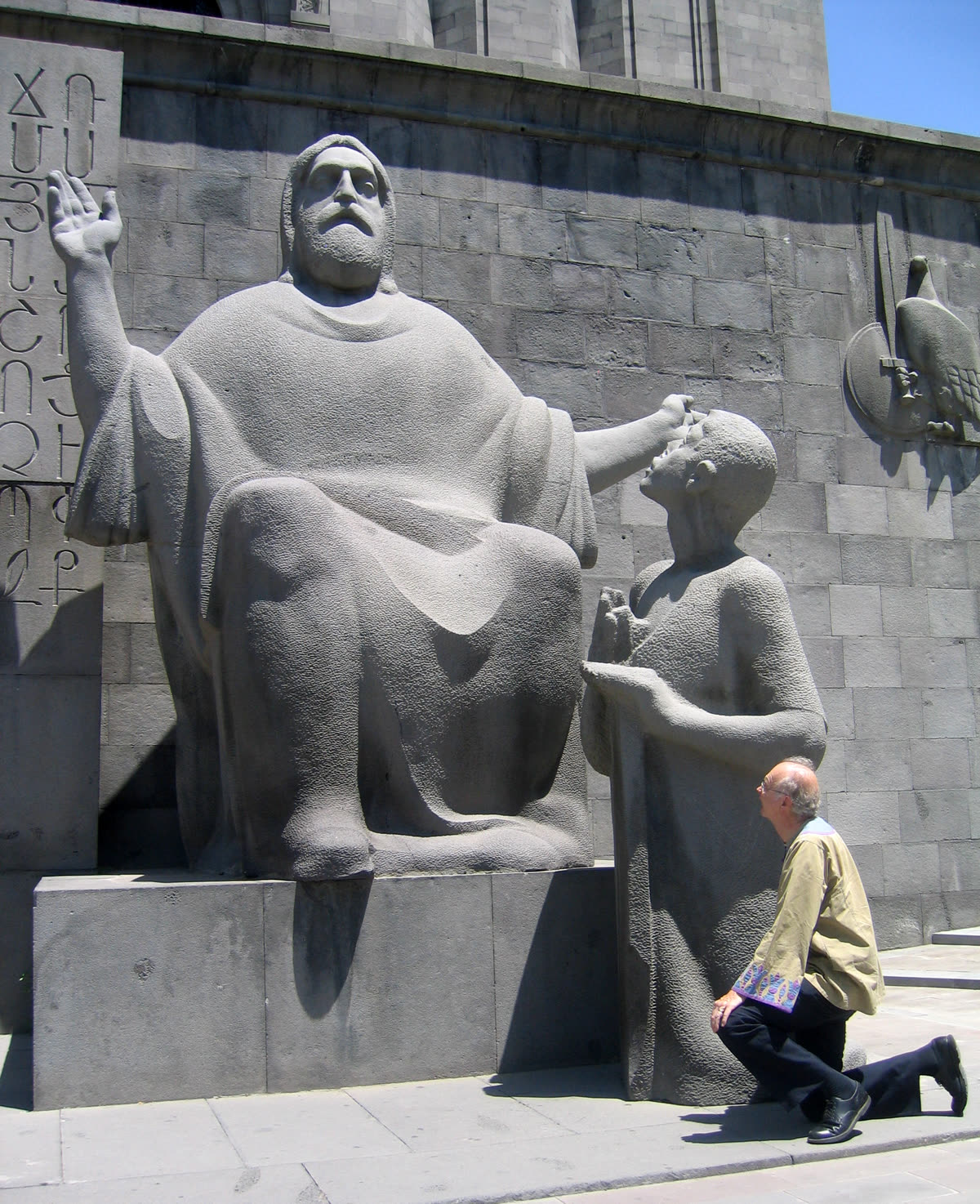
- Wikimedia Commons, "Donald Knuth in front of statue St. Mesrop Mashtots..." - source page for the 2006 photographic image used as this article's cover.