OpenBLAS is easy to miss because it usually disappears under a higher-level import. A Python user calls numpy.linalg, a simulation code links libopenblas, or a package manager pulls in a BLAS provider, and the actual architecture becomes invisible. That invisibility is the point of BLAS as an interface, but it is not the point of OpenBLAS as an implementation. OpenBLAS matters because it keeps the old linear-algebra contract stable while moving the hard work into CPU target selection, kernel dispatch, threading policy, ABI shape, and packaging discipline.[1][2][7]
The clean mental model is this: BLAS gives applications names for vector and matrix operations; OpenBLAS decides how those operations meet the machine. A call such as dgemm should look boring to the application. Underneath, the useful question is which kernel, which vector instructions, which thread pool, which integer width, and which packaging convention are actually in play. If those choices are left accidental, "uses BLAS" becomes too vague to explain performance or failures.
As of this article's creation on 2026-07-06, the current OpenBLAS release channel lists v0.3.33, published on 2026-04-23. The release notes are a good maintenance signal because they mix ordinary test fixes, imported Reference-LAPACK updates, architecture-specific corrections for arm64 and x86_64, WebAssembly work, and build fixes rather than only headline features.[5] The GitHub API snapshot at the same moment reported 7,499 stars, 1,692 forks, 123 open issues, and a most recent push timestamp of 2026-07-06T14:50:48Z.[6] Those numbers do not prove that OpenBLAS is the best provider for every workload. They do show a live compatibility project carrying a lot of downstream responsibility.
The Stable Interface Is The Trick
The BLAS reference site describes the contract in three levels: Level 1 covers scalar, vector, and vector-vector operations; Level 2 covers matrix-vector operations; Level 3 covers matrix-matrix operations. The reason BLAS became so durable is not that these names are glamorous. It is that they are efficient, portable building blocks for higher-level linear-algebra software such as LAPACK.[7]
OpenBLAS inherits that bargain. Its README describes the project as an optimized BLAS library based on GotoBLAS2, with BLAS and LAPACK context linked back to Netlib's reference material.[1] In practical terms, OpenBLAS is useful because it lets a large amount of software keep speaking the same call language while the implementation underneath tracks current hardware.
That separation is exactly why downstream stacks care. NumPy's build documentation says BLAS and LAPACK detection is automatic by default and can search providers such as MKL, Accelerate, OpenBLAS, FlexiBLAS, BLIS, and plain libblas / liblapack, with build options controlling ordering and integer-width choices.[8] The application-level function may not change at all, while the linked provider changes performance, threading behavior, symbol conventions, and failure modes.
So the first OpenBLAS architecture boundary is not a data structure. It is a promise: keep the external interface familiar enough that scientific software can link against it, while making the implementation concrete enough to exploit the processor in front of it.
Dispatch Is Real Architecture
OpenBLAS is not one generic loop wearing a fast-library label. The README's source-build section says a plain make will detect the CPU automatically, while TARGET=... can force a specific CPU target. It also documents DYNAMIC_ARCH=1, which builds support for multiple targets into one library and chooses a target at runtime.[2]
That runtime-dispatch option is easy to underrate. It is the difference between shipping a library that only makes sense for the build machine and shipping one that can run across a fleet. For x86_64, the documented dynamic list includes older and newer Intel and AMD families such as Prescott, Core2, Nehalem, Sandy Bridge, Haswell, Zen, SkylakeX, Cooper Lake, and Sapphire Rapids, with older targets available through another option.[2] The target list shows the same portability pressure across Power, MIPS, ARM, A64FX, ARM SVE, RISC-V vector targets, LoongArch, WebAssembly, and other families.[3]
The important lesson is not the names themselves. It is that the shape of a good BLAS implementation is a dispatch table backed by hand-tuned or architecture-aware kernels. Two machines can receive the same dgemm call and need materially different instruction sequences, cache assumptions, vector widths, and fallback behavior. OpenBLAS earns its keep by making that difference an implementation decision rather than an application rewrite.
This is also where adoption gets practical. If you run homogeneous servers, a target-specific build can be attractive. If you ship wheels, containers, desktop software, or packages across varied machines, a dynamic-architecture build is often the safer baseline. The cost is a larger binary and another layer of runtime choice. The benefit is avoiding accidental illegal-instruction or slow-path surprises when the binary leaves the build host.
Threading Is The Second Scheduler
The second architecture boundary is threading. OpenBLAS can make one BLAS call spread across CPU cores, which is powerful until it collides with an application that is already parallel. The FAQ is blunt about the OpenMP case: if BLAS/LAPACK calls happen inside OpenMP parallel regions, the OpenBLAS build should use USE_OPENMP=1; otherwise deadlocks may occur. It also notes that OpenBLAS restricts itself to a single thread when called from an OpenMP parallel region, and that alternating OpenMP and OpenBLAS thread pools may need idle-thread tuning.[4]
That warning captures a common production failure. Teams benchmark a matrix multiply in isolation, see strong scaling, and then put the same library under a multi-threaded application, a job scheduler, or a Python service that already has its own concurrency. The result can be oversubscription, latency spikes, nondeterministic tail behavior, or a process that looks CPU-rich but throughput-poor.
The fix is not "never use threaded BLAS." The fix is to choose the scheduler boundary explicitly. A batch simulation, a dense linear-algebra workload, or a controlled notebook environment may benefit from OpenBLAS threads. A web service, multiprocessing worker pool, OpenMP-heavy application, or NUMA-sensitive pipeline may need single-threaded OpenBLAS underneath a higher-level scheduler. The key is to decide which layer owns parallelism before performance incidents decide for you.
Packaging Turns Math Into Operations
The least glamorous OpenBLAS work is often the most operationally important. BLAS and LAPACK began as stable interfaces, but modern distributions do not all package those interfaces the same way. Quansight's 2025 packaging analysis points out that OpenBLAS often provides BLAS, CBLAS, LAPACK, and LAPACKE through one library, while Netlib and other implementations may split interfaces differently. It also explains how LP64 and ILP64 integer-width choices, symbol suffixes, and downstream packaging conventions can differ enough to matter at link time and runtime.[9]
NumPy's build options expose the same reality from a consumer's side. It lets builders control provider order, disallow slow internal fallbacks, choose ILP64 mode, and provide pkg-config metadata when the library lives outside standard search paths.[8] SciPy's build docs make the same family of concerns visible around provider selection, pkg-config, Fortran ABI, ILP64 support, and downstream Cython BLAS/LAPACK integer ABI.[9]
An independent distribution view reaches the same practical conclusion from the other side. Gentoo's package page describes BLAS as the computational kernel at the bottom of the food chain in linear-algebra and scientific applications, where an optimized implementation can benefit the whole application.[10] That is an adoption claim, not library trivia. Provider choice belongs in build and operations records because it changes how the rest of the scientific stack behaves under load.
That means "we installed OpenBLAS" is not an operationally complete sentence. A serious build record should capture provider name, OpenBLAS version, target or dynamic-architecture choice, threading model, LP64 versus ILP64, symbol suffix if relevant, compiler family, and how downstream packages discovered the library. Without that record, two environments can have the same Python package versions and still behave differently under heavy linear algebra.
Where OpenBLAS Fits
OpenBLAS is strongest when a team wants an open, inspectable CPU linear-algebra provider that can serve many architectures without binding the whole stack to one vendor runtime. It fits scientific Python wheels, Linux distributions, research clusters, embedded scientific tools, simulation codes, and applications where BLAS compatibility matters more than one proprietary accelerator path.[1][3][8]
It is weaker when the workload is dominated by GPU kernels, when a vendor library is known to be materially better for a tightly controlled CPU fleet, when the team cannot own thread-count policy, or when ABI and packaging details are treated as someone else's problem. In those cases, OpenBLAS may still be the right baseline, but it should not be mistaken for a magic performance switch.
The architecture note is therefore simple. OpenBLAS is not just a dependency name; it is a boundary between portable numerical interfaces and machine-specific execution. Keep that boundary visible: target selection, DYNAMIC_ARCH, thread ownership, ABI width, provider discovery, and release tracking. If those pieces are explicit, OpenBLAS can be dependable infrastructure. If they are accidental, the first serious matrix workload will explain the architecture in the least convenient way.
Sources
- OpenMathLib,
OpenBLASGitHub repository README - project description, GotoBLAS2 lineage, binary package notes, BLAS/LAPACK context, license, and repository metadata. - OpenBLAS README, source installation and
DYNAMIC_ARCHsection - CPU auto-detection,TARGET=..., dynamic architecture builds, and x86_64 / ARMV8 target examples. - OpenBLAS
TargetList.txt- supported CPU target names including x86_64, Power, ARM/A64FX/SVE, RISC-V, LoongArch, and WebAssembly targets. - OpenBLAS FAQ - OpenMP interaction,
USE_OPENMP=1guidance, single-thread restriction inside OpenMP regions, and thread-pool handoff notes. - OpenBLAS GitHub releases - release chronology and v0.3.33 notes covering Reference-LAPACK updates, architecture-specific fixes, and build changes.
- GitHub API snapshot for
OpenMathLib/OpenBLAS- stars, forks, open issues, and recent push activity at article creation time. - Netlib, "BLAS (Basic Linear Algebra Subprograms)" - Level 1, Level 2, and Level 3 BLAS definition and the role of BLAS as portable linear-algebra building blocks.
- NumPy documentation, "BLAS and LAPACK" - provider detection order, OpenBLAS selection,
blas-order,lapack-order,allow-noblas, ILP64, andpkg-configdiscovery. - SciPy documentation, "BLAS and LAPACK" - provider selection,
pkg-config, Fortran ABI, ILP64 support, and downstream Cython BLAS/LAPACK integer ABI notes. - Gentoo Packages,
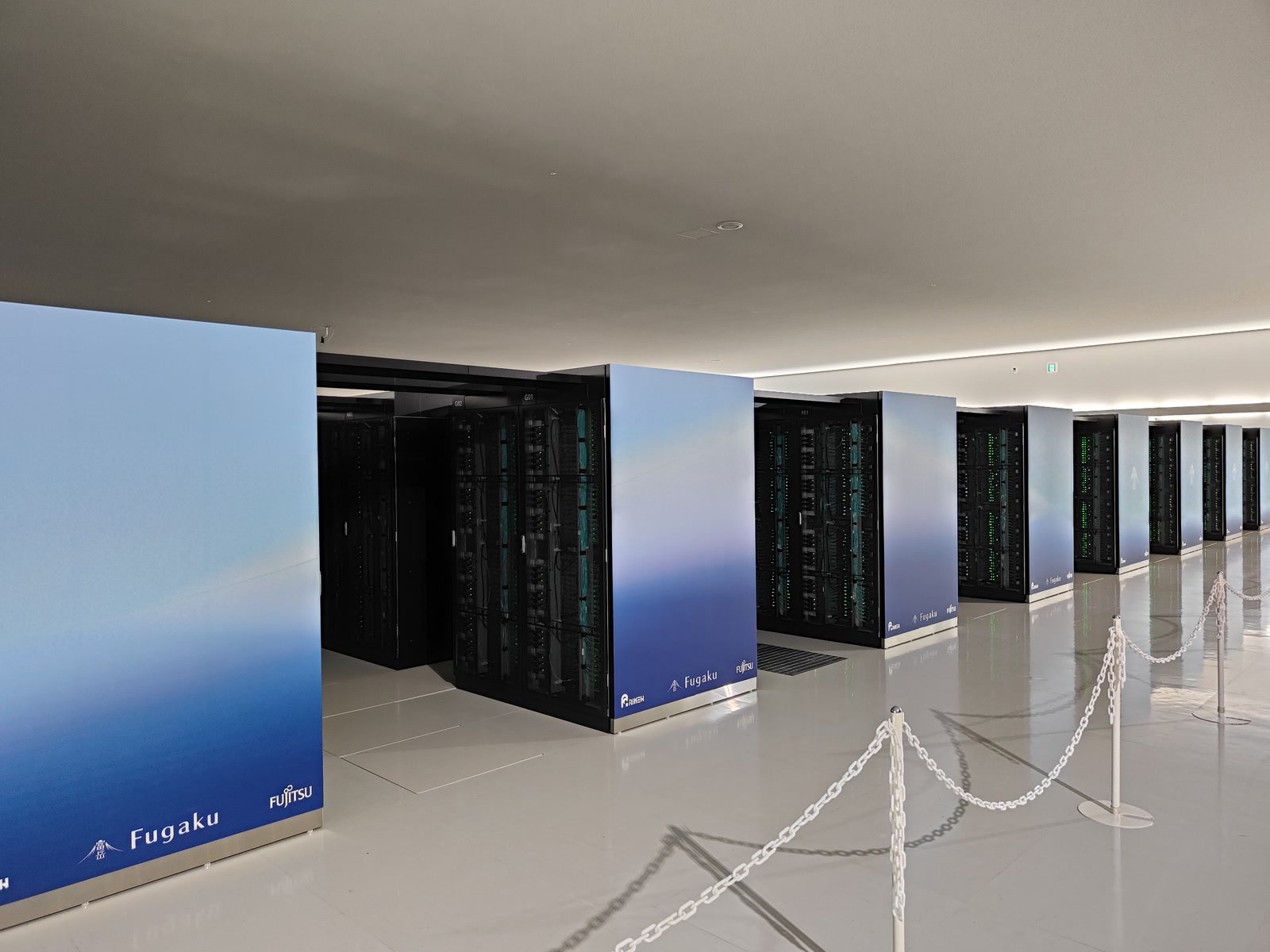
sci-libs/openblas- independent distribution package page describing OpenBLAS, GotoBLAS lineage, and the role of optimized BLAS in scientific applications. - Wikimedia Commons, "File:RIKEN R-CCS Fugaku.jpg" - source page for the real 2024 photograph of Fugaku used as this article's cover image.