A night of astrophotography ends with a peculiar kind of abundance: dozens of exposures of the same object, each too faint or uneven to look like the photograph the observer had in mind. Siril, the open-source astronomical image processor, gives that repetition a structure. Its processing chain corrects the camera's contribution, aligns the sky across frames, and combines the measurements.[1] Following those operations explains why a successful stack depends on more than collecting enough files.
The distinction that matters most is easy to miss: calibration removes unwanted patterns; stacking reduces random variation. They solve different problems, and substituting one for the other leaves defects in the result.[3][7] This account follows the project's stable documentation, labeled Siril 1.4.4 when consulted on October 23, 2026.
The unit of work is a sequence
Siril organizes related frames into a sequence. Numbered FITS files can form one sequence; a FITS sequence can also hold the frames in a single container. A neighboring .seq file records information including frame selection, statistics, and registration transformations. It is active processing state, which the documentation warns against editing by hand.[2]
This organization lets the photographer inspect an individual exposure without losing its relationship to the rest. Excluding a frame leaves its data intact; subsequent operations must be instructed to process only included images. A reference frame supplies the target for alignment and normalization.[2]
That is a useful design choice when a night contains both good exposures and a few spoiled ones. Selection becomes a recorded decision that can be revisited. The original observation need not disappear merely because it should contribute nothing to this particular photograph.
Correct the detector before moving the sky
Calibration uses master frames assembled from calibration exposures. A bias represents the electronic offset. A dark records the sensor's signal with light excluded and should match the light exposures' duration and ISO or gain, at approximately the same temperature. A flat measures uneven illumination and pixel response, including vignetting and dust shadows; the light frame is divided by the calibrated flat.[3]
These operations are bookkeeping for the detector. They do not identify a nebula or decide where a star belongs. Their usefulness depends on the calibration data representing the conditions under which the photographs were made.
The bookkeeping must also avoid charging the same offset twice. Siril's manual tutorial keeps the bias inside its master dark, so subtracting that dark removes both contributions from the lights. It separately corrects the flats for bias.[4] A recipe copied without knowing how its masters were prepared can therefore perform the wrong arithmetic even when every filename looks plausible.
Crucially, a master dark estimates a repeatable signal; it cannot predict the random fluctuation in an individual exposure. Calibration itself introduces uncertainty from its reference measurements. Siril explicitly warns that calibration does not reduce image noise, which is why the quality of the masters matters.[3][7]
Alignment has a calculation and a material cost
The calibrated frames still describe the sky at slightly different positions. Registration makes corresponding features meet. Siril distinguishes detecting features, calculating transformations relative to the reference, and applying those transformations to produce aligned images. Its global registration matches star patterns through triangles, then uses RANSAC to reject mismatches while estimating the transformation.[5]
The separation between calculating and applying a transformation has consequences on disk. For integer-pixel shifts, stacking can use the stored offsets while reading the frames. More complex transformations generally require exporting registered images first, commonly with an r_ prefix. A sequence containing alignment information is therefore not always a sequence whose pixels have already been moved.[5]
An illustrative 24-million-pixel RGB frame with three 32-bit channels contains 288 MB of pixel data before headers or compression. One hundred contain 28.8 GB. This calculation describes an uncompressed representation; additional saved processing stages add their own storage demand.[2]
Registration can bring a shifted star back to the right location. It cannot make an exposure taken through a passing cloud equivalent to a clear one. Frame inspection remains part of the work.
Decide which measurements belong together
Siril's average stacking with rejection calculates a mean after excluding outlying pixel values. Normalization first brings image levels into a comparable relationship with the reference. Without that step, a change in background brightness could confuse the interpretation of an unusually high or low sample.[6]
A satellite trail may contribute an unusually bright value in one exposure where others record the underlying sky. Rejecting that outlier preserves useful measurements elsewhere in the same exposure. Siril can save rejection maps showing where samples were discarded; its documentation illustrates a removed satellite trail.[6]
A localized interruption and an exposure spoiled throughout need different treatment. That is my reading of the separate controls for excluding whole frames and rejecting individual pixels.[2][6]
More frames help, but the return diminishes. Under the usual assumptions of comparable exposures and independent random noise, signal-to-noise ratio improves with the square root of the number combined: sixteen frames offer roughly four times the ratio of one; sixty-four offer roughly eight times. Doubling that improvement requires four times as many frames.[6][7] A repeatable calibration error does not obey this bargain simply because the stack grows.
The script preserves the order, not the judgment
Siril can automate the chain. Its established preprocessing tutorial organizes inputs into lights, darks, flats, and biases, with intermediate products in process. It emphasizes selecting the correct working directory and allowing several times the input volume in free disk space.[8] Those folder names give automation a concrete expectation about what it will receive.
The convenience does not make the workflow self-explanatory. In an independent hands-on review of version 1.2.6, Jacob Little reported repeatedly consulting the documentation while learning Siril.[9] That older review describes the learning experience rather than establishing the behavior of the current release.
Even a completed stack can initially look almost black in linear display. The project's tutorial separates changing the display to inspect it from the later processing needed for a finished photograph.[8] A disappointing first appearance is therefore not, by itself, proof that integration failed.
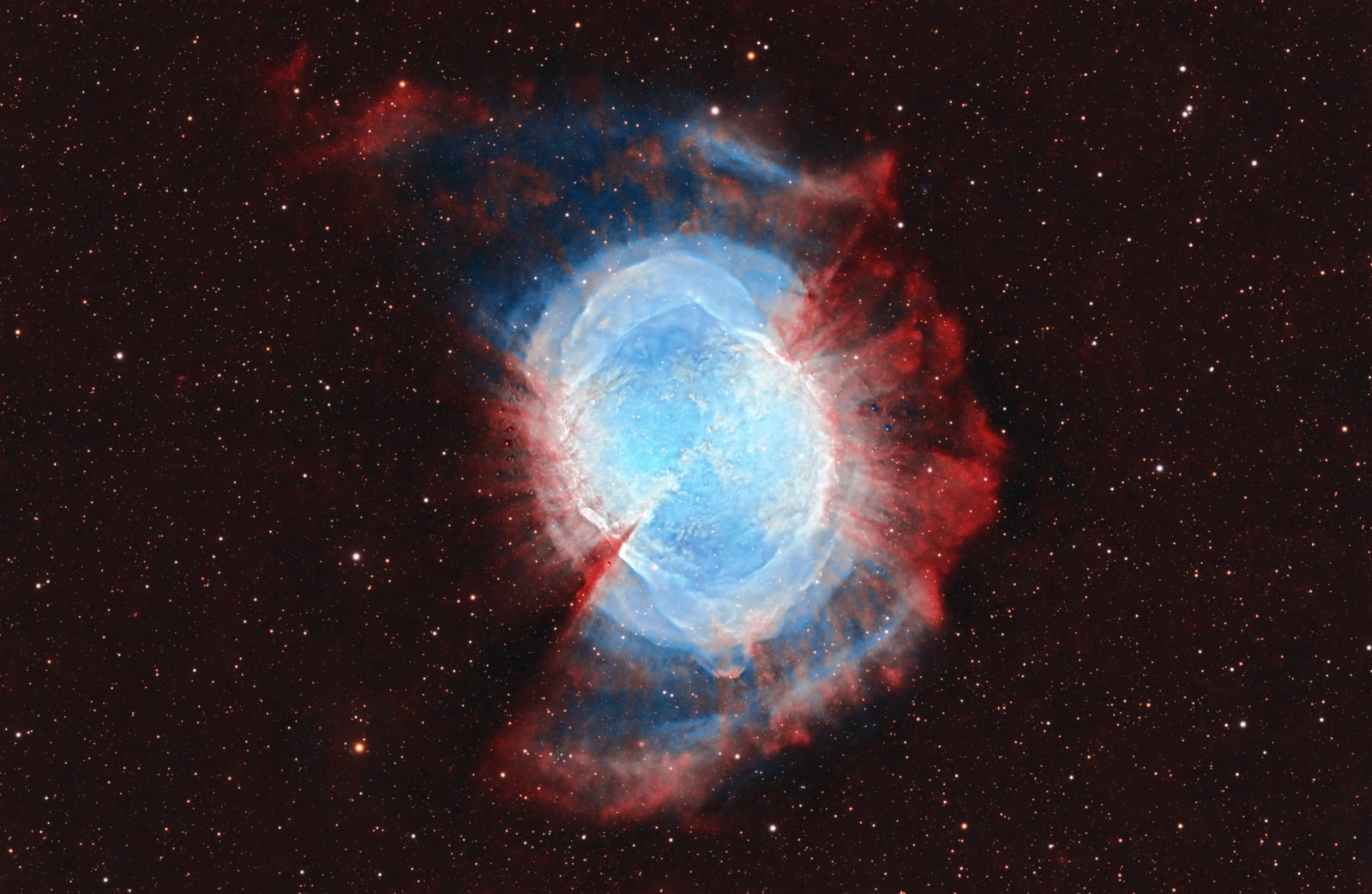
The rewarding part of this architecture is that it leaves specific questions to ask. Were the correct masters applied? Which sequence was registered? Were the transformed frames exported? What did rejection discard? The nebula emerges through those decisions, and the files between stages make the decisions inspectable.
Sources
- Siril, official project website — astronomical processing stages, automation, source availability, and stable release information.
- Siril 1.4.4 documentation, "Sequences" — FITS representations, frame selection, reference images, and
.seqprocessing state. - Siril 1.4.4 documentation, "Calibration" — bias, dark, and flat masters; acquisition matching; uncertainty introduced by calibration.
- Dominique Dhoosche, "Manual pre-processing," Siril — the tutorial's treatment of bias within dark masters and the order of operations.
- Siril 1.4.4 documentation, "Registration" — feature matching, transformations, and the distinction between stored shifts and exported registered images.
- Siril 1.4.4 documentation, "Stacking" — normalization, average stacking, pixel rejection, rejection maps, and signal-to-noise scaling.
- Rafa Barbera, "Signal to noise ratio," Siril — random variation, the limits of dark subtraction, and diminishing returns from additional exposures.
- Colmic, "Full image processing (pre-processed with scripts)," Siril — established folder workflow, intermediate storage, and inspecting a linear stack; tutorial originated with version 0.99.8.1.
- Jacob Little, "Siril astrophotography software review," Space.com, March 16, 2026 — independent hands-on experience with version 1.2.6 and its learning demands.
- Siril gallery, Olivier Moulard, "M27 – Dumbbell Nebula" — photograph, photographer credit, and filter-by-filter acquisition times.