ROS 2 is easiest to misunderstand when it is introduced as "the Robot Operating System." That name is useful history, but it can make the architecture sound like a single runtime sitting underneath a robot. The better mental model is a distributed graph: many nodes, often from different packages and languages, exchange typed messages over topics, services, actions, and parameters while a middleware layer handles discovery and transport.[1][3]
That graph model is why ROS 2 matters as open-source infrastructure. A real robot is not one program. It is a camera driver, lidar pipeline, localization stack, planner, controller, simulator bridge, diagnostics node, logging path, safety monitor, and operator interface all negotiating time, packet loss, process boundaries, and hardware churn. ROS 2's architectural bet is that those pieces should meet through explicit graph contracts rather than through one giant application process.
The current maintenance signal is active. As of 2026-06-27T03:33:20Z UTC, the ros2/ros2 GitHub API reported 5,684 stars, 919 forks, 150 open issues, rolling as the default branch, and a latest push timestamp of 2026-06-23T20:21:04Z.[9] The release feed listed recent binary releases including ROS Lyrical Luth on 2026-06-23 and ROS 2 Jazzy Jalisco on 2026-06-18.[8] The release schedule explains the larger cadence: ROS 2 releases annually, with even-year LTS releases such as Lyrical targeted for roughly five years of support and odd-year non-LTS releases targeted for about 1.5 years.[7] For teams building robots, that cadence is not trivia. It is the clock that decides when platform support, distro migration, and dependency testing become real engineering work.
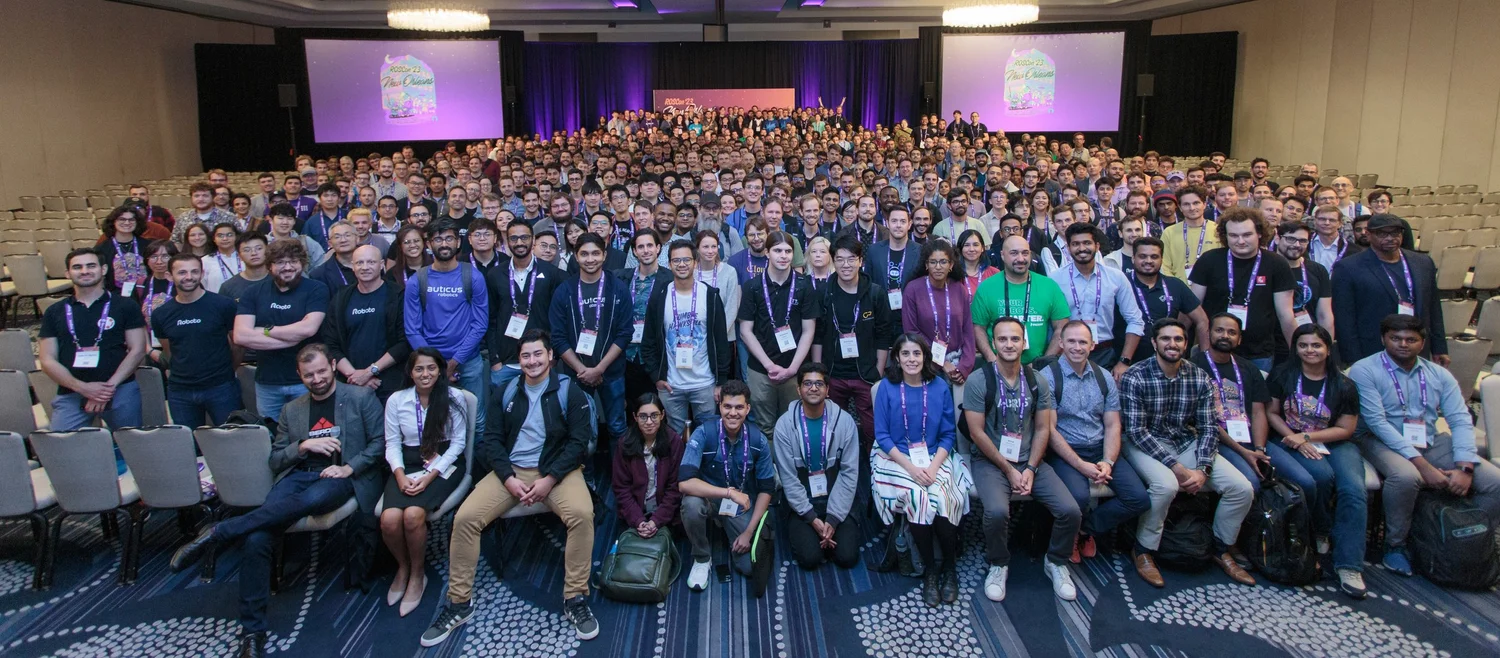
Image context: the ROSCon photo is deliberately a human conference image rather than a logo, graph diagram, or generated robot scene. ROS 2's architecture is technical, but its durability comes from many organizations agreeing to maintain one shared surface for robots that otherwise would be built from private glue code.[7][10]
Nodes Make The Robot Visible
The smallest useful unit in ROS 2 is the node. The documentation defines a node as a participant in the ROS 2 graph, usually doing one logical thing, and notes that nodes may communicate within the same process, across processes, or across machines.[3] A node can publish and subscribe to topics, expose or call services, provide or consume long-running actions, and carry parameters for runtime configuration.[3]
That sounds like ordinary distributed-systems vocabulary until the robot context is added. A camera node that publishes images at 30 frames per second, a perception node that consumes those images, and a controller that needs fresh pose estimates are not interchangeable microservices. They have different timing and failure requirements. Some data should be best effort because stale frames are worse than dropped frames. Some commands should be reliable because losing them can change physical behavior. Some callbacks may run in parallel; others must not.
The graph is valuable because it makes those relationships inspectable. If every subsystem is hidden inside one application, failure analysis turns into process archaeology. In ROS 2, a team can ask more precise questions: which node owns this sensor stream, which topic carries it, which service changes the mode, which action owns a long motion, which parameter mutates runtime behavior, and which discovery domain should be isolated from the test robot in the next room? The architecture does not remove complexity. It gives the complexity names.
DDS Removed The Master, But Added A Contract
ROS 1 had a central master. ROS 2 was designed around DDS and RTPS as a middleware foundation, with distributed discovery replacing that central coordination point.[1] The original ROS-on-DDS design note is candid about the trade. DDS brings an existing standard, publish-subscribe transport, message serialization, distributed discovery, and rich Quality of Service controls; it also brings complexity and a culture different from the older ROS community.[1]
This was a consequential choice. The design goal was not to expose DDS directly to every robotics developer. The design note says the goal was to make DDS an implementation detail below a ROS-like API, preserving familiar node, publisher, subscriber, and message concepts while letting advanced users reach deeper when needed.[1] The middleware-interface design sharpens that boundary: ROS client libraries should operate on ROS data structures, while the middleware layer converts to the implementation-specific representation underneath.[2]
For adopters, the boundary matters more than the acronym. If a robot only works when every developer knows the DDS vendor's configuration model, the abstraction has leaked too far. If the team ignores middleware behavior entirely, it will be surprised by discovery behavior, QoS incompatibility, multicast constraints, or cross-vendor differences. The right posture is in the middle: write normal ROS 2 nodes, but treat the middleware as an explicit deployment decision.
That is why the rmw layer is strategically important. The documentation lists supported implementations including Fast DDS as the default and packaged RMW, Cyclone DDS, Connext DDS, GurumDDS, and Zenoh, with Zenoh packaged starting with Kilted Kaiju.[5] It also warns that cross-vendor DDS communication is not guaranteed in all cases and suggests keeping a distributed system on the same ROS version and same RMW implementation when reliability matters.[5] The useful engineering rule is simple: middleware choice is not an afterthought when the robot crosses process, host, or network boundaries.
QoS Is Where Robot Semantics Become Transport Semantics
Quality of Service is the part of ROS 2 that most clearly separates a robotics graph from generic message passing. The QoS docs list policies such as history, depth, reliability, durability, deadline, lifespan, liveliness, and lease duration.[4] They also state the key compatibility rule: publishers offer a QoS profile, subscriptions request one, and a connection is made only when the requested profile is compatible with what the publisher offers.[4]
This is not just configuration surface. It is where a team's assumptions about physical time become transport semantics. A lidar scan may be useful only if it is fresh. A map update may tolerate delay but not loss. A service request should usually avoid transient-local durability because replaying an old request after a server restart can cause side effects.[4] The built-in sensor-data profile favors timely samples over complete delivery; default publisher/subscription QoS uses reliable delivery, volatile durability, and a queue depth of 10.[4]
The danger is that QoS failures can look like application bugs. A publisher and subscriber may both exist. The names may match. The types may match. Yet the nodes may not communicate because the QoS request-offer pair is incompatible.[4] This is a good failure mode only if the team knows to look for it. ROS 2 gives the robot graph stronger vocabulary than ROS 1, but it also requires teams to encode intent rather than assuming TCP-like delivery everywhere.
In practice, this means mature ROS 2 deployments should review QoS the way web teams review API contracts. Sensor topics, command topics, lifecycle events, diagnostics, latched-style state, and safety-relevant messages should not inherit defaults by accident. The default may be fine for a tutorial. A robot in a warehouse, field, hospital, or lab with lossy Wi-Fi needs every important edge in the graph to state what kind of loss, delay, staleness, and liveliness it can tolerate.
Executors Decide When Work Actually Runs
After discovery and transport, the next boundary is scheduling inside the process. ROS 2 executors invoke callbacks for subscriptions, timers, service servers, action servers, and other events.[6] The documentation describes rclcpp::spin(node) as expanding into a single-threaded executor in the simplest C++ case, while also documenting multi-threaded executors and newer event-oriented executor work.[6]
The executor page contains one of the most important low-level differences from ROS 1: to avoid counteracting middleware QoS, an incoming message is not stored in a client-library queue, but kept in the middleware until a callback takes it for processing.[6] That detail changes how overload should be understood. A slow perception callback is not just "slow code." It can affect when messages are taken, whether timers fire on time, and whether callback groups permit useful parallelism.
Callback groups make that boundary explicit. ROS 2 supports mutually exclusive callback groups, whose callbacks must not run in parallel, and reentrant callback groups, whose callbacks may run in parallel.[6] A multi-threaded executor can only create useful parallelism if the callback grouping permits it.[6] That means scheduler design belongs in application architecture, not only in performance tuning. A navigation stack that mixes blocking service calls, high-rate sensor callbacks, and control timers in one accidental scheduling lane can sabotage itself without any middleware failure.
The newer EventsCBGExecutor described in the rolling docs points in the same direction. It uses an event queue rather than polling wait sets and is documented as available from Lyrical Luth onward, with a warning that an overloaded process can accumulate an unbounded number of ready events in the queue.[6] That is an honest architecture signal: better executor mechanics can reduce overhead, but they do not repeal overload physics. A robot still needs bounded callback work, measured latency, and failure behavior when the processor falls behind.
Where ROS 2 Fits
ROS 2 is strongest when a robot system needs modularity across hardware, teams, simulation, and deployment environments. It gives developers a shared language for nodes, topics, services, actions, parameters, QoS, middleware selection, and callback scheduling. It is especially valuable when the alternative is a private integration layer that only one lab understands.
It is weaker when teams treat it as magic glue. A ROS 2 graph can become a distributed tangle if topic ownership, QoS policy, RMW choice, executor configuration, and release targets are left implicit. The framework gives enough rope because real robots need that rope: best-effort sensors, reliable commands, intra-process composition, cross-machine discovery, lifecycle control, and multiple middleware implementations are all legitimate requirements in different systems.[3][4][5][6]
The right adoption pattern is therefore architectural, not decorative. Start with the graph: name the nodes, identify the high-rate streams, choose where services and actions fit, decide which messages can be lost, pin the RMW implementation for the fleet, and write down executor assumptions for latency-sensitive processes. Then use the release cadence to plan platform upgrades rather than discovering them during a field deployment.[5][7][8]
ROS 2 earns its place when it makes a robot easier to reason about under stress. The point is not that every node talks. The point is that, when a robot stops behaving, the team can inspect the graph, the QoS edge, the middleware lane, and the executor path instead of guessing which hidden callback or private socket swallowed reality.
Sources
- William Woodall, "ROS on DDS," ROS 2 design documentation - DDS rationale, distributed discovery, QoS flexibility, ROS API boundary, and middleware tradeoffs.
- Dirk Thomas, "ROS 2 middleware interface,"
ros2/design- RMW abstraction, ROS data structures, DDS adapters, and middleware-agnostic client-library boundary. - ROS 2 documentation source, "Nodes" - node definition, graph participation, communication scopes, topics, services, actions, parameters, and distributed discovery.
- ROS 2 documentation source, "Quality of Service settings" - QoS policies, predefined profiles, request/offered compatibility, and sensor-data/default behavior.
- ROS 2 documentation source, "Different ROS 2 middleware vendors" - DDS/RTPS foundation,
rmwimplementations, default Fast DDS, Cyclone DDS, Connext, GurumDDS, Zenoh, and cross-vendor cautions. - ROS 2 documentation source, "Executors" - callback execution, single-threaded and multi-threaded executors, wait sets, callback groups, EventsCBGExecutor, and overload caveat.
- ROS 2 documentation source, "Release Schedule" - annual release cadence, LTS/non-LTS pattern, platform support rationale, and support durations.
- GitHub REST API,
repos/ros2/ros2/releases?per_page=5- recent ROS 2 release feed sampled at article creation. - GitHub REST API,
repos/ros2/ros2- repository activity snapshot sampled at article creation for stars, forks, open issues, default branch, and latest push timestamp. - Open Robotics, "ROSCon 2023 Recap" - source page for the real ROSCon 2023 group photograph used as the article image.