The architecture of QMK is easiest to see when a key press goes wrong. A single tap may appear twice, a three-key chord may invent a fourth key, a custom key may vanish, or the host may print a character that is nowhere on the cap. Those symptoms look similar at the screen. Inside the keyboard, they belong to different stages.
QMK does not begin with letters. It begins with voltages sampled from a switch matrix. From there it debounces raw samples, uses the resulting coordinate to resolve a keycode from the active layer of a compiled keymap, and offers that record to a chain of features and user hooks. A layer command or a consumed custom action may produce no keyboard report; a macro may produce several. For a host-visible basic key, the last device-side step is a USB report whose usage the host interprets.[1][2][6]
That staged path is the important thing about QMK. Programmability is the visible benefit; separable responsibilities are what make the same firmware practical across compact, split, ortholinear, and conventionally staggered boards. They also give a builder a better question than “Why did QMK miss my key?”: At which boundary did the event stop matching reality?
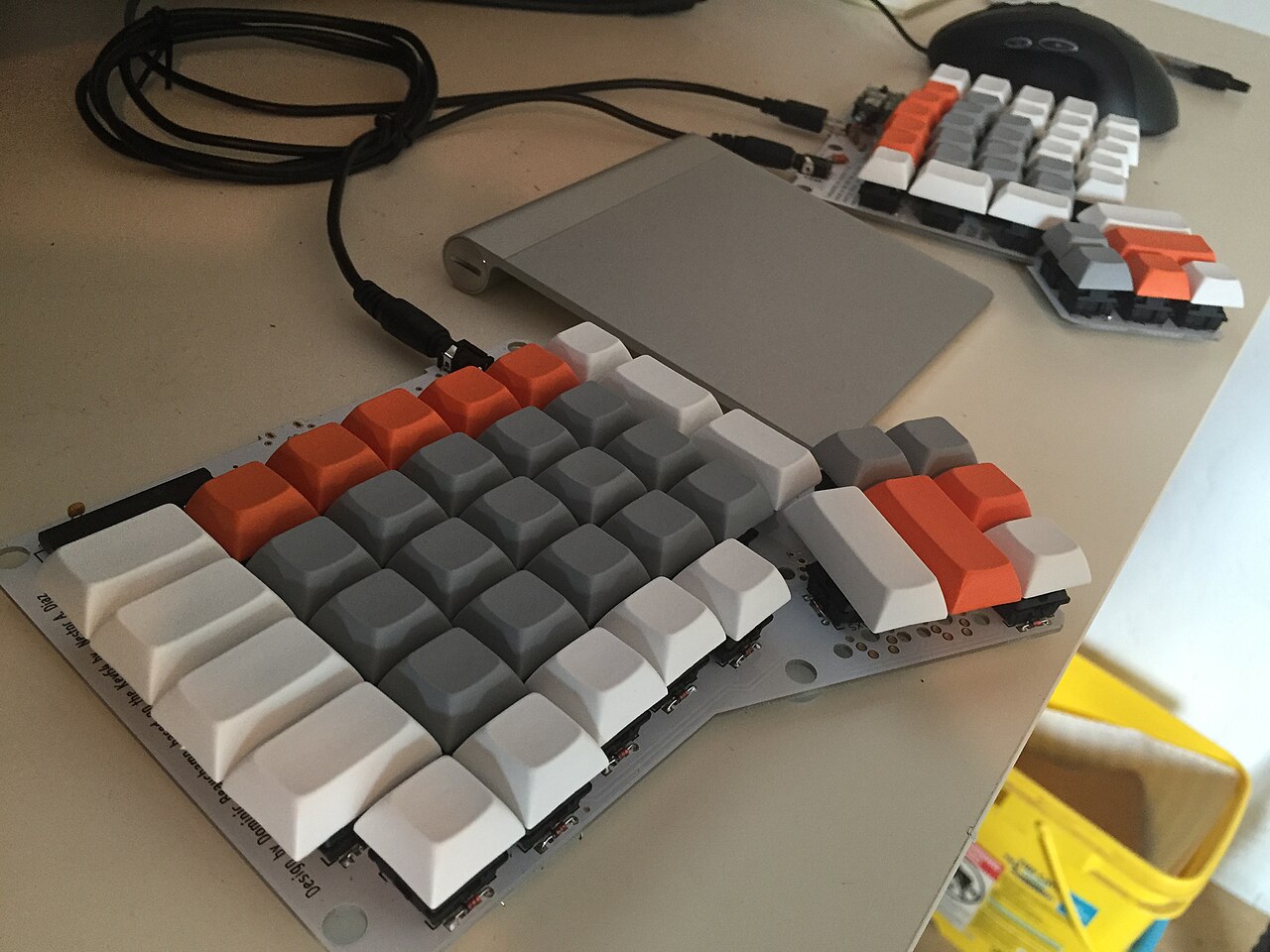
The cover photograph shows an uncased ErgoDox in 2014, its two circuit boards exposed around a trackpad. The blank caps have physical positions but no printed meanings. That is almost a literal view of QMK's model: hardware geometry exists first; behavior is assigned later.[3][8]
A key begins as a coordinate
A mechanical switch does not announce “A.” It connects one electrical line to another. Keyboard designers arrange switches in rows and columns so the controller can inspect many positions without dedicating a separate input pin to every key. During a conventional scan, firmware drives one side of the matrix in sequence and reads the other side. The result is a set of row-and-column positions that are open or closed at that moment.[2]
This economy creates its first failure boundary. With several switches held, current can find an unintended path through a plain matrix and make an unpressed position appear closed. That is ghosting. A diode at each switch constrains current direction so the scan can distinguish the intended chord. Firmware can react to the state it receives, but it cannot reconstruct a physical truth that ambiguous wiring has already erased.[2]
QMK makes the electrical contract explicit in a board's configuration. In info.json, fields such as matrix_pins.rows, matrix_pins.cols, and diode_direction describe how the controller reaches the switches. A board can instead declare direct pins or opt into custom matrix code, but those are different hardware contracts rather than alternate keymaps. The same file can identify the processor, bootloader, firmware output format, supported features, and the geometry that tools such as QMK Configurator display.[4]
That division matters during a port. If a row is silent, two positions are swapped, or a chord creates a phantom key, the first evidence should be the raw matrix and its wiring description. Changing KC_A to KC_B merely paints a different label on the same bad coordinate.
Debounce decides when a change is real
Even correct wiring does not produce a perfect edge. Mechanical contacts can chatter as they meet or separate, so successive scans may briefly alternate between open and closed. QMK applies debouncing after each raw matrix scan to decide when a sampled change is stable enough to expose to the rest of the firmware.[3]
The policy is configurable because responsiveness, noise rejection, memory, and matrix shape pull in different directions. QMK's documented default debounce interval is five milliseconds, and DEBOUNCE_TYPE selects the algorithm. A deferred algorithm waits for a quiet interval before reporting a change; an eager algorithm reports immediately and then suppresses further changes for the interval. State can be tracked globally, per row, or per key. Global state is cheaper, while finer state can keep activity on one part of the matrix from delaying an unrelated key at the cost of more RAM and processing.[3][4]
This is not just a “latency setting.” An eager key-down can feel fast but accept an early noisy edge. A deferred change can reject noise but necessarily waits for evidence. A global timer can be efficient yet couple otherwise unrelated switches. QMK's documentation even calls out the rotated matrix used by ErgoDox models when explaining why a per-row method can fit one geometry better than another.[3]
The useful diagnostic distinction is between an unstable sample and an incorrect meaning. If the raw position flickers, the keymap has not yet had a chance to be wrong. If the debounced position changes exactly once but the wrong action follows, adding milliseconds will only hide the real layer or processing error.
Physical layout and keymap are separate maps
The separation between physical arrangement and electrical coordinates is established when the firmware is compiled. A LAYOUT() macro translates the keyboard's human-facing list of positions into a row-and-column keymap initializer. This is necessary because a wide key may occupy one switch while covering more than one visual unit, a curved or split board may be wired in an order that does not resemble a rectangle, and some matrix positions may have no switch at all. QMK fills absent positions with KC_NO so keymap authors do not have to write their behavior directly in wiring order.[1]
At runtime, the debounced matrix coordinate indexes that compiled structure. Its C representation is organized by layer, row, and column; a position on the base layer might resolve to KC_A, while the same position on another active layer might become an arrow, a modifier, or a layer command. This is a clean seam: the board definition and LAYOUT() macro establish where a switch is stored, while the active keymap explains what that position should do now.[1][4]
QMK's community-layout mechanism can let one source-level keymap be reused unchanged when two boards implement the same LAYOUT_<name> contract. Two boards may look alike on a desk and expose different layouts; two boards with different electrical routing may still expose the same one. Board-specific code can still limit portability, so the shared contract creates a reuse path rather than a guarantee based on appearance or key count.[9]
The processing chain can transform—or consume—the event
QMK compares the current debounced matrix with the previous one and dispatches changes as press and release records. Those records enter process_record_quantum(), where enabled features can interpret them before ordinary key handling completes. The compiled chain can include behaviors such as combos, tap dance, Caps Word, key overrides, dynamic macros, and user-defined keycodes; unused features are normally removed by build-time configuration.[1]
The chain also exposes deliberate extension points. Keyboard-level code can implement process_record_kb(), and a keymap can implement process_record_user(). Returning true allows later processing to continue. Returning false stops it. That makes consumption possible—a custom key can perform its own action without also emitting the underlying keycode—but it means one careless return can make every downstream behavior appear broken.[1][5]
QMK provides hooks at other phases, including initialization, every matrix scan, and end-of-loop housekeeping. Their timing is part of the architecture. matrix_scan_user() runs as often as the controller can scan; housekeeping runs after the last scan's layer updates, USB reports, LEDs, and displays have been handled. QMK's guidance is to do as little as possible in these hot paths or throttle non-urgent work. Even a slow display update or an accidental busy loop can turn a logically correct key path into perceptible input lag.[5]
The safest customization therefore starts at the latest seam that can express the behavior. A board port belongs in hardware configuration and matrix code. A remap belongs in the keymap. A special event belongs in process_record_user(). Periodic non-urgent work often belongs in housekeeping. Forking the scanner to implement a macro does not add power; it moves ordinary behavior into the most timing-sensitive part of the system.
USB carries usages, not finished text
When processing yields a host-visible basic key action, QMK updates the keyboard report sent to the host. The crucial boundary is that a keyboard does not normally send the character painted on a keycap. It sends identifiers defined by the USB Human Interface Device convention. QMK calls one familiar basic keycode KC_A, but its documented numeric value is 0x04; the host stack—including the active keyboard layout and modifier, lock, and application state—determines whether that usage becomes text or participates in a shortcut.[6]
That is why firmware remapping and operating-system layout are complementary rather than interchangeable. QMK can decide which usage a physical position reports and can emit sequences for macros. It cannot make an arbitrary Unicode character a universal property of one HID usage. QMK's Unicode features instead invoke host-specific input methods, which brings operating-system and application compatibility back into the contract.[6]
The portability is still real. In an independent review of System76's QMK-based Launch keyboard, Ars Technica found that an onboard profile followed the keyboard to another computer without the configuration app. That demonstrates what firmware ownership buys: position-to-behavior choices can live with the device. It does not move the host's text layout, input method, or application shortcuts into the keyboard.[7]
Read failures from the earliest broken boundary
The pipeline gives each common failure a different shape. Phantom positions in particular chords point toward matrix topology or missing diodes. Repeated edges from one otherwise correct coordinate point toward the switch, electrical noise, scan timing, or debounce policy. A stable coordinate that produces the wrong action only on one layer points toward the layout and keymap state.
If standard keycodes work but a custom action disappears, the processing chain deserves attention: an earlier feature or hook may have consumed the record, or custom code may have stopped normal handling without replacing it. A key or modifier that remains active after release suggests a different mistake—code registered the press without a matching release path. If the expected usage reaches the host but the wrong glyph appears, the firmware has probably completed its job; the host stack owns the final interpretation. If every action becomes sluggish only after adding display or animation code, scan and housekeeping hooks are a better suspect than USB.[1][3][5][6]
This order avoids compensating at the wrong layer. Increasing debounce cannot repair ghosting. Reordering a keymap cannot repair a swapped row pin. Sending a macro cannot make an OS-independent Unicode key. And replacing the matrix scanner is a poor cure for work that blocks the main loop after scanning has already succeeded.
QMK's deepest design choice is not that every switch must emit one USB report. It is that a host-visible action is assembled from evidence behind explicit seams. The matrix says which circuit closed. Debounce says whether the change is credible. The board definition and compile-time layout establish where that coordinate enters the keymap. The active layer and processing chain decide the behavior—and whether anything leaves the device. When it does, USB reports a usage and the host supplies the final interpretation. A programmable keyboard remains understandable when those answers stay separate.
Sources
- QMK Firmware, “Understanding QMK's Code” — main loop, matrix-state comparison,
LAYOUT()mapping, keymap structure, and theprocess_recordchain. - QMK Firmware, “How a Keyboard Matrix Works” — row-and-column scanning, multi-key ghosting, and the role of per-switch diodes.
- QMK Firmware, “Contact bounce / contact chatter” — debounce timing, eager and deferred behavior, global/per-row/per-key state, supported algorithms, and the ErgoDox example.
- QMK Firmware, “
info.jsonReference” — processor and bootloader metadata, matrix pins, diode direction, direct/custom matrices, debounce configuration, and layout data. - QMK Firmware, “How to Customize Your Keyboard's Behavior” — keyboard and user hooks, processing return values, scan-loop cautions, and housekeeping timing.
- QMK Firmware, “How Keys Are Registered, and Interpreted by Computers” — the USB HID boundary, basic usage values, host layouts, and limits of firmware-level character entry.
- Scharon Harding, “System76 Launch review: Linux-friendly keyboard with a USB hub,” Ars Technica, March 8, 2022 — independent testing of QMK-based remapping and an onboard profile carried between computers.
- Ryan Forsythe, “Ergodox” (September 22, 2014), via Wikimedia Commons — provenance and license record for the archival hardware photograph used as the cover.
- QMK Firmware, “Layouts: Using a Keymap with Multiple Keyboards” — shared layout contracts, keyboard-agnostic keymaps, and limits introduced by board-specific code.