The openSUSE Board makes an unusually useful admission: it does not manage project releases or infrastructure. In a February 2026 interview, board members described their work as external contact, conflict resolution, legal and trademark handling, community moderation, communication with SUSE, and guidance—not approval of the next Tumbleweed snapshot.[1]
That is not an empty space where governance should be. It is the clue to where openSUSE’s technical authority actually lives. A package change enters a public integration chain, acquires a wider blast radius, is rebuilt in the Open Build Service, and meets automated operating-system tests before release engineers decide whether an integrated state is fit to publish. The strongest governance signal is not a title at the top. It is the series of people and machines able to say “not yet,” with evidence attached.[2][3][4]
This distinction matters beyond one Linux distribution. Many open-source projects publish an organization chart but leave the release boundary implicit: a maintainer merges, a bot signs, and users infer that the result was governed. openSUSE exposes more of the path. Its elected board is an escalation surface; its Factory machinery is the technical decision surface. Confusing the two makes both look weaker than they are.
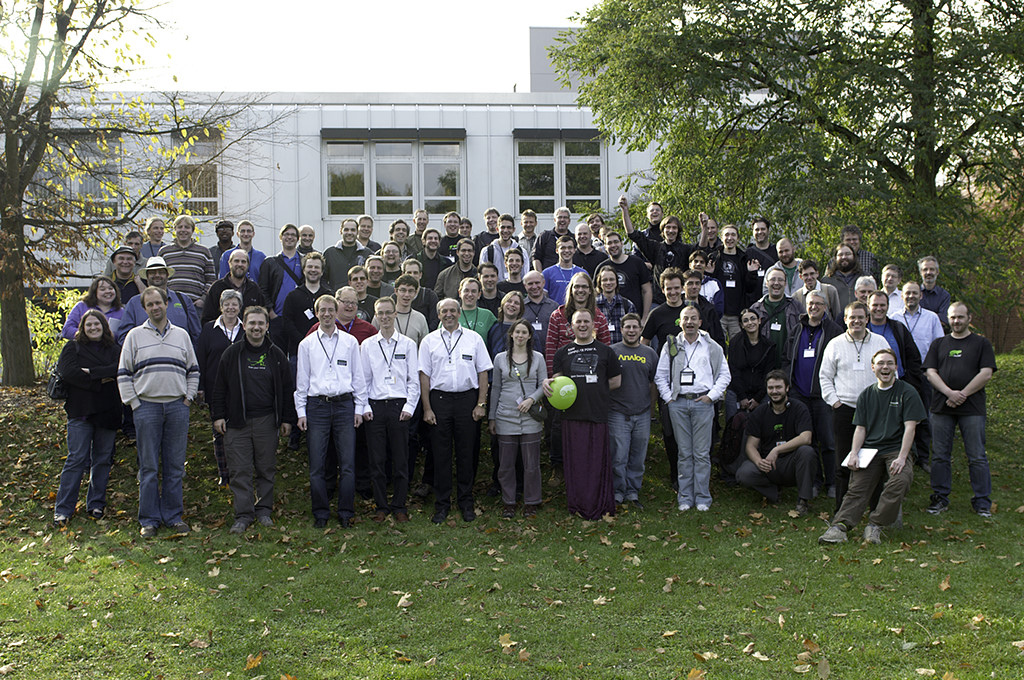
Image context: the cover is the official group photograph from the openSUSE Conference 2010. It belongs here because distribution governance is embodied work. The people who maintain packages, review integration, write tests, investigate failures, and operate release infrastructure collectively make the boundary that no single portrait could show.[7]
The board is an escalation plane, not a release control plane
The board’s narrowness is deliberate. In the 2026 interview, Jeff Mahoney said the board was not involved in releases or infrastructure; Rachel Schrader described it as a subset of the wider community rather than a gate through which every constructive act must pass. Their examples were non-routine problems: moderation decisions, conflicts with long histories, legal questions, trademarks, external relationships, and communication with the project’s principal corporate sponsor.[1]
That boundary protects technical work from organizational ceremony. A package maintainer does not need a board resolution to repair a build. A release engineer does not need elected officers to interpret a failed test. Conversely, a test dashboard should not adjudicate a conduct dispute or represent the community to an outside institution. The board and release system govern different failure classes.
There is a visible risk on the social side. The same interview notes that recent board elections had attracted few volunteers. A limited board can still be appropriately scoped, but a persistent shortage would reduce the project’s capacity to resolve conflicts and carry institutional memory. The health signal is therefore not “the board controls the distribution.” It is whether enough trusted people are willing to staff the duties that package tests cannot perform.[1]
Package authority starts close to the code
The current Factory repository makes the technical chain concrete. It defines Factory—also identified there as the Tumbleweed distribution—as an assembly of package sources. Each source is represented by a Git submodule that records its origin, branch, and exact commit. The _manifest file defines the package-source structure, while _config carries build configuration. A change is therefore not merely “the newest package”; it is a named source state placed into a named distribution state.[2]
The most revealing file is workflow.config. The repository documentation says the workflow bot opens a corresponding Factory pull request when a pull request targets the factory branch of a package repository used by the distribution. That handoff preserves two kinds of review. Package-level discussion stays beside the source, while distribution-level integration becomes visible in the umbrella Factory repository.[2]
This is a governance improvement only if the records remain meaningful. A bot-created pull request can show provenance and still receive superficial review. A maintainer field can exist while nobody has time to respond. But the structure gives reviewers precise questions to ask: Which source commit is proposed? Who owns the package? What else rebuilds? Which integration tests ran? Which person accepted the remaining risk? Those are better questions than “does the project have a board?” because they meet the software at the point where users inherit it.
The test budget grows with the blast radius
Every Factory pull request receives a predictable staging project in the Open Build Service. The documented form is openSUSE:Factory:PullRequest:N, where N is the pull-request number. By default, that project builds the packages whose sources changed. Release managers can request broader QA projects when a change reaches farther.[3]
The available templates express different integration budgets. MinimalX rebuilds changed packages and their dependents within a reduced graphical system. MinimalX-Full rebuilds the whole MinimalX selection, which is useful when a validation component such as rpmlint-mini changes. The Factory template rebuilds changed packages and their dependents across the entire distribution. A fixed :Base project can hold binary inputs still while those broader builds run.[2][3]
That progression is more than CI plumbing. It makes blast-radius judgment inspectable. Updating a leaf application and changing a package that validates thousands of other packages should not consume identical review or compute. The release manager’s job includes choosing how much of the system must be rebuilt to make a decision credible. Too little testing hides coupling; rebuilding everything for every edit makes the queue so expensive that contributors route around it. Governance lives in that tradeoff.
The boundary is also honest about what a successful build proves. It demonstrates that selected source states can be assembled under the project’s build configuration. It does not prove that every runtime path works, every physical device behaves, or every third-party repository remains compatible. Those claims belong to the next gate—and even that gate has limits.
openQA supplies evidence, not an oracle
openQA models a test execution as a job: a test suite, machine definition, architecture, and product combination runs through a sequence of test modules. Jobs can finish successfully, fail, become incomplete because the execution environment broke, or be cloned when a result needs to be reproduced. Visual checks use reference regions called “needles,” while the job record preserves settings and results for inspection.[5]
This turns a distribution image into observable behavior. Can it install? Can it boot? Does a desktop appear in the expected state? Do upgrade and application scenarios reach their checkpoints? When openSUSE reorganized Factory as a rolling release in 2014, the project described openQA both inside staging and again against integrated Factory media; Factory maintainers still made the publication decision from the resulting evidence.[4]
The human decision is essential. LWN’s independent account of openQA identified the boundary early: virtualized tests cannot cover the full diversity of physical drivers, changing interfaces can make visual references return an unknown result, and finite scenarios cannot exhaust even simple input spaces.[6] The current documentation is more capable and more detailed than the 2011 system LWN examined, but its job model remains explicit about scope: results belong to particular settings, machines, test code, and needles.[5]
A green openQA result therefore means “the declared scenarios passed in their declared environments.” It does not mean “Tumbleweed contains no defects.” It says even less about software installed from an external repository that never entered Factory. Treating green as omniscience would weaken governance by erasing the very boundaries the test record makes visible.
How to read the signal as an adopter
For an individual workstation, the official Tumbleweed publication boundary may be enough upstream diligence. The sensible local addition is modest: update when there is time to recover, retain a known-working system state, and report a regression with the snapshot and hardware identified. A small engineering team should add a canary on its actual GPU, storage, VPN, and authentication path, because those are exactly the environments a generic virtual test matrix cannot fully represent.[5][6]
A fleet operator needs a stronger contract. Mirror or pin the approved repository state, promote it through representative machines, keep a rollback route, and distinguish Factory packages from external repositories. The operational team should know who can pause promotion when its canary contradicts upstream’s test result. This is not a vote of no confidence in openQA; it is the same layered logic applied one boundary downstream.
The upstream warning signs are equally concrete. Watch for pull requests that repeatedly wait on one reviewer, QA labels understood by only one release engineer, stale needles that are habitually waved through, public failures with no named owner, or a board election that cannot attract enough candidates. None alone proves collapse. Together they would show formal surfaces outliving the people needed to exercise judgment through them.[1][3][5]
openSUSE’s design is valuable because it refuses to make one institution pretend to be all of governance. The board can handle conflicts and external responsibility without choosing packages. Maintainers can own code without unilaterally publishing a distribution. OBS can expose dependency fallout without deciding what risk users should accept. openQA can produce repeatable evidence without claiming universal coverage. Release engineers can make the final call without hiding the path that informed it.
The result is not governance by automation. It is governance with stops. A healthy project keeps those stops staffed, legible, and difficult to bypass.
Sources
- Luboš Kocman, “openSUSE Board on Participation, Governance and Community,” openSUSE News, February 12, 2026 — board scope, release and infrastructure boundaries, community duties, and volunteer capacity.
- openSUSE Factory,
README.md— current package-submodule model,_manifest, build configuration, workflow bot, and available QA build templates. - openSUSE Factory,
STAGING.md— predictable OBS pull-request projects, fixed base projects, release-manager controls, and broader QA rebuild scopes. - Ancor Gonzalez Sosa, “Factory moves to Rolling Release Development Model,” openSUSE News, July 29, 2014 — staging projects, pre- and post-integration openQA testing, and the human publication decision.
- openQA Project, “openQA Documentation” — architecture, jobs, settings, machine and architecture combinations, test modules, needles, cloning, and result states.
- Joe “Zonker” Brockmeier, “openSUSE introduces openQA,” LWN.net, October 12, 2011 — independent technical account of whole-system testing and its hardware, interface, and input-space limits.
- Jos Poortvliet, “openSUSE Conference big success,” openSUSE News, October 28, 2010 — event report and provenance page for the archival conference group photograph used as the article image.