OpenZFS gets easier to reason about once you stop entering through snapshots, clones, or general "data integrity" folklore. Those features matter, but they are downstream of a stricter contract. The real architectural decision sits lower: how disks are grouped into vdevs, where redundancy lives, and how the system verifies and repairs blocks when media starts to drift.[1][2][3][4]
As of 2026-04-08T03:06:45Z UTC, the upstream openzfs/zfs repository reports 12,102 stars, 1,978 forks, 1,682 open issues, and a most recent push at 2026-04-08T00:17:41Z.[6] The release lane is still active, with zfs-2.4.1 and zfs-2.3.6 both published on 2026-02-25.[7] That matters because OpenZFS is not a frozen legacy filesystem. It is a live storage stack whose recent improvements, including wider topology flexibility around RAIDZ, still sit on top of the same foundational pool math.[7][8]
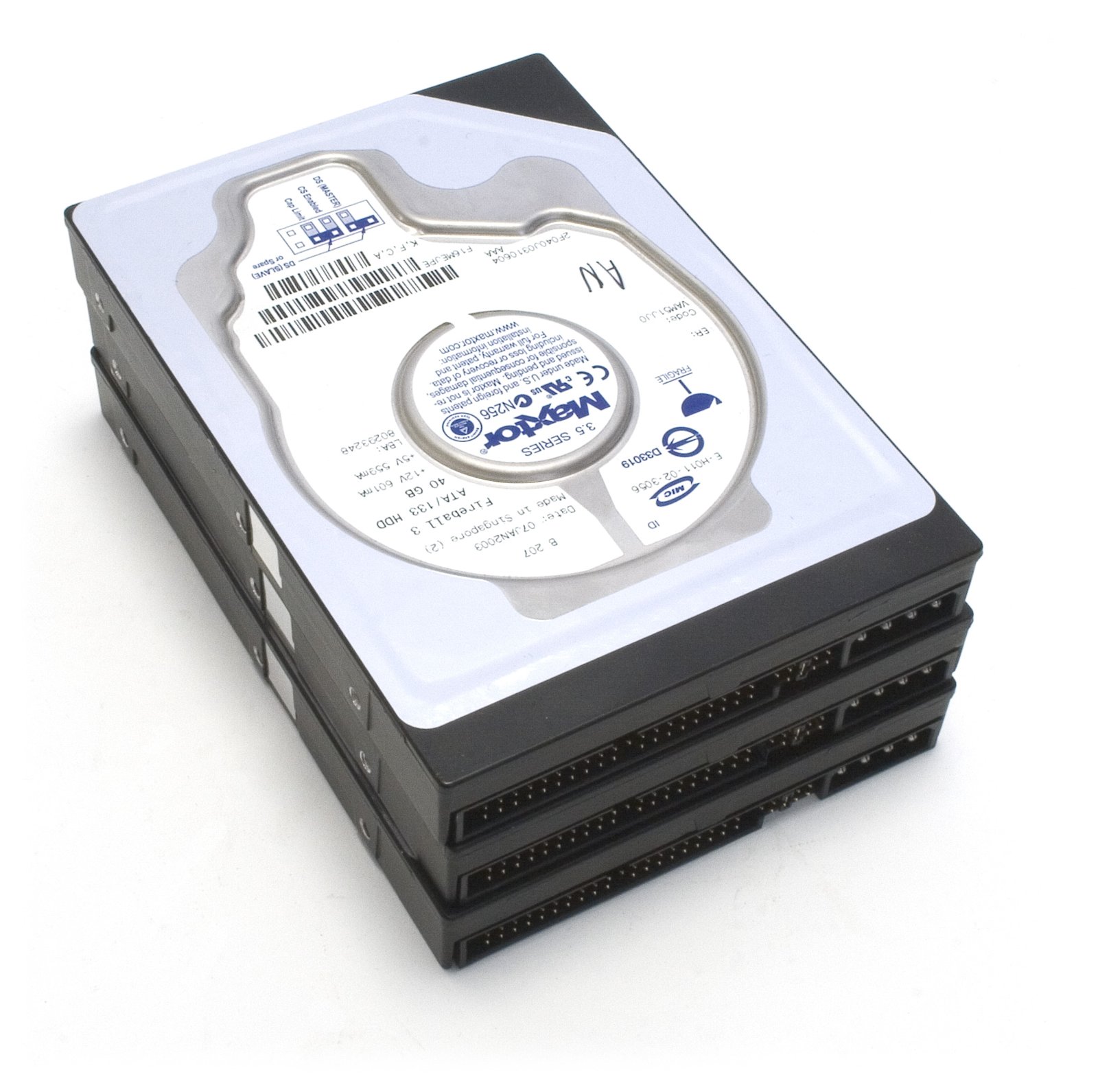
Image context: the cover uses a real photograph of stacked hard drives rather than a dashboard screenshot. That choice fits because OpenZFS makes its strongest promises at the device layer first. Long before an operator thinks about datasets or snapshots, the pool layout has already determined how capacity, parity, and repair will behave.[9]
The pool shape is the product
The OpenZFS docs are explicit that data is dynamically distributed across top-level vdevs, also called root vdevs.[1][4] That one sentence carries most of the architectural weight. A pool feels like one storage space, but redundancy is not created at the pool level in the abstract. It is created inside the top-level vdevs you choose to build.[1][4]
That is why the mirror-versus-RAIDZ decision is not a cosmetic tuning preference. A mirror replicates identical data across its member disks; the zpoolconcepts manual says a mirror with N disks of size X can hold X bytes and survive N-1 member failures.[4] RAIDZ, by contrast, is a distributed-parity layout analogous to RAID-5 or RAID-6, but with parity spread across the stripe and with protection against the classic write-hole inconsistency after power loss.[2][4] Those are different recovery contracts, different space-efficiency profiles, and different small-write behaviors.
The RAIDZ performance note makes the tradeoff concrete. In the worst case, a RAIDZ vdev's write IOPS collapses toward the slowest disk in the group because all stripe parts have to complete their write path together.[2] Mirrors spend more raw capacity, but they buy a different latency and rebuild profile. OpenZFS does not hide that trade. It makes you encode the trade into the pool.
This is the first reason the product feels opinionated. Operators coming from hardware RAID or appliance UIs often expect redundancy to be a setting they can adjust later without changing the storage logic underneath. OpenZFS asks for a more structural decision: pick the top-level layout early, because later datasets inherit the consequences.[1][2][4]
Checksums turn redundancy into repair
The second architectural move is what makes the first one worth so much trouble. OpenZFS documents end-to-end checksums as a key differentiator, and the checksums page says they do three things that matter immediately: detect corruption on read, automatically repair damaged blocks when redundant copies or parity are available, and let periodic scrubs find latent media damage before an application trips over it.[3]
That point is easy to flatten into marketing language, but it changes how redundancy should be understood. Extra copies or parity by themselves only give you alternate places where data might still be correct. Checksums tell OpenZFS which copy is wrong. The filesystem, the block pointer metadata, and the pool layout work as one chain.[3] This is why OpenZFS's redundancy story feels different from a simple "filesystem on top of RAID" mental model. Verification and correction are designed together.
The documentation is also blunt about operator temptation here. The checksums page says disabling checksums is an extraordinarily bad idea.[3] That warning is more than a best practice. It is a statement about product identity. OpenZFS is built around the assumption that every block write records enough truth to verify the block later. Remove that, and the rest of the integrity model starts shedding meaning.
Scrub and resilver expose the real recovery budget
This is where storage design stops sounding elegant and starts sounding operational. The zpool-scrub manual defines a scrub as a full examination of pool data to verify checksums and repair damage when replicated devices exist; it contrasts scrub with resilvering, which only examines data OpenZFS knows is out of date, such as after a replacement or attach event.[5] The same page also notes that only one scrub or resilver can run at a time because both are I/O-intensive.[5]
That distinction is the practical reason vdev topology matters so much. A pool built from mirrors has one replacement rhythm. A pool built from wide RAIDZ groups has another. In both cases zpool status can report progress and results, but the amount of data that has to be read, rewritten, and verified during a degraded period is a direct consequence of the earlier layout decision.[4][5]
This is also the right place to read the current flexibility story soberly. The FreeBSD Foundation's OpenZFS 2.3 write-up highlights RAID-Z expansion as a major operator-facing improvement because it lets teams add disks to an existing RAIDZ vdev without the old all-at-once replacement pattern.[8] That is a meaningful change. It lowers one of the classic entry costs of RAIDZ planning.
It does not, however, erase the architectural hierarchy above it. Expansion makes one existing parity layout wider; it does not make root-vdev math disappear, and it does not turn all topologies into equivalent choices. Mirrors, RAIDZ, dRAID, cache devices, and special allocation classes still live in different places in the pool model and solve different problems.[4][8]
The 2026 boundary: more flexible, still not improvisational
The most useful way to frame OpenZFS in 2026 is not as a universal storage answer and not as an old-school filesystem made fashionable by home-lab culture. It is a storage system that rewards operators who are willing to treat topology as design work rather than as cleanup after deployment.[1][2][3][4]
That makes OpenZFS especially strong when teams can answer a few questions early and honestly:
- where should redundancy live: mirrors, RAIDZ, or another top-level layout?[1][2][4]
- what rebuild and scrub budget can the hardware tolerate when the pool is degraded?[5]
- how much capacity efficiency is worth giving up for a different small-write and recovery profile?[2][4]
- which devices belong in data vdevs, and which belong in narrower roles such as cache or special allocation classes?[4]
Teams that will do that design work get a storage stack whose integrity model is unusually coherent. Teams that mainly want to improvise parity later, mix arbitrary disks and roles under pressure, or treat storage expansion as a reversible UI toggle will keep running into the same lesson: OpenZFS offers a lot of flexibility, but it does not suspend the consequences of pool geometry.[1][4][8]
That is why the most durable way to understand OpenZFS is to start below the filesystem. Datasets, snapshots, replication, compression, and all the higher-level conveniences are real advantages. They just rest on a lower contract that does the actual heavy lifting: top-level vdev choice sets the failure domain, checksums decide what truth looks like, and scrub or resilver decides how repair spends time.[2][3][5] Once that structure is clear, the rest of the platform stops looking mystical and starts looking like engineering.
Sources
- OpenZFS documentation, "VDEVs" - root vdev hierarchy, top-level data distribution, and the main redundancy-bearing device types.
- OpenZFS documentation, "RAIDZ" - distributed parity, write-hole avoidance, space-efficiency tradeoffs, and worst-case write-IOPS behavior.
- OpenZFS documentation, "Checksums and Their Use in ZFS" - end-to-end checksums, automatic repair, scrub value, and the warning against disabling checksums.
- OpenZFS manual page,
zpoolconcepts.7- mirror and RAIDZ durability properties, root-vdev distribution, dRAID, cache devices, and special allocation classes. - OpenZFS manual page,
zpool-scrub.8- scrub versus resilver behavior, automatic repair on redundant devices, and one-at-a-time recovery operations. - GitHub API snapshot for
openzfs/zfs- stars, forks, open issues, default branch, and most recent push timestamp used in the article. - GitHub releases for
openzfs/zfs- current stable release tags and publication timestamps, includingzfs-2.4.1andzfs-2.3.6. - FreeBSD Foundation, "OpenZFS RAID-Z Expansion: A New Era in Storage Flexibility" - independent operator-facing context for why RAIDZ expansion matters without changing the underlying pool model.
- Wikimedia Commons file page for the hard-drive photograph used as the article image.