OpenWrt is easiest to describe as open-source router firmware. That description is accurate, but it undersells why the project is still useful in 2026. The interesting part is not that OpenWrt replaces a vendor web panel. The interesting part is that it turns a constrained network appliance into a small Linux distribution with a deliberately narrow control surface: text-backed configuration, reloadable network state, supervised services, generated firewall rules, and an upgrade path that respects the difference between firmware image and local state.[1][2][3][4][5][6]
That architecture matters because routers fail in ways that ordinary servers do not. They sit between households, offices, labs, and the internet. They often have little flash, little RAM, awkward switch chips, radios with regulatory constraints, and users who cannot afford a broken default route after a routine change. OpenWrt's design is therefore less about adding a fashionable orchestration layer and more about keeping each moving part legible enough that a small device can be configured, recovered, and upgraded without becoming opaque.
As of the 24.10 stable series, that distribution framing is explicit. The 24.10.6 service release describes OpenWrt as a Linux operating system for embedded devices and points users to firmware images by device target, while the 24.10.0 first stable release says the series incorporated more than 5,400 commits since 23.05, moved the kernel baseline to 6.6, supported more than 1,970 devices at launch, and still used OPKG for 24.10 even though main branch work had moved toward APK.[1][2] Those details are not trivia. They show the real OpenWrt constraint: every architecture decision has to survive hardware variety, storage limits, upgrade compatibility, and the daily reality of people running network edges from small boxes.
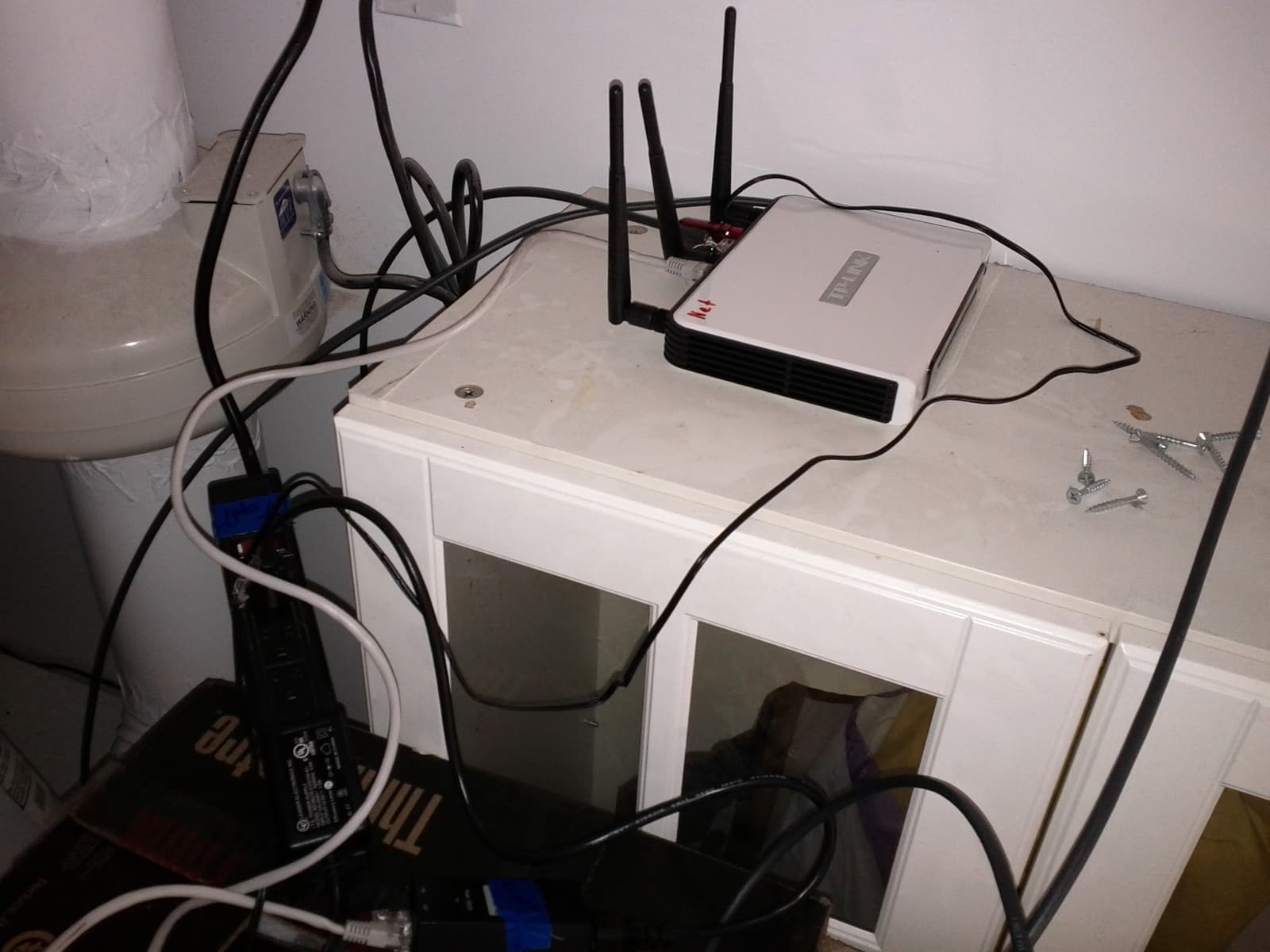
Image context: the cover uses a real Wikimedia Commons photograph of a TP-Link router running OpenWrt in 2012. It is not a diagram or logo because the point of this piece is operational: OpenWrt's abstractions only matter when they make an actual router easier to own, repair, reconfigure, and recover.[9]
UCI is the contract layer that keeps configuration from scattering
The first OpenWrt idea worth understanding is UCI, the Unified Configuration Interface. The technical reference describes UCI as a small C utility and library intended to centralize the configuration of a device running OpenWrt, succeeding the older NVRAM-style configuration used in the historical White Russian branch.[3] UCI files live under /etc/config/, and the same source can be changed with a text editor, the uci command, programming APIs, or LuCI.[3]
That sounds mundane until you compare it with the usual embedded-router alternative. Vendor firmware often hides state inside a web UI, a private database, and a set of scripts that only make sense to the vendor. OpenWrt instead gives packages a common place to express device state. Network interfaces, wireless settings, DHCP, firewall zones, and many package defaults can share a configuration shape without pretending that every service is the same kind of daemon.
The staging behavior is the key engineering detail. UCI stages set, add, rename, and delete operations under /tmp/.uci, then writes them to flash with uci commit; reload_config can reload the necessary configurations based on the last commit.[3] This is a small-device answer to a real failure mode. Flash writes are not treated as casual scratchpad updates, and scripts or UI flows can prepare a change before committing it. LuCI adds its own apply and confirm flow, which matters because a remote firewall or network change can cut off the operator who made it.[3]
My inference from that design is that OpenWrt's control surface starts with a bias toward reversible intent.[3] A router admin should be able to describe desired state, stage it, apply it, and recover from mistakes without learning five different vendor storage models. UCI is not a universal schema language. It is narrower and more practical: a common editing and persistence layer that keeps a router's configuration from dissolving into unrelated files and one-off scripts.
netifd makes network state reloadable instead of script-shaped
The second architectural piece is netifd, the Network Interface Daemon. OpenWrt's technical reference says netifd is an RPC-capable C daemon with better access to kernel APIs and netlink events, and that it replaced older network configuration scripts such as /lib/network/*.sh, /sbin/ifup, and some hotplug scripts.[4] It is meant to stay compatible with the existing /etc/config/network format while taking over the harder job of tracking runtime network state.[4]
This is where OpenWrt stops being "Linux plus shell glue" and starts looking like a specialized router OS. Network changes are rarely isolated. A VLAN change can affect bridges, firewall zones, DHCP service, Wi-Fi interfaces, PPPoE sessions, and route state. Old scripts can apply a sequence of commands, but they struggle to understand whether the live system already matches the new configuration.
The netifd reference calls out that problem directly. When /etc/config/network changes, an operator can run /etc/init.d/network reload; that reload issues a ubus call to netifd, which compares runtime state with the new configuration and applies only the needed differences on a per-interface basis.[4] The same section says the old script mechanism suffered from lack of statefulness, race conditions, weak protocol nesting, and shell limits, while netifd can manage complex combinations of bonding, VLANs, bridges, and dependencies without unnecessary bloat.[4]
That is the right boundary for a router. The configuration file should remain simple enough to inspect, but the runtime authority needs to be stateful enough to avoid tearing the network down just to apply a local change. netifd is OpenWrt admitting that a network edge has dependency graphs, not just startup scripts.
procd treats services as instances with observable state
OpenWrt's process supervision follows the same pattern. The procd init-script guide says a procd script defines current configuration for service instances and specifies when and how to reconfigure them. Services are described through start_service(), with commands, parameters, observed files or devices, respawn settings, logging, user/group choices, pidfiles, and other instance settings passed through helpers such as procd_set_param().[5]
The important phrase is "service instance state." The guide explains that procd stores the state generated by the init script; on a relevant system change, start_service() runs again, and if it generates different state than the previous one, procd detects the difference and restarts the service.[5] Triggers live in service_triggers() and can connect configuration or system events to reload behavior.[5]
This is not systemd transplanted onto a router. It is a smaller local answer to the same operational question: what is supposed to be running, what inputs should cause it to change, and what should the supervisor do when it exits or its watched configuration changes? On a constrained router, that discipline matters more than feature breadth. DNS, DHCP, Wi-Fi helpers, VPN daemons, telemetry agents, and user-installed packages should not all invent their own lifecycle story.
The procd model also explains why OpenWrt packages feel more integrated than random binaries copied onto /usr/bin. A good package can connect UCI configuration, init scripts, triggers, reload behavior, and logging into the same router-native lifecycle. A bad package can still be awkward, but the platform gives it a place to become well-behaved.
firewall4 hides nftables complexity without hiding policy
Firewalling is the place where OpenWrt's "simple surface, complex compiled result" pattern is clearest. The firewall overview says OpenWrt uses firewall4, or fw4, with Linux netfilter nftables. fw4 runs in user space, parses configuration, and sends nftables rules to kernel netfilter modules.[6] The same overview notes that a typical router can have more than 100 rules to support routing, NAT, packet mangling, loopback behavior, zones, and special targets.[6]
That is exactly why the abstraction exists. A small router needs a firewall policy that a human can reason about: zones, forwarding, masquerading, input/output defaults, port forwards, and exceptions. The kernel needs much more exact rule machinery. OpenWrt's firewall layer lets the operator work at the policy level while still exposing inspection paths such as fw4 print when the generated rules matter.[6]
The danger with any generated firewall is false comfort. A concise UCI firewall file can still produce many kernel rules, and a package that adds chains or sets can make the final behavior harder to audit. The right way to use OpenWrt is therefore to treat firewall4 as a compiler boundary, not as magic. Read the policy in /etc/config/firewall, inspect the generated output when debugging, and remember that network reachability comes from the compiled rule set, not from the friendliness of the UI.
Upgrade discipline is part of the architecture, not an afterthought
OpenWrt's release notes show the other half of the operating model: firmware images and local configuration are related but not identical. The 24.10.6 release notes say upgrades from 23.05 to 24.10 are supported in many cases through sysupgrade, which attempts to preserve configuration, while still advising a backup. They also state that sysupgrade from 22.03 to 24.10 is not officially supported and call out device-specific migration exceptions such as DSA changes or partition layout changes.[1]
Those caveats are the architecture speaking plainly. OpenWrt serves a hardware catalog, not one appliance. Some devices can preserve configuration across a release boundary. Some need a factory install. Some have target migrations that make old state dangerous. A mature router OS has to put that boundary in front of the operator instead of promising an abstract "update" button that works everywhere.
The OpenWrt One announcement sharpens the same point from the hardware side. Software Freedom Conservancy described the device as the first wireless router designed and built with software freedom and right to repair in mind, with source code available from the start, a US$89 complete-router price at launch, MediaTek MT7981B and MT7976C hardware, 1 GiB DDR4 RAM, split SPI NAND/NOR flash, 2.5 GbE plus 1 GbE ports, USB-C power, and an unbrickable design that can separately flash NOR and NAND.[7] TechCrunch's coverage framed it similarly as a router designed from the ground up for OpenWrt with right-to-repair goals.[8]
That device is not necessary for OpenWrt to matter. The project already runs across a broad device catalog.[1][2] But OpenWrt One makes the architecture visible in hardware: recovery paths, source availability, flash layout, serial access, and software freedom are not separate from the operating system story. They are the physical substrate that makes operator control credible.[7][8]
Where OpenWrt fits, and where teams misread it
OpenWrt is strongest when a team needs durable control over small network edges: lab routers, community networks, travel or branch-office boxes, homelab gateways, Wi-Fi access points, customer-premises prototypes, and embedded network devices where vendor firmware is too opaque. Its best feature is not one UI screen. It is the combination of inspectable configuration, stateful network management, supervised services, compiled firewall policy, package extensibility, and an explicit image-upgrade model.[1][3][4][5][6]
OpenWrt is weaker when a team expects it to behave like a general server distribution. Flash budget, target support, kernel module availability, Wi-Fi driver state, switch-chip quirks, and package storage all matter. The fact that OpenWrt is Linux does not mean every Linux operational pattern belongs on a router. Containers, heavyweight agents, frequent package churn, and ad hoc post-install mutation can erase the very clarity that makes the system attractive.
The adoption question should therefore be narrow: which router or embedded-network boundary needs operator control, and can the team live inside OpenWrt's configuration, service, firewall, and upgrade contracts? If the answer is yes, OpenWrt is still one of the clearest OSS ways to turn a network appliance into owned infrastructure. If the answer is no, forcing it into a miniature server role will create the same opaque box under a different name.
Sources
- OpenWrt, "OpenWrt 24.10.6 - Service Release - 18. March 2026" - current stable-series context, supported upgrades, security fixes, and core component updates.
- OpenWrt, "OpenWrt 24.10.0 - First Stable Release - 6. February 2025" - 24.10 launch highlights, commit count, Linux 6.6 baseline, device count, and OPKG/APK boundary.
- OpenWrt, "UCI (Unified Configuration Interface) - Technical Reference" - centralized configuration,
/etc/config/, staged changes,uci commit, and LuCI apply behavior. - OpenWrt, "netifd (Network Interface Daemon) - Technical Reference" - stateful network reloads,
ubus, netlink events, and replacement of old network scripts. - OpenWrt, "Procd Init Scripts" - service instance state,
procd_set_param(), triggers, respawn behavior, and reload semantics. - OpenWrt, "Firewall overview" - firewall4, nftables, generated netfilter rules, NAT, zones, and
fw4 printinspection. - Software Freedom Conservancy, "First Router Designed Specifically For OpenWrt Released" - OpenWrt One launch, hardware specs, source-code availability, price, donation model, and unbrickable design.
- TechCrunch, "The OpenWrt One router is designed with 'software freedom and right to repair' in mind" - independent coverage of OpenWrt One's project and right-to-repair context.
- Wikimedia Commons file page for the TP-Link router running OpenWrt photograph used as the article image.