Debian is often praised as the conservative Linux distribution. That shorthand is useful, but it hides the more interesting engineering signal. Debian's real product is the archive contract: a set of social documents, delegated authorities, package-maintainer practices, migration rules, release freezes, architecture decisions, and face-to-face contributor work that turns a sprawling volunteer project into something users can install as "stable."[1][2][3][4][5][6][7]
That contract matters in 2026 because Debian 13 "trixie" is no longer a future release target. Debian's release page lists 13.4 as the current trixie point release as of March 14, 2026, with 13.0 initially released on August 9, 2025.[3] The same page sets the support horizon: three years of full Debian support through August 9, 2028, followed by Long Term Support through June 30, 2030.[3] For platform teams, that is the practical Debian promise. You are not buying novelty. You are buying a legible sequence of freeze, release, point updates, security work, and eventual LTS narrowing.
The visible numbers from the 13.0 release show the scale of the problem. Debian said trixie followed 2 years, 1 month, and 30 days of development; contained 69,830 packages; added more than 14,100 new packages; removed more than 8,840 obsolete packages; updated 44,326 packages; and represented about 403 GB of installed package content and more than 1.46 billion lines of code.[4] Phoronix's independent release readout framed the same release around Linux 6.12 LTS, GNOME 48, GCC 14.2, Python 3.13, official 64-bit RISC-V support, HTTP Boot, the completed 64-bit time_t ABI transition, and further reproducible-builds work.[8] Those details are not a spec-sheet victory lap. They show why Debian governance has to be slower and more explicit than a single upstream's release process.
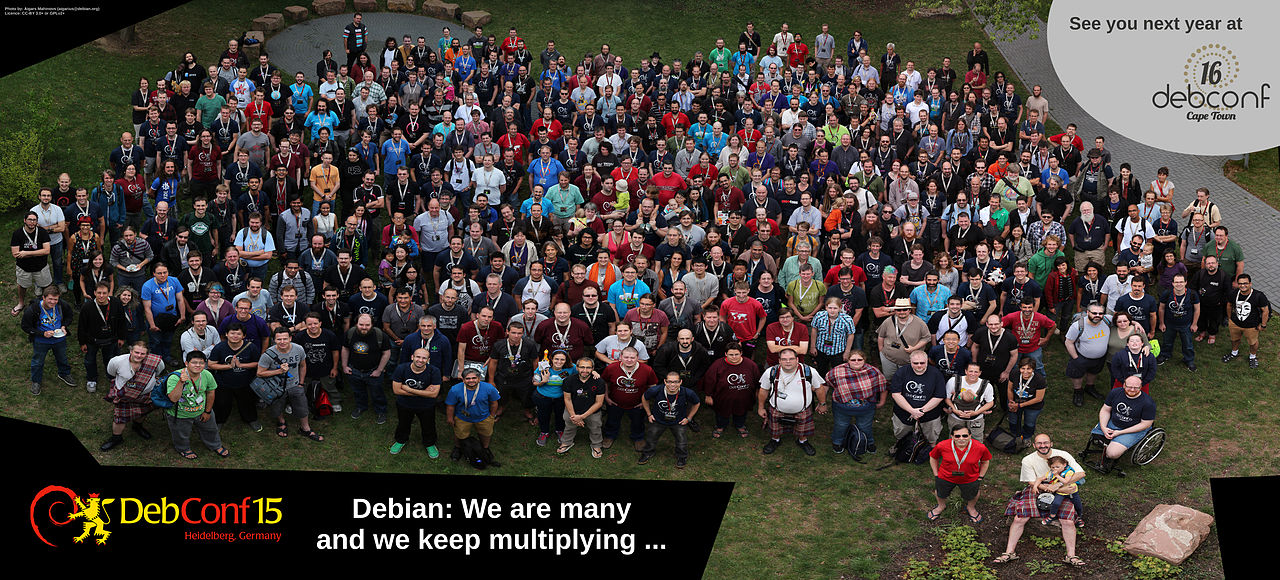
Image context: the cover uses a real Wikimedia Commons photograph from DebConf15 in Heidelberg. It is an archival community photograph, not a logo or diagram, because the point of this article is that Debian's release reliability comes from people, meetings, delegated roles, and maintenance norms as much as from tooling.[9]
The foundation documents make scope explicit
Debian's Social Contract is the first governance signal to read. Version 1.2, ratified in 2022, says Debian will remain 100% free and points to the Debian Free Software Guidelines as the test for what belongs in the Debian system.[1] It also draws the familiar archive boundary around contrib and non-free: those areas can be supported by Debian infrastructure, but their packages are not part of the Debian system; official media may include firmware that is otherwise not part of the Debian system when hardware requires it.[1]
That distinction is easy to mock as old language until a procurement or compliance team has to define what it is actually installing. Debian's value is not that it makes every license argument disappear. Its value is that it exposes the boundary early. The core system, contrib, non-free, and firmware handling are not left to a download-page footnote. They are tied back to a public foundation document that can be cited in audits, derivative distributions, and internal platform standards.[1]
The Constitution is the second signal. It describes Debian as an association of individuals creating a free operating system and lays out who can make decisions: developers by general resolution or election, the Project Leader, the Technical Committee, individual developers working on their own tasks, delegates appointed by the Project Leader, and the Project Secretary.[2] It also states a rule that matters for volunteer sustainability: nothing in the constitution obligates anyone to do work for the project.[2]
Those two points explain much of Debian's personality. Maintainers have real local authority over their work, but Debian has constitutional mechanisms for project-wide questions, technical disputes, delegated responsibilities, and foundation documents.[2] The system is deliberately resistant to one-person product management. That resistance can frustrate impatient users, but it is also why the project can survive leadership turnover, vendor pressure, and large technical transitions without turning every conflict into a founder decision.
The release train is built from gates, not vibes
The trixie freeze policy makes Debian's release discipline concrete. The soft freeze began on April 15, 2025, limiting trixie changes to small, targeted fixes, increasing the testing migration delay to 10 days, and preventing packages not already in trixie from entering the release.[5] On May 15, 2025, key packages and packages without autopkgtests moved into a harder regime requiring release-team review, while non-key packages with non-trivial autopkgtests could still migrate automatically after a 20-day delay.[5] The full freeze began on July 27, 2025, after which packages could migrate only after manual release-team review.[5]
This is the operational core of Debian stable. "Stable" is not a mood word. It is a sequence of increasingly narrow admission rules. New packages stop entering. Migration delays lengthen. Key packages receive manual review. Changes must become targeted: release-critical fixes, important bugs, translation and documentation fixes, release-process updates, and carefully justified unblock requests.[5]
The important adoption lesson is that Debian's release cycle is not only about a date every two years. It is about turning an unstable stream into a testing candidate and then deliberately reducing entropy until the archive can be declared stable. Teams that treat Debian as merely "older packages" miss the point. The age of a package is a side effect of a larger release contract: once the archive approaches release, change has to justify itself against the whole system, not just against one maintainer's package.
Britney makes the archive a tested graph
The migration layer gives that contract its machinery. The britney documentation says its job is to semi-automatically select migration items from source suites such as Debian unstable that are ready to move into target suites such as Debian testing.[6] A candidate must pass policies for the target suite, largely avoiding regressions in QA checks, and must not cause installability to regress.[6] Britney then performs more expensive installability testing for items that pass policy checks, including architecture-specific consequences when binary packages would become uninstallable.[6]
That mechanism is why Debian can be both decentralized and coherent. Maintainers upload packages, but uploads do not become part of the next stable release only because a maintainer acted. The package has to move through a graph-aware gate where bugs, tests, dependencies, build status, regressions, and uninstallability interact.[6] During a freeze, those gates become stricter and more human-reviewed.[5][6]
For operators, the practical signal is straightforward. Debian's archive is not a bucket of upstream tarballs. It is a tested dependency graph with policy memory. The downside is latency: new upstream releases can wait, and some packages miss the release. The upside is that the distribution can make a whole-system promise across architectures, package relationships, upgrade paths, and security support windows.[3][4][5][6]
Architecture policy is part of maintenance
Trixie also shows that Debian governance includes saying no. The release page lists supported initial architectures: amd64, arm64, armhf, ppc64el, riscv64, and s390x, with i386 supported only as a co-architecture on amd64 and armel supported only for upgrades rather than new installations.[3] The release announcement is even blunter: i386 is no longer a regular architecture with an official kernel or installer, and armel will be in its last release.[4]
That is not nostalgia management. It is maintenance budgeting. Every architecture carries build infrastructure, porting work, toolchain exposure, security response, installer behavior, and package graph consequences. Adding official 64-bit RISC-V support while demoting older paths is a governance choice, not merely a hardware note.[3][4][8]
The useful inference is that Debian stability depends on reducing unsupported promises as much as adding new ones. A platform that refuses to retire any architecture, installer path, or package surface eventually spends its maintenance budget pretending. Debian's public release notes make the tradeoff inspectable: new RISC-V support enters the stable set, while i386 and armel move into narrower roles.[3][4][8]
DebConf is maintenance infrastructure
DebConf is easy to treat as community decoration. Debian's own DebConf25 closeout makes it look more like maintenance infrastructure. The project reported more than 443 attendees from 50 countries, a combined 169 events, more than 50 talks, 39 short talks, 5 discussions, 59 Birds of a Feather sessions, 10 workshops, and a DebCamp week for focused development and team sprints.[7] It also called out work around dormant packages, package acceptance challenges, Salsa-CI, daily newcomer onboarding, key-signing, DPL updates, and internal team sessions.[7]
That event list maps directly onto Debian's harder problems. Dormant packages affect release quality. Package acceptance affects archive health. Salsa-CI affects confidence in changes. Newcomer onboarding affects maintainer succession. Key-signing affects developer trust. Internal team sessions let delegated groups reconcile policy, tooling, and human capacity before the next freeze makes every delay more expensive.[7]
This is why the cover image matters. Debian's release contract is not reducible to britney, autopkgtests, and package metadata. Those tools need people who understand when to remove a package, when to unblock a fix, when to mentor a maintainer, when to escalate a technical dispute, and when to let a release wait. The social layer is not soft filler around the engineering. It is part of the engineering system.
How to adopt Debian without misreading it
Debian is strongest when a team values a predictable base operating system, a broad package archive, transparent governance, long security horizons, and conservative upgrade behavior. It fits servers, appliances, base images, research computing, public infrastructure, internal platforms, and derivative distributions where the operating system should be boring in production and legible under audit.[1][2][3][4]
It is weaker when a team needs a fast-moving desktop stack, the latest upstream language runtime by default, or vendor-polished lifecycle management wrapped around one narrow hardware or cloud product. Debian can still serve those environments through backports, containers, vendor repositories, or derivative systems, but those layers are additions to the Debian contract, not replacements for understanding it.
The adoption question should therefore be precise: do you want your base OS to optimize for release-train discipline, archive coherence, and a public governance record, or do you need the fastest upstream intake path? Debian's maintainer signal in 2026 is that it still knows which side it is on. It accepts slower intake so that the archive can become a stable whole.
That is the lesson from trixie. Debian's release machine is not only a calendar. It is a contract among foundation documents, delegated authority, migration gates, freeze policy, architecture support, security horizons, and contributor work. The result is not fashionable, but it is unusually inspectable. For a base operating system, that is still a serious advantage.
Sources
- Debian Project, "Debian Social Contract" version 1.2, covering the Social Contract, Debian Free Software Guidelines,
contrib,non-free, and firmware boundaries. - Debian Project, "Constitution for the Debian Project" version 1.9, covering decision-making bodies, developer powers, delegates, elections, and technical committee authority.
- Debian Project, "Debian 'trixie' Release Information," covering Debian 13.4, the initial 13.0 release date, support horizon, LTS period, and supported architectures.
- Debian Project, "Debian 13 'trixie' released" (August 9, 2025), covering package counts, development duration, architecture changes, installer notes, and upgrade guidance.
- Debian Release Team, "trixie Freeze Timeline and Policy," covering soft, hard, and full freeze gates, migration delays, unblock requests, and acceptable changes.
- Debian Release Team, "A short introduction to migrations," britney2 documentation covering policy checks, valid candidates, regressions, installability testing, and migration attempts.
- Debian Project, "DebConf25 closes in Brest and DebConf26 announced" (August 3, 2025), covering attendee count, countries represented, events, DebCamp, sprints, and newcomer onboarding.
- Michael Larabel, Phoronix, "Debian 13.0 'Trixie' Now Available - Powered By Linux 6.12 LTS" (August 9, 2025), an independent release readout covering kernel, desktop, compiler, RISC-V, HTTP Boot,
time_t, and reproducible-builds notes. - Wikimedia Commons, "File:Debconf15 group photo.jpg," source page for the 2015 DebConf group photograph by Aigars Mahinovs used as the cover image.