OpenSSL is easy to read through the loudest cryptographic feature in the room: post-quantum algorithms, Encrypted Client Hello, FIPS validation, or whichever protocol change happens to touch a release. That is useful, but too shallow for an infrastructure dependency that sits inside operating systems, browsers, package managers, language runtimes, appliances, databases, and embedded devices. The stronger 2026 signal is not one algorithm. It is that OpenSSL has made its maintenance clock, migration boundary, and support institutions much more inspectable.[1][2][5]
As of July 5, 2026, that clock is concrete. OpenSSL 4.0 exists as the current feature line but is not an LTS release; the project says it is supported until May 14, 2027. OpenSSL 3.5 is the current long-term support branch and is supported until April 8, 2030. OpenSSL 3.6 is supported only until November 1, 2026, while the older 3.0 LTS branch reaches support end on September 7, 2026.[1] Those dates matter more than a raw "latest version" reflex. They tell operators whether they are choosing a migration lane, a stability lane, or a short-lived bridge.
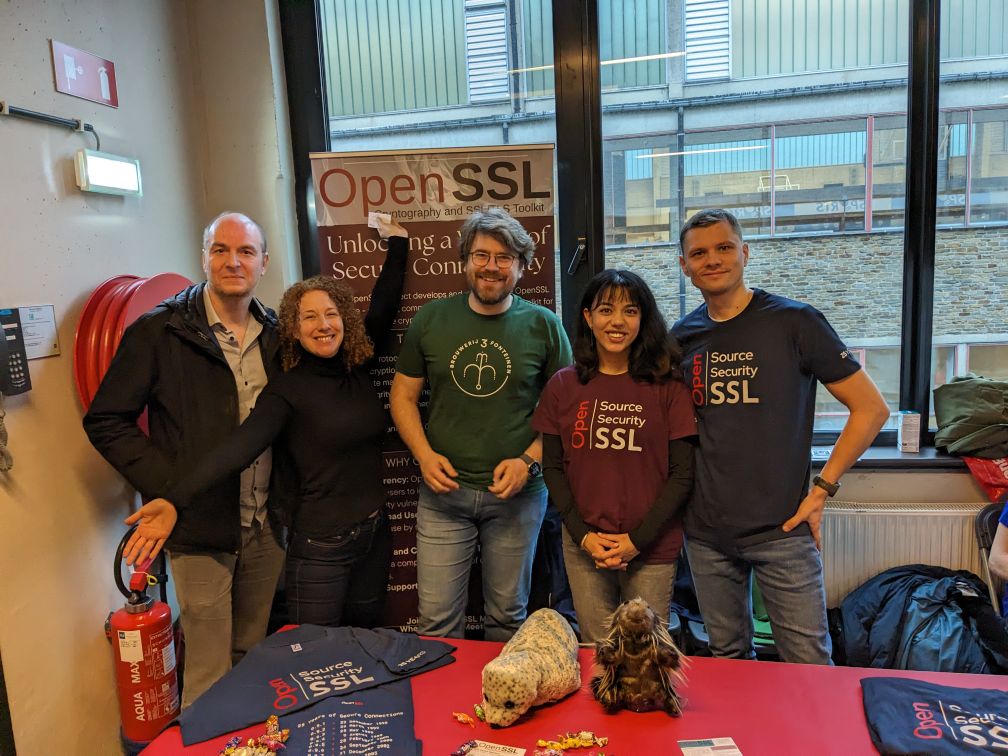
The cover photo comes from OpenSSL's first FOSDEM participation in 2024, where the project hosted a stand and used the event to meet the broader open-source community face to face.[9] It is the right visual because this is a governance note, not a cipher catalog. Crypto libraries survive when the technical surface, funding surface, standards work, release discipline, and user feedback loops all stay connected.
The support clock is now part of the API
OpenSSL 4.0 is a useful release precisely because it does not pretend to be the conservative answer for everyone. The April 14, 2026 announcement labels it as non-LTS, points users to the release policy, and says the next release will be OpenSSL 4.1 in October 2026.[2] That turns the branch into a clear feature and migration lane. If a team wants 4.0's new behavior, it gets a defined window. If it wants a slower base for operating-system images, regulated products, or appliance firmware, 3.5 LTS is the more obvious anchor.[1][2]
That distinction is a maintainer signal. Mature projects do not only publish code; they publish expectations. OpenSSL's release strategy now gives each supported line a date, including 4.0, 3.6, 3.5 LTS, 3.4, and 3.0 LTS.[1] The GitHub release feed shows why that matters operationally: on June 9, 2026, the project shipped security patch releases across multiple supported branches, including 4.0.1, 3.6.3, 3.5.7, 3.4.6, and 3.0.21, all carrying the same high-severity PKCS7 fix.[7] A dependency owner can read that as a branch-management promise, not just a tag list.
The decision rule should be blunt. If you are packaging an application for broad enterprise deployment in mid-2026, OpenSSL 3.5 LTS is the boring baseline to justify first. If you are building toward post-3.x API behavior, testing removed features, or experimenting with newer protocol surfaces, 4.0 is the right lane to pilot. If you are still on 3.0 because it says "LTS," the label is now misleading without the date beside it: support ends on September 7, 2026.[1]
4.0 cashes in old deprecations
The 4.0 release is not interesting because it has a large changelog. It is interesting because the changelog makes maintenance debt visible. The announcement lists incompatible or significant changes such as making ASN1_STRING opaque, changing many API signatures to add const qualifiers, removing SSLv3, removing support for engines, removing deprecated custom EVP_CIPHER, EVP_MD, EVP_PKEY, and EVP_PKEY_ASN1 methods, removing fixed SSL/TLS version method functions, and disabling several older elliptic-curve paths by default.[2] LWN's independent release note compressed the same point: 4.0 adds new cryptographic algorithms and carries incompatible changes.[8]
Those removals are not housekeeping trivia. They define where applications have been leaning on old assumptions. If your product still depends on the ENGINE API, low-level custom crypto methods, SSLv3 compatibility, or output formatting that changed in 4.0, the release tells you exactly where your migration work is hiding. The useful maintainer behavior is not that OpenSSL avoided breakage forever. It is that the project put the break on a major-version line, tied it to the support policy, and kept a long-lived 3.5 LTS lane available at the same time.[1][2]
The new features deserve attention too. OpenSSL 4.0 adds Encrypted Client Hello support, cSHAKE, SNMP and SRTP KDF support, deferred FIPS self tests during openssl fipsinstall, and negotiated FFDHE key exchange in TLS 1.2.[2] But the adoption question is still not "Which feature is exciting?" It is "Which applications can tolerate the changed contract?" For a crypto dependency, compatibility testing is part of security work because failed migrations often turn into unsupported forks, local patches, or pinning behavior nobody revisits.
Providers are the real migration boundary
The provider model is the place where OpenSSL's technical and governance stories meet. The project documentation describes providers as containers for algorithm implementations. When applications use the high-level APIs, OpenSSL selects a provider implementation to do the work. The standard set includes the default provider, legacy provider, FIPS provider, base provider, and null provider.[3]
That split has practical consequences. The default provider holds the standard built-in implementations and is loaded automatically only under specific conditions. The legacy provider contains older or discouraged algorithms and is not loaded by default. The base provider carries non-cryptographic support algorithms such as key serialization and is especially relevant when using the FIPS provider without the default provider. The null provider can prevent accidental default-provider loading in a library context.[3]
This is not just internal architecture. It is the operator's policy surface. If an application needs legacy algorithms for backward compatibility, that is now an explicit provider choice. If a regulated deployment needs FIPS behavior, that is a provider and validation choice, not a vague "compiled with crypto" checkbox. If an application developer writes directly against deprecated low-level methods, 4.0's removals and the provider model point in the same direction: move policy through high-level APIs and provider selection instead of treating algorithms as private implementation hooks.[2][3]
The boundary is also a test plan. Before a serious 4.0 move, inventory provider configuration, custom engines, legacy-provider assumptions, FIPS mode expectations, and any code that reaches below EVP into older method surfaces. A library may compile while still choosing the wrong provider at runtime. That is the kind of migration failure that only shows up when tests exercise configuration files, environment paths, distro packaging, and real TLS or signing workloads.
FIPS is a certificate boundary, not a configure flag
OpenSSL's FIPS documentation is unusually important because it refuses to let compliance become folklore. The README says the FIPS module is implemented as an OpenSSL provider, but it also says a cryptographic module is only FIPS validated after the validation process, and that users needing a validated module must generate a FIPS provider only from OpenSSL versions with valid FIPS certificates. It also states that the FIPS provider is a shared library, such as fips.so on Unix, and does not get built and installed automatically unless OpenSSL is configured with enable-fips.[4]
That language is strict for a reason. A team cannot treat "OpenSSL version X has FIPS somewhere in the family" as equivalent to "our deployed binary is operating inside a validated module boundary." The validated provider, the security policy, the build source, the installation process, and the runtime configuration all matter.[4] This is where governance becomes supply-chain reality: regulated users need repeatable evidence, not a comforting package name.
OpenSSL 4.0 complicates that in a healthy way. The release adds deferred FIPS self-test support for FIPS installation, while the 3.5 line remains the long-term support anchor.[1][2] The result is not one universal answer. It is a matrix: feature branch versus LTS branch, validated provider versus non-validated use, distro package versus upstream build, and application API use versus provider policy. OpenSSL's value in 2026 is that these choices are visible enough to document rather than hidden behind a monolithic library name.
Governance is split by constituency
The organizational signal is just as important as the technical one. In July 2024, OpenSSL announced a new governance structure with two independent, co-equal organizations supporting the OpenSSL Mission: the Foundation, focused primarily on non-commercial communities, and the Corporation, focused primarily on commercial communities. The old OpenSSL Management Committee was dissolved, and the Foundation and Corporation each elected boards of directors. The same announcement described Business Advisory Committees and Technical Advisory Committees as channels for community input.[5]
That structure is easy to dismiss as foundation paperwork. It is not. OpenSSL has different constituencies with genuinely different needs. Volunteer users want trust, transparency, code access, community participation, and continuity. Commercial users want support contracts, FIPS services, security response, roadmap confidence, and migration guidance. The 2024 Corporation annual report puts numbers under that reality: more than 15 million OpenSSL Library downloads during 2024, $5.5 million in total income from commercial support, an 88 percent support-contract renewal rate, more than 100 customers, and a time-based release model covering 3.3, 3.4, and planned 3.5 work.[6]
Those numbers do not prove perfection. They prove a healthier funding and accountability shape than "critical infrastructure maintained by vibes." The Corporation report also says commercial support funds most ongoing development and has supported the Foundation's non-commercial activities.[6] The governance bet is that OpenSSL can serve commercial and non-commercial communities without pretending they have identical incentives.
Where OpenSSL fits now
The practical adoption reading is narrower than "upgrade to 4.0." Start with the branch contract. Use 3.5 LTS when the priority is a supported baseline through April 2030, especially for productized software that cannot tolerate frequent crypto-library migrations. Pilot 4.0 when you can test incompatible API changes, removed ENGINE behavior, SSLv3 removal, provider configuration, and the newer feature surface deliberately. Treat 3.0 as a near-end branch unless a vendor support arrangement or platform policy explicitly justifies it.[1][2][7]
Then test the provider boundary. Load the providers you mean to load. Make legacy algorithms an explicit exception. Keep FIPS deployments tied to a validated provider and its security policy. Remove local patches that disguise unsupported behavior. Audit code for older low-level APIs and ENGINE assumptions before they become emergency work.[2][3][4]
The positive governance signal is that OpenSSL now gives dependency owners enough public structure to make these calls: support dates, LTS labels, security patch releases across branches, provider documentation, FIPS validation rules, independent Foundation and Corporation entities, advisory channels, and commercial support economics.[1][3][5][6][7] The falsifier would be drift: missed release clocks, unclear LTS transitions, provider behavior that remains hard to test, or FIPS guidance that fails to track actual deployment needs.
For now, the better reading is that OpenSSL's 2026 health is not best measured by one headline algorithm. It is measured by whether operators can choose a branch, explain a provider policy, document a FIPS boundary, and know who is accountable for the release train. That is what a critical open-source crypto library owes its users.
Sources
- OpenSSL Library, "Release Strategy" - current support windows for OpenSSL 4.0, 3.6, 3.5 LTS, 3.4, 3.3, 3.2, and 3.0 LTS.
- OpenSSL Library, "OpenSSL 4.0 Final Release - Live" (April 14, 2026) - 4.0 feature release, removals, incompatible changes, ECH and FIPS-install updates, support window, and next-release note.
- OpenSSL GitHub repository,
README-PROVIDERS.md- provider model, standard providers, default/legacy/FIPS/base/null behavior, and loading mechanics. - OpenSSL GitHub repository,
README-FIPS.md- FIPS provider model, validation boundary, validated-source requirement,fips.so, andenable-fipsinstallation guidance. - OpenSSL Library, "New Governance Structure and New Projects under the Mission" (July 24, 2024) - Foundation/Corporation split, board structure, OMC dissolution, advisory committees, and mission expansion.
- OpenSSL Corporation, Annual Report 2024 - governance formalization, support income, download scale, customer renewal, release model, engineering activity, and support economics.
- OpenSSL GitHub releases - June 2026 patch releases across 4.0, 3.6, 3.5, 3.4, and 3.0 branches and current release-cadence evidence.
- LWN.net, "OpenSSL 4.0.0 released" (April 14, 2026) - independent release note summarizing new algorithms and incompatible changes.
- OpenSSL Library, "OpenSSL at FOSDEM 24" (March 28, 2024) - source page for the official real FOSDEM 2024 OpenSSL booth photograph used as this article's image.