OpenRefine is easy to underestimate because it looks, at first glance, like a better spreadsheet for dirty CSV files. That reading is too small. The project's stronger value is that it gives data repair a reviewable middle layer: close enough to the raw table for humans to notice ambiguity, structured enough to record transformations, and extensible enough to connect messy labels to authority files, Wikidata, or another reconciliation service.[2][3][4]
As of 2026-06-06T16:03:12Z UTC, the OpenRefine/OpenRefine repository metadata showed 11,855 stars, 2,141 forks, 729 open issues, a 2026-06-05T18:53:42Z push timestamp, and a BSD-3-Clause license. The latest GitHub release was OpenRefine 3.10.1, published on 2026-03-04T21:18:45Z.[1][9] Those numbers are not a popularity contest. They are maintenance signals for a project that often sits between fragile source data and public-facing catalogs, research datasets, investigative indexes, or knowledge-base uploads.
The adoption question is therefore not "Can OpenRefine clean data?" It can. The better question is: when does a team need a human-centered cleaning workbench before it writes code, loads a warehouse table, or pushes reconciled entities into a shared graph?
The workbench sits before the pipeline
The official manual describes OpenRefine as a tool for importing a dataset, inspecting it with facets, filters, and sorting, transforming it through common and custom operations, clustering similar values, reconciling against outside sources, writing expressions, and exporting the improved result.[2] The order matters. OpenRefine is most useful before a team has enough confidence to encode every rule as a script.
That is a common data failure mode. A spreadsheet contains variant spellings, leading spaces, duplicate institutions, mixed date formats, merged fields, partial identifiers, and human notes pretending to be structured categories. A developer can write cleanup code immediately, but the first script often freezes the wrong assumptions. OpenRefine makes a different bargain: let a domain-aware person look at the distribution first, decide which differences are meaningful, and only then turn repairs into operations.
Facets are the quiet center of that bargain. A text facet makes repeated values visible. A numeric or timeline view exposes impossible ranges. A cluster operation groups similar strings without forcing the operator to accept every merge. GREL expressions can split, trim, replace, parse, or construct values when the rule is clear enough to state. The point is not that every step is automatic. The point is that each step can be inspected at table scale before it becomes part of an export.[2][7]
Programming Historian's peer-reviewed OpenRefine lesson frames the same practical lesson in human terms: do not take data at face value. Its exercise uses museum metadata to remove duplicates, separate multiple values, analyze value distributions, and group different representations of the same reality.[7] That is exactly the lane where OpenRefine remains durable. It is not trying to be the warehouse, the BI layer, or the canonical catalog. It is the place where humans discover what the source data is actually doing.
Operation history is the audit trail
OpenRefine's strongest operational feature is not only the transformation menu. It is the fact that a cleanup session becomes a sequence of operations rather than an undocumented hand edit. That changes the risk profile. A team can try a split, undo it, refine the expression, replay the operation on a similar file, or export the project with enough context for another reviewer to understand what changed.[2]
This is where OpenRefine differs from ordinary spreadsheet cleanup. In a spreadsheet, the final cells often survive while the reasoning disappears. In OpenRefine, the cleaning session is closer to a lightweight lab notebook. It is still not a full data lineage system, and teams should not pretend that it replaces versioned source files, code review, or automated tests. But it can preserve the shape of a repair session long enough to make the next step safer.
The boundary is important. OpenRefine is a local application, and the GitHub README states that running from source requires JDK 11 or newer, Apache Maven, and Node.js 18 or newer.[10] That is not heavy infrastructure, but it is also not a headless batch engine by default. Teams that need nightly deterministic cleanup over millions of rows should eventually translate stable operations into code, SQL, dbt models, or a dedicated ETL job. OpenRefine is best at the earlier stage: finding and validating the rules before automation hardens them.
Reconciliation is the real differentiator
The reconciliation system is where OpenRefine stops being just a cleaning tool and becomes linked-data infrastructure. The manual defines reconciliation as matching a project dataset with an external source, including authority files, Wikidata, Wikibase instances, local datasets, or investigative databases. It also states the key caveat plainly: reconciliation is semi-automated, and human judgment is required to review and approve results.[3]
That caveat is the product. Entity matching is full of near misses. "Apple" can be a fruit, a company, a place nickname, a music label, or a bad OCR fragment. A person name can collide across centuries. A museum object title can hide a date, maker, school, or place. The reconciliation API describes a service that accepts a label string, optional type, and optional property values, then returns ranked candidate entities in a particular identifier space. OpenRefine supports the current reconciliation API v0.2, while older v0.1 support is discouraged because of JSONP security risk.[4]
That model creates an unusually useful boundary. OpenRefine does not need to own every authority file. A reconciliation service owns its identifier space and matching logic. OpenRefine owns the review surface where a user binds columns to properties, narrows by type, inspects candidates, accepts or rejects matches, and exports the result. The protocol keeps the pieces separable enough that libraries, archives, museums, journalism teams, and Wikibase operators can all bring their own reference data.[3][4]
Wikidata shows why this matters. Wikidata's own OpenRefine documentation describes reconciliation as linking free-text tabular cells to knowledge-base identifiers, with options to restrict by class, use multiple columns as tie-breakers, match external identifiers, and pull data from Wikidata after reconciliation.[5] That turns a messy table into a bridge. A dataset can move from "these are strings in a column" to "these are reviewed references to named entities," then enrich or publish those links with a clearer audit trail.
Where it fits
OpenRefine is a good fit when the source data is small or medium enough for interactive inspection, messy enough that blind automation would encode bad assumptions, and important enough that field-level judgment matters. Museum collections, library authority cleanup, newsroom spreadsheets, civic datasets, research metadata, donor lists, public-record extracts, Wikibase uploads, and one-time migration audits all fit that profile.[3][5][7]
It is a weaker fit when the rules are already stable, the volume is too large for local review, or the organization needs continuous production cleaning with formal scheduling, observability, and rollback. In those cases, OpenRefine can still be useful as a rule-discovery tool. Let analysts explore facets, clusters, GREL expressions, and reconciliation settings on a sample. Once the team agrees on the repair logic, promote that logic into a tested pipeline and keep OpenRefine for exceptions, audits, and new source formats.
The security boundary deserves the same pragmatism. The project's "What's new" page documents past vulnerabilities involving project import and database-extension behavior, including CVE-2023-37476, CVE-2023-41886, CVE-2023-41887, and CVE-2024-23833.[6] That does not make OpenRefine unusually unsafe. It means operators should treat project files, database connections, and extensions as executable trust surfaces rather than harmless spreadsheets. Run current releases, review sources before importing projects, and avoid connecting to untrusted services in sensitive environments.
The reason to care about OpenRefine in 2026 is that a great deal of valuable data still arrives before schema discipline. It comes from forms, legacy catalogs, hand-built spreadsheets, scraped tables, OCR, partner exports, and half-remembered administrative conventions. OpenRefine gives teams a place to slow down without losing structure. Facets reveal patterns. Clusters expose near-duplicates. GREL records transformations. Reconciliation turns names into identifiers. Exports move the work onward.
That is a modest promise, but a durable one. OpenRefine does not eliminate data cleaning labor. It makes the judgment inside that labor visible enough to review.
Sources
- GitHub API,
OpenRefine/OpenRefinerepository metadata sampled on 2026-06-06 - stars, forks, open issues, push timestamp, license, and project description. - OpenRefine, "OpenRefine user manual" - workflow overview from importing and faceting through transformation, reconciliation, expressions, Wikibase upload, and export.
- OpenRefine manual, "Reconciling" - reconciliation workflow, semi-automated review model, Wikidata default service, external authority services, and local reconciliation options.
- OpenRefine technical reference, "Reconciliation API" - protocol concepts, identifiers, candidate matching, optional types/properties, and API version support.
- Wikidata, "Tools/OpenRefine" - Wikidata reconciliation, class restriction, multiple-column matching, external identifiers, and data augmentation after reconciliation.
- OpenRefine, "What's new" - release-note security history including project-import and database-extension vulnerabilities.
- Seth van Hooland, Ruben Verborgh, and Max De Wilde, "Cleaning Data with OpenRefine," Programming Historian 2 (2013; tested 2024) - peer-reviewed lesson on data-quality diagnosis, deduplication, faceting, clustering, and transformations.
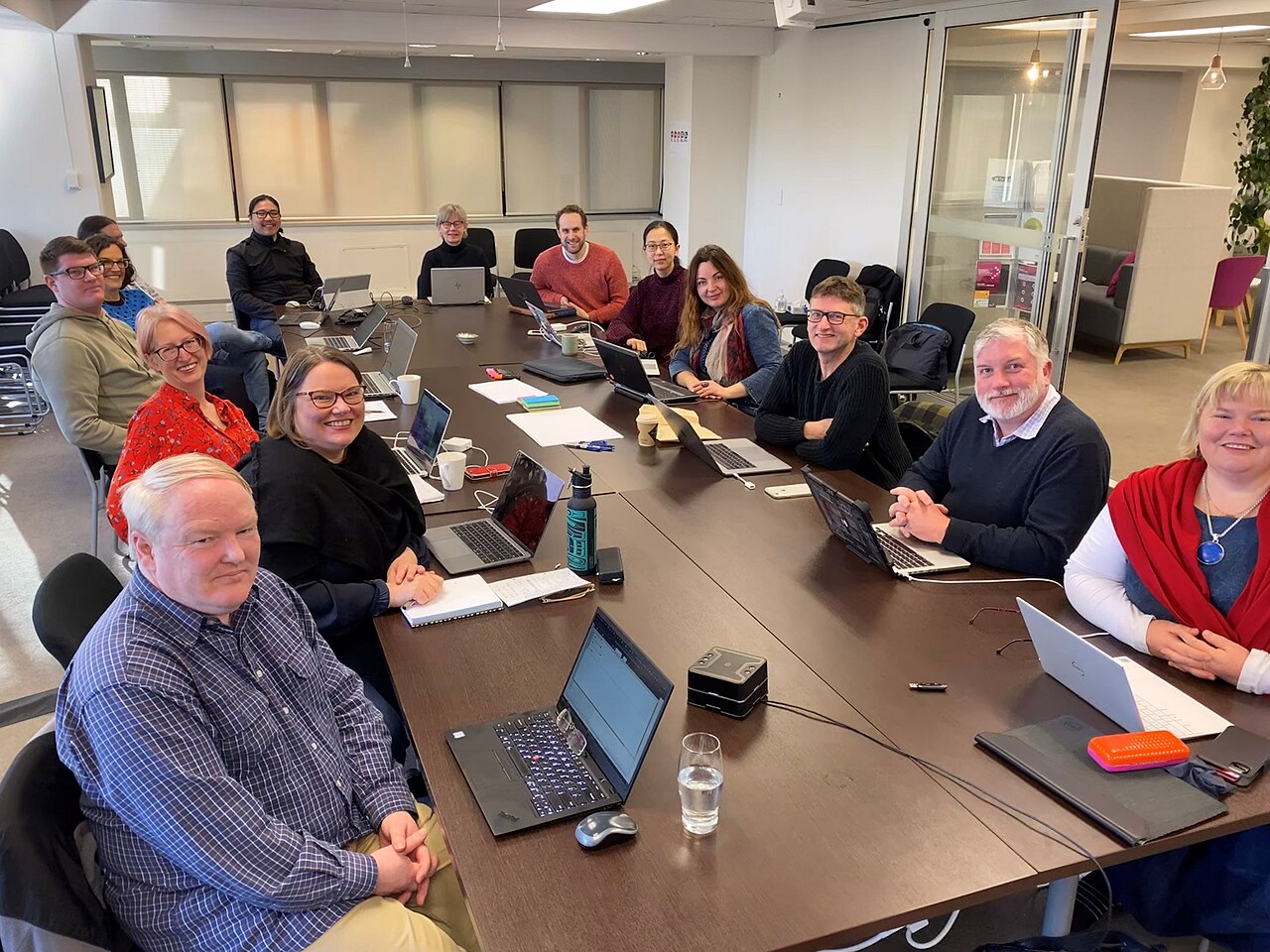
- Anton Angelo, "2020 Open Refine Wellington.jpg," Wikimedia Commons - CC0 photograph of an OpenRefine workshop used as the article image source.
- GitHub releases,
OpenRefine/OpenRefine3.10.1 - latest release page and publication timestamp used for the freshness check. - GitHub repository,
OpenRefine/OpenRefineREADME - source-run requirements and project documentation links.