A lookup table does not look executable. In a grading suite it looks like a creative ingredient: a small file that maps input values to output values so a camera image, review monitor, visual-effects plate, or delivery master appears as intended. OpenColorIO's May 2026 security disclosures showed why that intuition is unsafe. Four of its LUT readers had paths that accepted text tokens into fixed-size stack buffers without bounding their length. The full four-format exposure applied to non-Windows builds; two readers also exposed unsafe paths on Windows. A crafted color asset could therefore corrupt memory inside the application that opened it—before the transform changed a single pixel.[1][3][4]
OpenColorIO 2.5.2 fixed the paths for .spi3d, .spi1d, .cube, and .lut files. The project's release notes say the CVE affects every earlier OCIO 1.x and 2.x version, while 2.5.2 remains ABI-compatible with 2.5.1.[1] That last detail makes one upgrade path easier, but it does not make the response a one-package job. OCIO is a library embedded in creative applications, plug-ins, command-line tools, Python environments, containers, and render images. The unit to patch is every execution lane that can parse a color asset, not the first libOpenColorIO package an administrator finds.
This is a postmortem of a vulnerable code path, not a report of a disclosed studio breach. The public sources cited here document a proof-of-concept parser failure; they do not document a production compromise. CISA's enrichment labels exploitation “poc” and automation “no,” while the CNA-scored CVSS v4 scenario uses Local attack vector and Active user interaction.[4][9] Those boundaries should constrain the response. They should not be mistaken for a reason to leave a parser exposed.
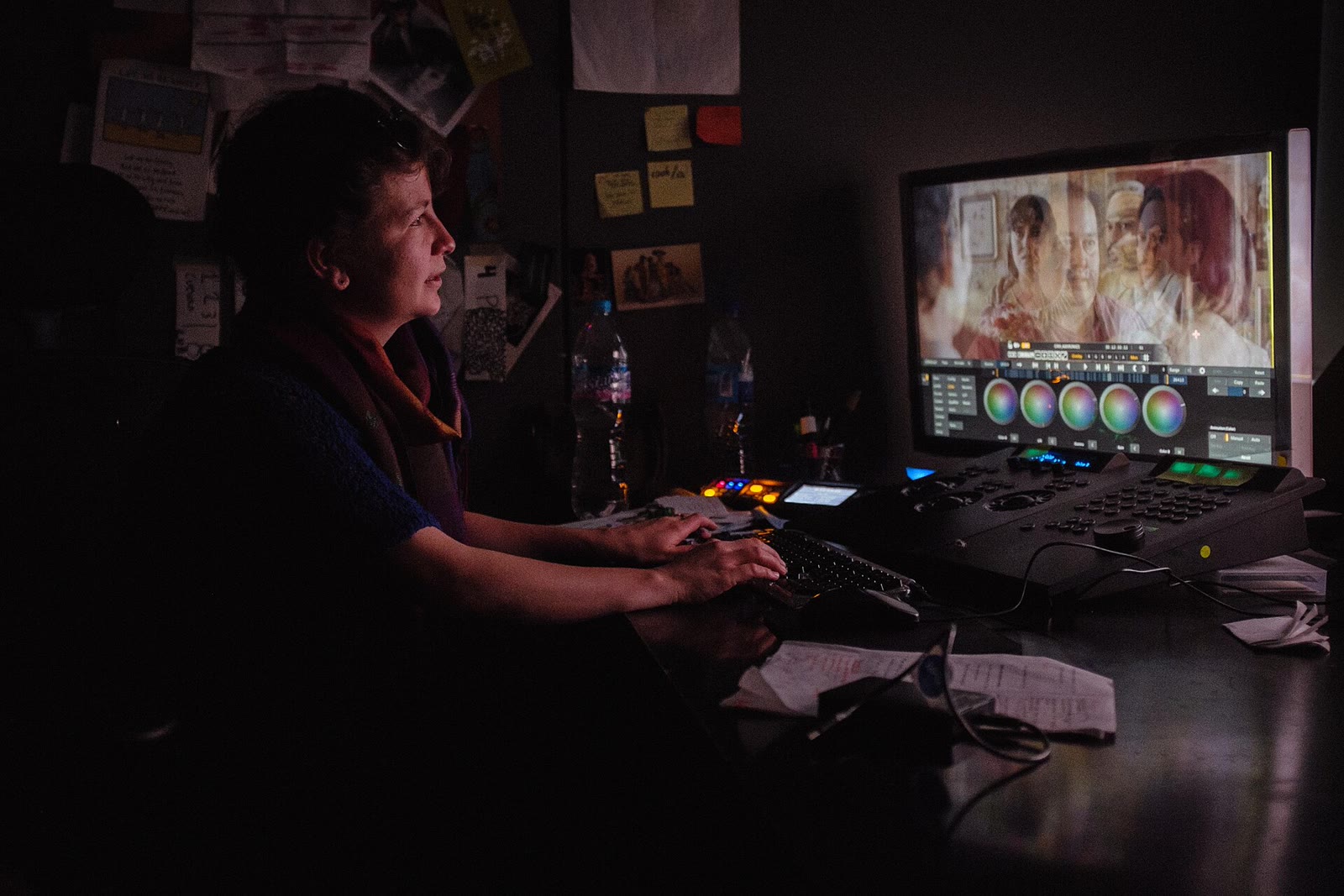
The cover photograph shows a colorist working in Assimilate Scratch at Mexico's Cineteca Nacional in 2015.[11] It is contextual rather than evidentiary—the source does not say this workstation used OpenColorIO. Its value is the scale contrast. A color decision arrives as a modest asset, then enters an application with access to frames, project storage, caches, credentials, and sometimes a render farm. The parser inherits that application's authority.
What failed: one C habit repeated across four readers
The clearest case is the Spi3D reader. It read a line into a 4,096-byte array, then used C's sscanf with unbounded %s conversions to place three values into three 64-byte character arrays. %s stops at whitespace; without a width, it does not know the destination's capacity. The project's advisory showed that one long token could overrun a buffer by roughly 4,000 bytes. It rated the issue 8.4, High, and described attacker-controlled data reaching the stack through any OCIO API or tool that loads a crafted .spi3d file.[4]
The same parsing assumption appeared in three neighboring formats. Spi1D had unbounded reads in its From header and data rows. The Iridas .cube reader parsed DOMAIN_MIN and DOMAIN_MAX values into 64-byte arrays. The legacy Discreet .lut reader placed a token into a 16-byte array. The platform matrix was uneven: Spi3D and Discreet .lut used unsafe ordinary sscanf paths on Windows and non-Windows, while the Windows branches for Spi1D and .cube already used sscanf_s with destination sizes. Pull request 2307 added explicit widths such as %63s and %15s across the readers, preserving room for the terminating null byte, and corrected the Windows Spi3D call to sscanf_s.[1][3][4]
Four source files changed because one unsafe habit had been copied across four format grammars, but the vulnerable format set depended on platform. On non-Windows systems, all four readers required the fix. On Windows, the disclosed overflow paths were in Spi3D and Discreet .lut; the patch also hardened the already size-aware branches in the other two readers.[3][4]
That distinction matters. Blocking only .spi3d would address the format named in the CVE database's short description while leaving the other repaired readers out of the response. So would scanning for one proof-of-concept string. The release and patch are the right scope: the vulnerable version, across every affected reader, wherever that version runs.[1][3][9]
Nor does “High” mean code execution is guaranteed whenever an oversized token appears. A stack overwrite may terminate the process; turning it into controlled execution depends on the exact build, platform, compiler protections, host layout, and input path. The advisory's impact model is a serious plausible outcome, not a claim that every application integration is equally exploitable.[4] SUSE supplies a useful downstream contrast: it labels the issue Moderate while still shipping fixed OpenColorIO 2.5.2 packages for Tumbleweed.[10] SUSE does not explain the rating difference on that page. The contrast should prompt deployment-specific reachability analysis, not weaken the upstream version boundary.
The trust boundary was hidden inside FileTransform
OpenColorIO's own security document provides the architectural clue. A config.ocio file may refer to external transform files. Those files can be arbitrarily large, can live on any accessible volume, and are loaded lazily when a Processor needs them. Search paths may include environment-variable substitutions. The project explicitly warns that a modified environment can redirect reads to an insecure location.[2]
There is a second surprise: FileTransform does not treat the filename extension as proof of format. The API documentation says it will try registered readers until one succeeds, even when a file has an unsupported extension or no extension.[5] That behavior is useful in untidy production pipelines. It also means an extension allowlist is classification, not a security boundary. Renaming an incoming file does not remove the parser that will inspect its contents.
A representative path therefore looks like this:
- An artist, automation process, or render job selects a show config or look package.
- The config resolves a
FileTransformthrough its search path and runtime context. - An application asks OCIO to construct the needed processor.
- OCIO lazily opens the referenced file and chooses a reader from its contents.
- On a vulnerable build, one of the four readers can overwrite stack memory in the host process.
Nothing in that chain requires the LUT to be a program. It only requires a program to interpret the LUT. “Local” and “Active” describe the scenario scored in the published CVSS vector: the vulnerable process must be made to load the asset rather than receiving one unauthenticated protocol request directly into the parser.[4] They are not universal properties of every integration. A network-facing ingest service or remotely submitted render job may make that local parsing step reachable through a wider workflow. The vector also does not tell a studio whether a file came from its own color department, a vendor handoff, a freelancer's package, a marketplace download, an old show archive, or a writable shared directory. Those deployment questions determine the real exposure.
Blender's independent documentation illustrates the distribution problem from the application side: Blender uses OCIO for color management and can share an OCIO configuration with other applications.[8] That interoperability is the feature. It also means a single config-and-LUT bundle can travel between heterogeneous hosts whose bundled library versions, file access, and sandboxing differ. Updating a Python wheel does not patch an application's private copy; updating a workstation does not rebuild yesterday's render container.
Response phase one: inventory runtimes, not filenames
Start with a matrix whose rows are places work actually executes: artist workstations, review stations, render-node images, transcoding workers, ingest services, farm submission tools, plug-in hosts, Python environments, and CI jobs that validate show packages. For each row, capture the host application and version, operating system, how OCIO is supplied, runtime OCIO version, config source, whether external LUTs are accepted, process identity, reachable storage, and owner.
Do not infer runtime version from a developer package. OpenColorIO exposes PyOpenColorIO.GetVersion() to Python integrations, and its tools report the library they actually load; vendor applications may expose the value in diagnostics or dependency manifests.[6][7] Where the host provides no trustworthy report, inspect the shipped binary or ask the vendor. Record uncertainty rather than converting “we installed 2.5.2” into “every application is fixed.”
The remediation target is upstream 2.5.2 or a vendor build that demonstrably backports the same patch. Upstream calls 2.5.2 ABI-compatible with 2.5.1, but that statement does not authorize dropping a new shared library into an arbitrary application built against an older major or minor line.[1] Commercial DCC packages and tightly coupled plug-ins need their supported vendor update. Containers and render images need rebuilding and redeployment, not merely a changed base-image tag in source control.
Prioritize lanes using three questions:
- Can an external or low-trust party influence the config, search path, or transform file?
- Does the process read secrets, write shared project storage, submit farm jobs, or reach production services?
- Can the same asset fan out automatically to many workers?
A single-user workstation with a centrally managed, read-only config and no third-party LUT intake has a narrower path than a multi-vendor facility that expands incoming show packages onto shared storage. Both should patch. The second also needs containment because one user action may multiply across a farm.
Response phase two: promote color assets into the dependency ledger
Patching closes this disclosed overflow. It does not make every future parser infallible, and OpenColorIO's security policy does not claim otherwise.[2] The durable response is to give configs and transform files the controls already applied to scripts and plug-ins.
Keep the approved show config and LUT set in a versioned, read-only bundle. Record a manifest of paths, sizes, cryptographic hashes, origin, reviewer, and approval date. Resolve context variables and search paths during publication so an operator can answer which bytes a given show version will load. Move a new vendor LUT through quarantine and review before it reaches the production share; do not let email attachments or download folders become implicit search paths.
Validation must run on a patched, low-privilege worker. ociocheck can identify YAML and OCIO-specific consistency errors, but the documentation is careful about its limit: it can verify that a config loads and has coherent references, not that the transforms are artistically or numerically correct.[6] For security, a successful parse is likewise not proof of harmlessness. Validation should be one controlled stage, followed by a representative transform test and an image comparison against an approved result.
Do not overfit the gate to this exploit. A maximum overall file size would not necessarily reject a malicious token small enough to overflow 64 bytes. An extension filter misses content-based reader selection.[5] Antivirus signatures may recognize a published proof of concept but not a rearranged input. The dependable controls are a fixed parser, provenance, least privilege, and a narrow place where untrusted files are first interpreted.
Response phase three: make a parser crash survivable
Creative software often runs with generous access because interactive work is easier when the application can browse home directories, project shares, caches, and review outputs. Render workers may have even broader read access. That convenience can turn an exploitable native parser defect into an identity-and-storage problem.
Run automated ingestion and rendering under service accounts that cannot read artist credentials or write source assets. Mount approved inputs read-only where the workflow permits it. Give workers separate scratch storage, constrain network egress, and make publication a later authenticated step rather than a side effect of parsing. A small shop may not be able to isolate every desktop application, but it can still prevent a desktop token from becoming a farm administrator and keep the master config share non-writable.
Preserve enough evidence to investigate: host and OCIO versions, resolved config path, LUT hashes, submitter, job ID, parser stderr, crash dumps under an appropriate retention policy, and which worker image ran the job. Parser crashes on malformed assets deserve security triage, especially when the source is external. The absence of a crash does not prove that parsing a hostile asset caused no memory corruption or other effect.
If a suspicious LUT was loaded on an affected host, installing 2.5.2 is containment for the next run, not recovery for the previous one. Isolate the system, preserve the asset and process evidence, determine the privileges and credentials available to the host, and rotate or rebuild according to that exposure. The CVE does not justify assuming compromise, but neither does a clean subsequent render erase a possible memory-corruption event.
The useful lesson is larger than four width specifiers
The code repair is admirably small. Width-limited conversions turned an unbounded write into a bounded parse, the change was reviewed, and the project shipped a security release.[1][3] The operational repair is larger because OpenColorIO sits at an interoperability seam. It allows different applications to agree about color by sharing configs, roles, transforms, and files. The more successful that seam becomes, the farther one trusted asset can travel.
Studios should keep that interoperability. They should change the noun they use for a LUT. It is still a creative artifact, but once a native library parses it, it is also a software input, a dependency, and a potential security boundary. Version it. Trace it. Open it first in a place built to fail safely. And when a parser fix arrives, patch every process that can meet the file—not merely the package whose name is easiest to search.
Sources
- Academy Software Foundation, OpenColorIO v2.5.2 release notes — affected release range, four repaired LUT readers, publication date, and ABI compatibility with 2.5.1.
- OpenColorIO Technical Steering Committee, “Security and OpenColorIO” — trust guidance for configs and LUTs, lazy transform loading, environment-expanded paths, and file-format expectations.
- Doug Walker, “Improve LUT loading checks (CVE-2026-42450),” OpenColorIO pull request 2307 — reviewed patch across the four affected reader implementations.
- OpenColorIO security advisory GHSA-rxp3-rrgx-f547 —
Spi3Dbuffer sizes, input path, proof of concept, affected versions, reachability, and CVSS v4 vector. - OpenColorIO API documentation,
FileTransform— supported format discovery and the content-reader behavior for unsupported or absent filename extensions. - OpenColorIO documentation, “Using OCIO” —
ociocheckvalidation boundaries, supported LUT formats, and bundled command-line tools. - OpenColorIO API documentation, “Global” —
PyOpenColorIO.GetVersion()and its compile-time equivalent. - Blender Foundation, Blender 5.0 Manual, “OpenColorIO” — independent downstream documentation of shared OCIO configurations and host-application integration.
- CVE Program, CVE-2026-42450 — official vulnerability record with independent CISA SSVC enrichment, affected-version boundary, and publication timeline.
- SUSE, “CVE-2026-42450” — downstream severity assessment and fixed OpenSUSE Tumbleweed package versions.
- Erwin Verbruggen, “Colour grading with Scratch,” Wikimedia Commons — source, date, dimensions, and provenance for the Cineteca Nacional photograph.