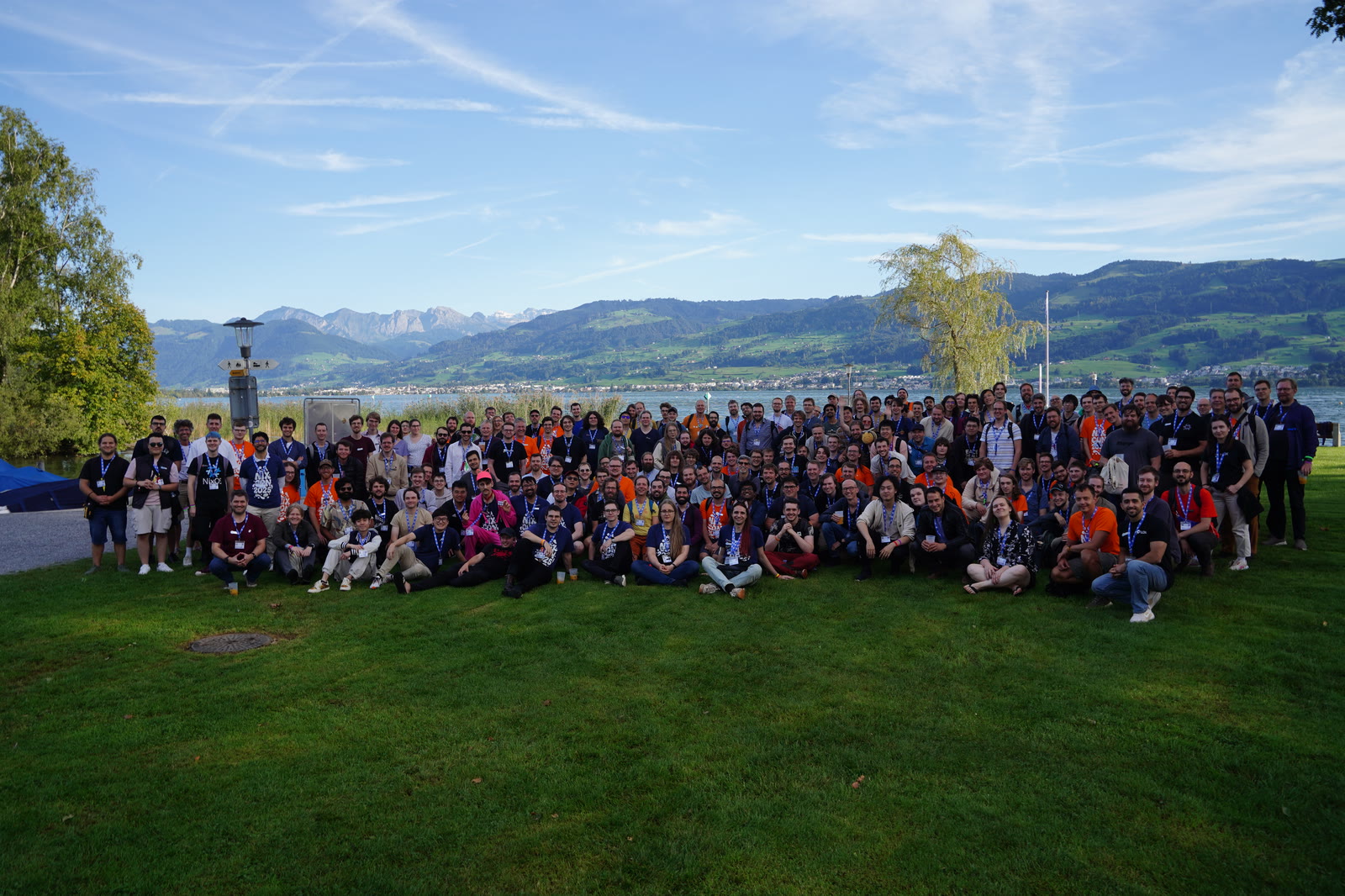
The most useful picture of Nix governance is not an organization chart. It is a conference lawn crowded with hundreds of people: package maintainers, infrastructure operators, tool builders, employers, users, and volunteers who may share a deployment model without sharing a boss. NixCon 2025 counted 442 attendees.[8] The system that coordinates them has to distribute authority without letting responsibility dissolve.
That is why NixOS's governance is now an engineering signal, not community-page decoration. The project replaced an arrangement shaped heavily by founder authority with a written constitution, a seven-seat elected Steering Committee, a legally separate Foundation board, public voting machinery, and delegated teams. Its current governance page names two leadership bodies and 21 teams, while stressing that nearly everyone involved is a volunteer.[1] The formal interfaces are far clearer than they were two years ago.
The hard dependency is trust: whether people believe those interfaces will still work when a decision is slow, commercially sensitive, or socially contentious. Nix has evidence of real institutional repair. It also has a later moderation breakdown showing that a constitution cannot manufacture usable authority by itself. For an organization betting on Nix, both facts matter more than a simplistic verdict that the project is either “fixed” or “in chaos.”
The failure was authority that existed mostly in prose
The 2024 rupture exposed a gap between the project people thought they had and the project they could actually operate. LWN's contemporary report described a five-member Foundation board responsible for legal and financial administration but not technical direction. Contributors alleged that founder Eelco Dolstra could nevertheless use social standing to reopen or block decisions made through boards and teams. The memorable diagnosis was “responsibility without authority”: people held accountable for moderation, review, or policy could not rely on their delegated decisions surviving escalation.[6]
This was not merely an argument over one conference sponsor. The sponsorship conflict made older coordination problems impossible to ignore: unclear final decision rights, disputed conflicts of interest, exhausted moderators, and technical or community processes that could be overridden by influence not documented anywhere. A project can tolerate ambiguity while its trusted group is small. As contributors, employers, infrastructure, and money multiply, invisible authority becomes a production risk.
The lesson is narrower than “democracy is always better” or “founders should leave.” Open-source projects succeed under many governance models. The dangerous state is a mismatch: the written model says one body decides, while participants learn that a different person or relationship decides in practice. That mismatch makes planning impossible because the escalation path changes precisely when a decision becomes difficult.
The constitution separates powers instead of pretending they vanish
Nix's constitution gives the project two top-level bodies with different scopes. The elected Steering Committee owns technical and community direction, delegation, official resources, and escalation. The NixOS Foundation board owns legal, financial, trademark, donation, and partnership work. Policies that touch both worlds—sponsorship is the obvious example—need both bodies.[2]
The split is concrete. The Steering Committee has seven seats. Regular elections happen annually for alternating halves of the seats, producing terms of at most two years and a limit of two consecutive terms. A candidate needs contributor standing, public endorsements, and conflict-of-interest disclosure. The election rules set both a soft limit of one member with the same payer and a hard ceiling of two. Each Foundation board term is at most two years; renewals are allowed, but the Steering Committee can object to appointments or renewals through defined votes.[2]
Those rules do not eliminate influence. Employers still fund contributor time; maintainers still accumulate expertise and trust; charismatic people still persuade. The improvement is observability. Affiliation is declared, tenure expires, exceptional decisions have thresholds, and there is a named place to appeal when delegated work stalls. Governance becomes inspectable state rather than oral tradition.
The constitution is also deliberately not a command tree. The current project page lists 21 formal teams beneath the two leadership bodies.[1] The Steering Committee delegated Nixpkgs-wide leadership to a Nixpkgs Core Team whose charter emphasizes bottom-up consensus, disagreement resolution, and lightweight technical direction. Its members explicitly say governance should not become so heavy that they must abandon ground-level contribution.[4] That is the right tension for a package collection: centralize the ability to resolve a deadlock, not every package decision.
Lightweight leadership has an immediate capacity boundary. In May 2026, the core team reported that it was down to two members, was responding more slowly than it wanted, and considered recruitment a high priority. The same update covered an automation policy, delegated software-provenance authority, and the response to a leaked committer token.[9] A charter can grant decision rights; it cannot give two volunteers limitless attention.
Paper rules have started producing operational artifacts
A constitution becomes credible when it leaves traces. After the 2025 Steering Committee election, the incoming committee formalized asynchronous voting, committed to publishing outcomes in a public decision log, and opened a repository for meeting minutes, decisions, and procedures. Its first logged vote authorized that repository; another amended the no-confidence mechanism.[3] These are modest artifacts, but modest is useful. A maintainer should be able to reconstruct who decided, under which rule, and whether the decision is still live.
The Foundation's March 2026 operations update provides a second kind of evidence. It reported another roughly €100,000 for Nix@NGI work, funding for more than 20 community events, paid administration for Google Summer of Code, and operational support around NixCon, grants, accounts, and trademarks. It also described onboarding a second person for Dutch tax-reporting access specifically to raise the bus factor, and completing the founder's removal from Foundation registrations and accounts.[5]
These details matter more than celebratory language. A legal separation is real when credentials move. Funding governance is real when named people can sign, report, pay, and be replaced. Delegation is real when a technical team can obtain infrastructure support through the Foundation without becoming the Foundation. The €100,000 grant and the second tax credential are very different sizes of work, yet both test whether the new interfaces carry actual capability.
There is still concentration. The same Foundation update describes individual board members doing large shares of budgeting, accounting, inbox work, event support, and partnership handling.[5] The governance page says most contributors are volunteers.[1] Written succession rules lower key-person risk; they do not create spare capacity. For adopters, the honest reading is that Nix now exposes where institutional load sits, not that the load has disappeared.
The moderation failure is a necessary counter-signal
The first elected structure did not pass every test. In September 2025, LWN reported that most of the NixOS moderation team resigned together after conflicts in which the Steering Committee repeatedly overrode it. The moderators argued that difficult disagreement needed active, safe facilitation and that communication with the committee had become less effective.[7] Whatever one's view of the underlying disputes, the governance failure is legible: a delegated team no longer believed it possessed enough authority or backing to perform its assigned job.
This does not prove the constitutional model is pointless. It proves that delegation needs more than a charter. The delegating body must define the team's domain, intervene predictably at its boundary, explain overrides, and retain a repair path before volunteers conclude that resignation is their only effective escalation. Public calm is a poor success metric if it comes from people leaving or declining to report problems.
The project has acknowledged the operational cost. The Foundation said it gave the Steering Committee a budget after the moderation turmoil and that some of it paid for professional help.[5] That is a sensible use of the legal-and-financial body: fund capacity while the community leadership body owns the policy problem. It is evidence of the new separation working, but not evidence that trust has already returned. The latter requires a durable moderation function whose scope and appeals remain usable during the next contentious case.
What the governance signal says to engineering teams
Nix's technical value proposition—reproducible builds, declarative systems, a huge package collection, and shared binary infrastructure—does not rise or fall with every community dispute. Nor can a serious adopter treat governance as irrelevant social weather. Governance determines who can resolve a security-process gap, authorize infrastructure spending, arbitrate a stuck cross-repository change, or keep a release-critical volunteer from burning out.
The present signal is therefore cautiously positive and unusually inspectable. There is a constitution with explicit decision rights; recurring elections with affiliation limits; separate community and corporate scopes; a public decision log; delegated Nixpkgs leadership; and a Foundation converting money into grants, events, access, and administrative continuity.[1][2][3][4][5] Those are meaningful controls for a project without a conventional vendor hierarchy.
The falsifier is equally clear. If hard decisions migrate back into private influence, if public logs go quiet while overrides continue, or if delegated teams repeatedly lose people because responsibility outruns authority, the formal design will be only a diagram. The 2025 moderation resignation is why that condition cannot be waved away.[7]
For a small team consuming Nix at the package-manager or workstation layer, this may justify observation rather than special mitigation: follow release and security channels, pin inputs, and keep rollback paths. An organization making Nix central to build, fleet, or developer infrastructure has a higher exposure. It should know which upstream teams own its critical paths, contribute where it can, and preserve an exit or fork strategy for components it cannot wait to have governed. No community constitution is an SLA.
The best next signals will look boring: annual elections that complete on time, decision records that include disagreements rather than only easy votes, Foundation reports that spread credentials and accounting work, and delegated teams that retain both contributors and authority. NixOS has made power easier to locate. Its harder work is proving, repeatedly, that people can use it without first having to leave.
Sources
- NixOS, “Governance” — current leadership split, Steering Committee elections, 21-team structure, and community values.
- NixOS organization, “Nix Governance Constitution” — scopes, terms, decision thresholds, elections, delegation, and conflict-of-interest rules.
- Nix Steering Committee, “Steering Committee Update #1” (November 20, 2025) — asynchronous voting, public decision logs, repository creation, and a constitutional amendment.
- NixOS, “Nixpkgs Core Team” — delegated Nixpkgs governance, consensus model, dispute resolution, and the lightweight-leadership boundary.
- NixOS Foundation, “NixOS Foundation Update August 2025–February 2026” (March 3, 2026) — grants, event funding, operational bus factor, moderation support, and account handover.
- Daroc Alden, “A leadership crisis in the Nix community,” LWN.net (April 29, 2024) — independent reporting on the pre-constitution authority conflict and moderation strain.
- Daroc Alden, “NixOS moderation team resigns,” LWN.net (September 29, 2025) — independent reporting on the conflict between the first Steering Committee and its delegated moderation team.
- NixCon 2025, official event page — attendance context and source page for Arik Grahl's CC BY-SA 4.0 conference photograph.
- Nixpkgs Core Team, “Nixpkgs core team update 2026-05-11” — two-member capacity warning, recruitment, automation policy, provenance delegation, and security-response work.