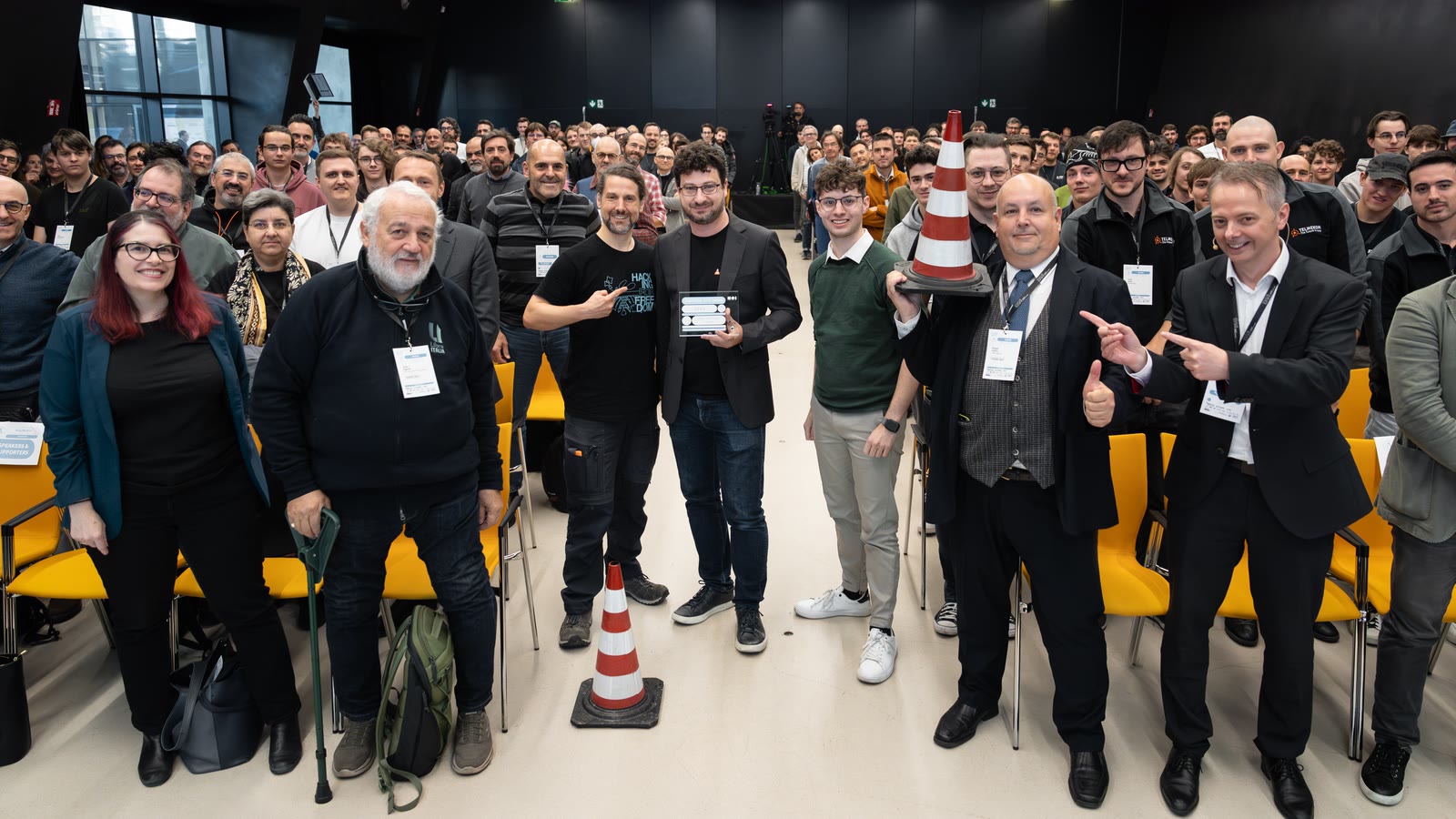
The orange traffic cone is so recognizable that it can hide the most interesting thing about VideoLAN. VLC is only the public entrance. Behind the player sits an embeddable engine, language bindings, codec implementations, optical-disc libraries, broadcast tools, and a nonprofit that gives these projects a shared institutional home. Some pieces ship inside VLC; others are useful precisely because another application can adopt them without adopting the VLC interface.[1][2]
That distinction makes VideoLAN worth mapping as an ecosystem rather than treating it as a single famous download. The map has four layers: the VLC application people operate directly; libVLC, which exposes the playback engine to other software; specialist libraries such as dav1d, x264, libdvdnav, and libbluray; and the stewardship layer that keeps projects, contributors, trademarks, events, and funding connected. The layers overlap, but they solve different jobs. Knowing which layer owns a problem can save an engineering team from choosing an entire media stack when it needs one decoder—or from assembling low-level parts when it really needs a maintained player engine.
VLC is the distribution surface
VLC packages a messy media world into an application: files, network streams, subtitles, hardware decoders, renderers, audio devices, playlists, filters, and platform-specific interfaces arrive behind one familiar play button. That surface is why VideoLAN can report a community spanning developers in 40 countries and projects ranging from streaming utilities to codec and disc libraries.[1] It is also why users often attribute every capability to “VLC” even when the work happens in a library shared with other software.
The current 3.0 release page makes the maintenance burden visible. It calls VLC 3.0.23 the twenty-fourth update to the Vetinari branch, lists refreshed third-party libraries alongside demuxer stability and security work, and credits Germany's Sovereign Tech Fund for supporting maintenance.[8] A mature player is therefore less a sealed product than a continuously reconciled distribution: upstream codecs change, operating systems age, file parsers meet hostile inputs, and hundreds of modules still have to produce one coherent user experience.
That is VLC's ecosystem role. It is the integration and distribution surface. If the job is “give a person a cross-platform player,” that surface is the point. If the job is “put reliable playback inside our own product,” the next layer is more relevant.
libVLC turns the player into an engine
VideoLAN describes libVLC as both the core engine beneath VLC and the interface other applications can embed. It is a C library, released under LGPL 2.1, with hundreds of runtime-loaded plugins and a version line tied to the VLC application: version 3 is stable while version 4 is the development track. Official bindings extend that C surface into C++, Objective-C and Swift, Java and Kotlin, and .NET; community bindings carry it into Python, Rust, Go, and other ecosystems.[2]
The API shows what “embedding VLC” actually means. An application creates a media-player object with libvlc_media_player_new, assigns media with libvlc_media_player_set_media, obtains an event manager with libvlc_media_player_event_manager, and controls playback through calls such as libvlc_media_player_play and libvlc_media_player_set_pause.[3] The host application owns its product interface and lifecycle. libVLC owns the media machinery behind that interface.
This is a different abstraction from shelling out to the VLC executable. It gives a product a player engine, not a second user interface. It is attractive when broad format and network support matter more than building a custom media pipeline from individual elements. The cost is equally concrete: the product inherits libVLC's native deployment, plugin packaging, platform integration, major-version transitions, and event-driven lifecycle. “VLC already plays it” is a useful proof of capability, but it is not yet a deployment plan.
dav1d and x264 occupy opposite sides of the codec lane
The specialist codec projects make the map less intuitive. dav1d is an AV1 decoder, developed by the VideoLAN and FFmpeg communities with sponsorship from the Alliance for Open Media. Its goals are narrow and infrastructural: speed, small size, portability, correct threading, and a permissive BSD two-clause license.[4] It does not provide a player window, a playlist, or a container workflow. It turns AV1 bitstreams into decoded pictures for whatever application or framework calls it.
x264 sits on the other side of the path. It is a library and command-line application for encoding video into H.264/AVC, with controls for rate, reference frames, B-frames, latency, and psychovisual optimization. Its official page also makes the distribution boundary explicit: x264 is available under the GPL and under a commercial license, and its users include applications and services well outside VLC.[5]
Putting dav1d and x264 beside VLC reveals the ecosystem's real shape. VideoLAN is not merely accumulating features for its own player. It hosts reusable implementations at sharply defined points in the media chain. A browser, editor, transcoder, streaming service, or hardware product may use one of these libraries while never presenting a cone to its users. Conversely, choosing libVLC does not eliminate codec provenance or licensing review; it moves those questions underneath a broader engine.
The relationship with FFmpeg reinforces that point. FFmpeg exposes command-line tools—ffmpeg, ffplay, and ffprobe—plus developer libraries such as libavcodec, libavformat, and libavfilter for codecs, containers, protocols, and processing.[9] VideoLAN and FFmpeg are therefore collaborators, upstreams, downstreams, and alternatives depending on the layer. dav1d is explicitly a joint-community decoder; x264 can be used through FFmpeg; VLC's own developer page lists FFmpeg's libavcodec among its component libraries.[4][5][13] “Which project wins?” is usually the wrong question. The useful question is which project should own playback, transformation, probing, or one codec in the product being built.
Disc libraries preserve awkward interoperability
The optical-disc projects show why smaller libraries survive inside a broader multimedia commons. libdvdnav presents DVD playback as a logical stream of blocks interrupted by navigation events. An application repeatedly requests the next block and responds to user actions while the library encapsulates the DVD virtual machine and its internal playback state. libdvdread handles the lower-level reading side.[6] That API keeps menu logic and interactive disc behavior out of every player that wants DVD navigation.
libbluray performs a related but separate job for Blu-ray: navigation, playlist parsing, menus, and BD-J support. Its project page is unusually clear about the limit. The library does not circumvent DRM, so it is not sufficient by itself to play protected commercial discs; AACS and BD+ sit outside that promise.[7] The boundary is legal as well as technical, and documenting it is part of interoperability work.
These libraries matter even as streaming dominates consumer attention. Media software inherits old formats, archives, specialist collections, kiosks, testing fixtures, and user expectations for decades. A reusable navigation library concentrates that maintenance where multiple players can benefit. VideoLAN's role is not to pretend the awkwardness disappeared. It is to give the awkwardness a named module, source repository, release line, and contribution path.
The neighboring stacks answer different questions
Two adjacent ecosystems clarify where VideoLAN ends. FFmpeg is strongest when the center of the job is inspection, conversion, filtering, or low-level composition through its command-line tools and libav* libraries.[9] GStreamer begins from a different premise: applications construct pipelines from elements, link them through pads, negotiate media types, and combine plugins into playback, capture, editing, streaming, or other data-flow systems.[10]
libVLC offers less pipeline authorship but more of a ready playback engine. GStreamer offers explicit graph construction and negotiation. FFmpeg offers a deep toolbox and libraries around formats, codecs, filters, and devices. These are overlapping choices, not a neat ladder. A product may even combine them. The decision turns on where the team wants to own complexity:
- Choose the VLC application when the product is the player experience itself.
- Choose libVLC when an application needs broad playback and streaming behavior behind its own interface.
- Choose a specialist library such as dav1d or x264 when the requirement is one codec job with a defined API and license surface.
- Choose FFmpeg when probing, transcoding, filtering, or direct
libav*composition is central. - Choose GStreamer when the application must explicitly assemble and control a live media pipeline.
This is not a universal ranking. Latency targets, hardware paths, mobile packaging, license compatibility, security-update ownership, and the team's native-code experience can reverse the answer. The value of the map is that it makes the comparison happen at the correct layer.
A shared home, with visible concentration
VideoLAN says the project became open source in 2001, separated completely from École Centrale Paris in 2009, and is now supported by an autonomous French nonprofit with a named board. Its project list spans VLC, libVLC, x264, dav1d, disc libraries, multicast and broadcast utilities, and other multimedia work.[1] That shared home supplies continuity without forcing every repository into one monolithic product.
The labor and money underneath it are less tidy. In a September 2025 interview, VideoLAN president Jean-Baptiste Kempf described the nonprofit as continuously improved by volunteer contributors, said he still spent roughly 30 to 40 hours a week on the work, and distinguished the association from service companies created from 2013 onward that employ community members and work with commercial clients.[11] The latest VLC 3 maintenance, meanwhile, carries an explicit public-funding credit.[8] Those are three different support channels—volunteer labor, commercial services, and targeted institutional sponsorship—and teams should not collapse them into an imagined vendor SLA.
The Free Software Foundation Europe's 2025 award for Kempf captures both the strength and the risk of that model. It credits his long stewardship and the wider VideoLAN community, while quoting him on the multimedia community's limited resources.[12] A famous application can still depend on concentrated human judgment. The practical adoption signal is neither “one heroic maintainer” nor “a giant anonymous crowd.” It is a small institution coordinating reusable projects, specialist contributors, outside communities, and episodic funding around software used at enormous scale.
That is the multimedia commons behind the cone. VLC gives it a public face. libVLC lets other products borrow the engine. Codec and disc libraries let the pieces travel independently. Neighboring projects interoperate where their abstractions meet. The nonprofit keeps a shared address over the whole arrangement. Once the layers are visible, VideoLAN becomes easier to evaluate—and much more interesting than a player that simply opens almost any file.
Sources
- VideoLAN, “VideoLAN, a project and a non-profit organization” — project history, board, contributor geography, hosted projects, and contribution channels.
- VideoLAN, “libVLC” — engine role, runtime plugins, license, version lines, supported platforms, and official/community bindings.
- VideoLAN,
libvlc_media_player.hAPI reference for VLC 3.0 — media-player construction, media assignment, events, playback, pause, and lifecycle calls. - VideoLAN, “dav1d” — AV1 decoder scope, joint VideoLAN/FFmpeg development, sponsorship, technical goals, and BSD license.
- VideoLAN, “x264” — H.264/AVC encoder scope, feature surface, external users, and GPL/commercial licensing.
- VideoLAN, “libdvdnav & libdvdread” — DVD navigation API, logical-block stream, event handling, and virtual-machine encapsulation.
- VideoLAN, “libbluray” — Blu-ray navigation, playlist, menu, and BD-J scope plus the DRM-circumvention limit.
- VideoLAN, “VLC 3.0.23 Vetinari” — twenty-fourth VLC 3 update, third-party library refreshes, stability and security work, and Sovereign Tech Fund support.
- FFmpeg, “About FFmpeg” — command-line tools and the roles of
libavcodec,libavformat,libavfilter, and the other developer libraries. - GStreamer Application Development Manual, “What is GStreamer?” — element-and-pipeline model, plugin framework, media negotiation, and application scope.
- Adrien Tsagliotis, “VLC est le logiciel français le plus utilisé au monde,” Journal du Net (September 18, 2025) — independent interview on VideoLAN's history, volunteer labor, user scale, and the association/company funding boundary.
- Free Software Foundation Europe, “Jean-Baptiste Kempf receives the European SFS Award 2025 at SFSCON” — independent stewardship context and source page for the CC BY-SA 4.0 article photograph by NOI Techpark–Marco Parisi.
- VideoLAN, “VLC media player” developer page — source, contribution workflow, and the component-library list including FFmpeg's
libavcodec.