Mesa is easy to describe badly. Calling it "the Linux graphics driver" hides the thing that makes it useful: Mesa is the userspace boundary where application graphics APIs, shader compilers, GPU-specific command streams, window-system integration, and kernel driver contracts meet. The current release notes make that boundary visible. Mesa 26.1.0 implements OpenGL 4.6 and Vulkan 1.4 at the project level, but the reported version still depends on the individual driver and the features that hardware and driver code actually support.[2]
That caveat is the architecture. Mesa is not one uniform driver with a long feature checklist. It is a shared userspace graphics stack that lets different hardware families and API front ends reuse as much infrastructure as possible while keeping hard device limits explicit. The release notes page shows the pace of that machine: as of this writing, the public list has 26.1.x and 26.0.x maintenance releases side by side, while the release calendar already shows the next 26.1 point releases and the 26.2 release-candidate window.[1][10] The practical adoption lesson is simple: when you update Mesa, you are not just updating a library. You are updating the translation layer between applications, compositors, games, toolkits, and the kernel.
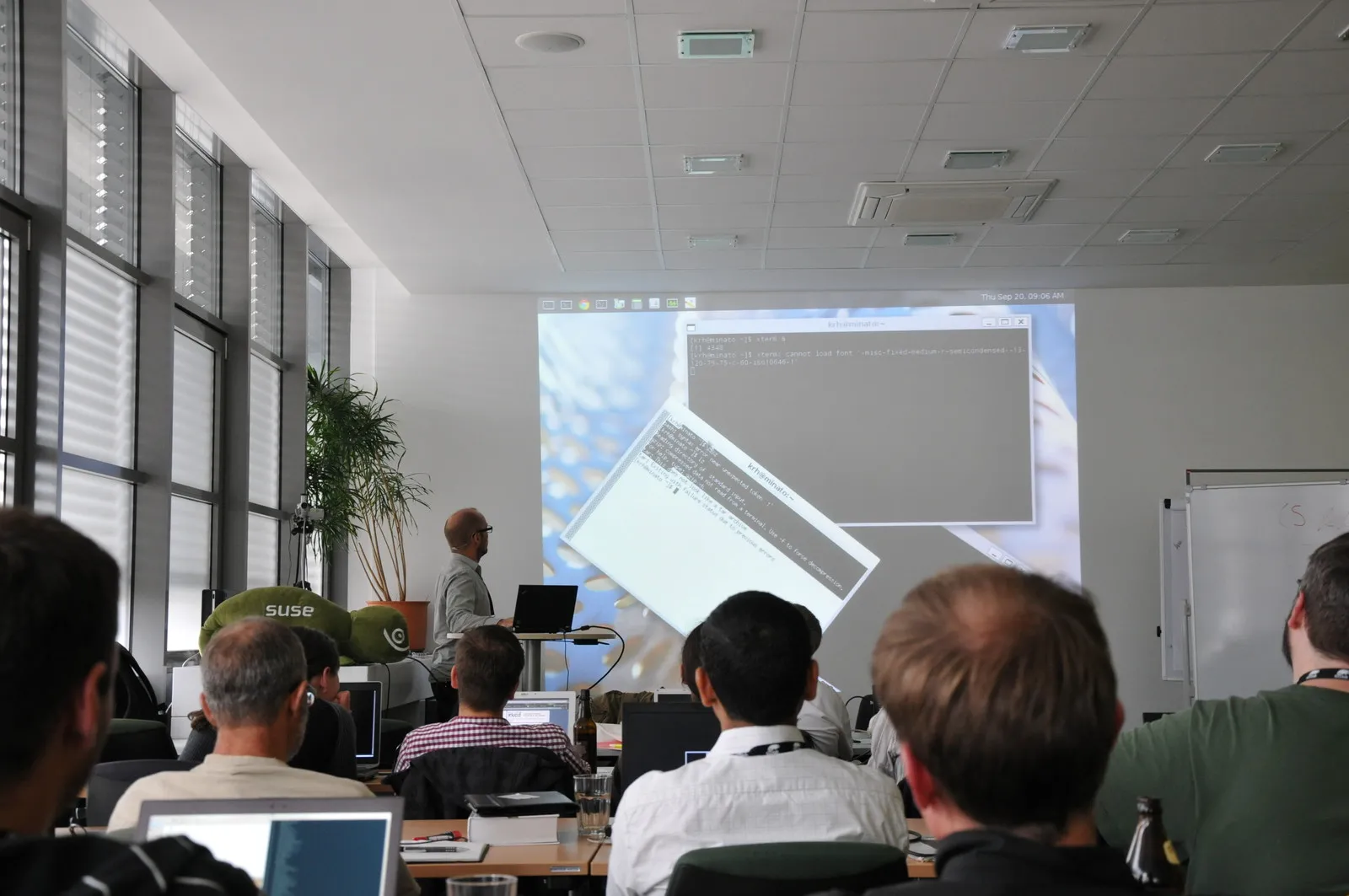
The cover image comes from Phoronix's X.Org Developers Conference coverage. That matters because XDC is no longer just about the old X server; the same coverage describes the conference as a place for Mesa graphics drivers, Wayland, libinput, DRM kernel drivers, and related desktop infrastructure.[11] Mesa belongs in that room. Its job is to make the room coherent.
Gallium turns OpenGL into a reusable driver contract
Gallium is one of Mesa's clearest architectural moves. The docs define Gallium as an API for writing graphics drivers in a largely device-agnostic way, with objects that encapsulate core graphics-hardware services.[3] That sentence sounds dry until you compare it with the alternative: every OpenGL-era driver building its own state tracking, resource handling, and hardware-capability model from scratch.
The useful unit in Gallium is not "draw a triangle." It is the set of boundaries around a device. A Gallium screen represents the context-independent part of a device; its capability table exposes whether graphics or compute is supported, how textures, render targets, shader features, alignment rules, query types, memory behavior, and hardware acceleration are represented.[4] That is not glamorous, but it is why a higher-level API layer can ask a driver what the hardware can actually do instead of guessing from marketing names.
This also explains why Mesa can support old, new, physical, virtual, and translation targets in the same project. The platforms-and-drivers documentation spans AMD, NVIDIA, Intel-adjacent paths, Qualcomm, Broadcom, Arm Mali, PowerVR, VMware SVGA3D, virgl, Venus, Zink, LLVMpipe, and others.[13] Some are hardware drivers. Some are virtual or software paths. Some are translation layers. The shared architecture matters because Linux graphics is not one hardware market. It is laptops, desktops, Steam Decks, single-board computers, VMs, CI runners, workstations, and old devices people still expect to boot.
NIR makes shaders a shared compiler problem
Shaders are where driver duplication gets expensive. A modern graphics stack cannot treat shader compilation as a private afterthought in every driver because the same logical operations need optimization, lowering, validation, debugging, and hardware-specific finalization across many back ends. Mesa's NIR docs describe NIR as the optimizing compiler stack at the core of most Mesa drivers' shader compilers, with data structures, helper functions, optimization passes, and lowering passes.[5]
That division of labor is the important part. NIR does not erase the need for hardware-specific compilers. It creates a common middle where many transformations can be shared before code reaches a GPU's native instruction set. The result is not only less duplicated code. It is a better place to reason about correctness. If a shader optimization or lowering rule is shared, multiple drivers can benefit, and multiple drivers can reveal when the shared assumption is wrong.
This is one reason Mesa feels more like infrastructure than a bundle of vendor drivers. A game, compositor, browser, or CAD program may enter through OpenGL, Vulkan, or another API path. Underneath, much of the shader work still passes through a common compiler culture. The boundary is not "application talks to card." It is application API, shared IR, driver-specific lowering, command generation, kernel submission, and hardware execution.
Vulkan keeps dispatch explicit
Mesa's Vulkan side shows the same pattern in a newer API world. The Vulkan dispatch docs describe generated entrypoint and dispatch tables, aliases for core and extension names, and driver-specific entrypoint generation.[6] The details are necessarily mechanical, but they reveal a key design pressure: Vulkan moves quickly, extensions graduate or gain aliases, drivers implement different subsets, and client code still needs stable function lookup.
Mesa handles that by making dispatch a generated and inspectable part of the stack rather than a cloud of handwritten glue. A driver can generate entrypoints with a chosen prefix; unimplemented entrypoints become null entries instead of link failures; layers and clients such as Zink can load dispatch tables from an underlying implementation.[6] That makes Vulkan feature movement survivable. The API can grow without forcing every driver to edit the same boilerplate by hand.
RADV, Mesa's AMD Vulkan driver, shows where the generated machinery meets hardware. Its docs describe RADV as a userspace driver implementing Vulkan on modern AMD GPUs and explain the split between kernel-mode and user-mode responsibilities.[7] The kernel driver handles PCIe communication, display, video-memory management, and writing submitted commands to GPU ring buffers; RADV records commands, programs GPU registers, compiles shaders to native ISA, and submits command streams through kernel interfaces.[7]
That separation is the Mesa boundary in one paragraph. The kernel owns privileged hardware management. Mesa's userspace driver owns API implementation, shader compilation, command construction, and the interface to the kernel uAPI. When Mesa breaks, the symptom can look like "the GPU driver is broken," but the actual fault line might be shader lowering, extension exposure, winsys behavior, kernel uAPI assumptions, compositor interaction, or an application relying on behavior no spec promised.
Zink turns translation into an architecture choice
Zink is the best proof that Mesa is not just a bag of native hardware drivers. The Zink docs describe it as a Gallium driver that emits Vulkan API calls instead of targeting a specific GPU architecture, letting devices with Vulkan support expose full desktop OpenGL support.[8] In other words, Mesa can implement OpenGL by translating it into Vulkan inside the same project.
That matters for maintenance. Native OpenGL drivers are expensive to carry forever, especially for newer GPUs where Vulkan is the healthier implementation target. Zink offers a different strategy: keep OpenGL applications working by using a Vulkan driver underneath, then express OpenGL support as a set of Vulkan feature requirements.[8] The docs make those requirements concrete, walking through what Vulkan versions, device features, extensions, and limits are needed for different OpenGL levels.[8]
NVK makes the shift more tangible. The NVK docs describe NVK as Mesa's Vulkan driver for NVIDIA GPUs, conformant to Vulkan 1.4 for officially supported GPUs, and say that starting with Mesa 25.1, Turing and later NVIDIA GPUs use NVK plus Zink as their default OpenGL implementation instead of the old Nouveau GL driver.[9] That is a major architectural statement. The future of an OpenGL implementation can be a Vulkan driver plus a translation layer, not a separate GL driver forever.
The tradeoff is that Zink pushes responsibility into capability matching and Vulkan driver quality. If the underlying Vulkan implementation lacks the right features or has rough edges, OpenGL-over-Vulkan will inherit those limits. That is still a better boundary than pretending every API deserves a full native stack for every GPU generation. Mesa's strength is that it can draw the boundary honestly and then improve it in public.
Release cadence is part of the interface
Mesa's release cadence is not administrative trivia. The release calendar says Mesa provides feature/development and stable releases, keeps the current and next two feature releases visible, and rotates the person in charge of the next feature release.[10] That matters because Mesa sits below user-visible applications but above distributions and kernels. A compositor bug, game regression, video path issue, or driver feature can be fixed upstream, but the fix only helps users when it moves through release branches and distribution packaging.
The 26.1.0 release notes show why the cadence has to be disciplined. The feature list includes new OpenGL and Vulkan extensions across RADV, NVK, Turnip, ANV, panvk, v3dv, lavapipe, PowerVR, and other paths, while the same release still warns stability-focused users to wait for the first point release.[2] Phoronix's independent release readout framed Mesa 26.1 similarly: a broad open-source OpenGL and Vulkan driver release with Vulkan-driver improvements, gaming-related optimizations, Rusticl, Zink work, RADV Vulkan Video movement, NVK improvements, and smaller-driver progress.[12]
The pattern is not "new Mesa equals faster games." Sometimes it does. Sometimes a point release is a regression fix. Sometimes a new extension matters only to one driver, one compositor, one game engine, or one hardware family. The architecture note is that release cadence is the public transport mechanism for all of those small moving parts.
Where Mesa fits
Mesa is strongest when an operating system or distribution needs a shared, inspectable, fast-moving userspace graphics stack for heterogeneous hardware. It is especially important for Linux desktops, handheld gaming devices, virtual machines, browsers, compositors, scientific visualization, and CI environments that depend on software or virtual drivers. Its value is not only open-source licensing. Its value is that OpenGL, Vulkan, compiler IR, driver capabilities, command submission, and translation paths are developed in one visible conversation.
The adoption boundary is just as important. Mesa does not magically make unsupported hardware modern. A driver can expose OpenGL 4.6 or Vulkan 1.4 only when that driver and hardware meet the requirements.[2] A Zink path can be elegant only if the Vulkan layer below it is healthy.[8][9] A RADV improvement can still depend on kernel support, firmware, libdrm, distribution packaging, and application behavior.[7] Treating Mesa as a single switch labeled "graphics driver" is how teams misdiagnose problems.
The better operating model is layered. Know your kernel driver. Know whether the workload enters through OpenGL, Vulkan, OpenCL, video, or a translation path. Know whether the relevant Mesa driver is native, software, virtual, or layered through something like Zink. Track the branch your distribution ships, not only the upstream headline. Then Mesa becomes readable: not a driver pile, but the userspace boundary that lets the graphics stack change without every application and every GPU having to negotiate from scratch.
Sources
- Mesa 3D, "Release Notes" - current release-note index showing 26.1.x, 26.0.x, and earlier branches.
- Mesa 3D, "Mesa 26.1.0 Release Notes / 2026-05-06" - OpenGL 4.6 and Vulkan 1.4 implementation notes, per-driver version caveats, and new feature list.
- Mesa 3D, "Gallium: Introduction" - Gallium as a device-agnostic driver API and shared object model.
- Mesa 3D, "Gallium: Screen" - screen object role and driver/GPU capability reporting through
pipe_caps. - Mesa 3D, "NIR Intermediate Representation" - NIR as the optimizing compiler stack used by most Mesa shader compilers.
- Mesa 3D, "Vulkan Runtime: Dispatch" - generated entrypoint tables, dispatch tables, aliases, and driver dispatch generation.
- Mesa 3D, "RADV" - AMD Vulkan userspace driver scope, supported hardware notes, loader behavior, and UMD/KMD responsibility split.
- Mesa 3D, "Zink" - OpenGL-over-Vulkan Gallium driver overview, feature requirements, and OpenGL support levels.
- Mesa 3D, "NVK" - NVIDIA Vulkan driver status, Vulkan 1.4 conformance note, and NVK+Zink OpenGL default for Turing-and-later GPUs.
- Mesa 3D, "Release Calendar" - feature/stable release process, rotating release manager note, and 26.1/26.2 schedule.
- Michael Larabel, "X.Org Developers Conference 2026 Being Hosted By Arm In Toronto," Phoronix, February 3, 2026 - XDC scope note and source page for the real X.Org Developers Conference photograph used as the article image.
- Michael Larabel, "Mesa 26.1 Released With Many Improvements For Open-Source Vulkan Drivers," Phoronix, May 6, 2026 - independent release readout on Mesa 26.1 driver, Zink, Rusticl, RADV, and NVK changes.
- Mesa 3D, "Platforms and Drivers" - supported platform notes and driver list across hardware, software, virtual, and translation targets.