Matrix is easiest to misunderstand when it is introduced as "open-source Slack" or "federated Discord." Those comparisons help a user picture rooms, clients, usernames, and bridges, but they hide the architectural center. Matrix is an event graph first. Chat is the most visible application sitting on top of a replicated, signed, eventually consistent room history shared by homeservers that do not answer to one operator.[1][2]
That framing changes the adoption conversation. If a team wants a private chat service with one operator, one database, one moderation boundary, and one incident owner, Matrix can do that, but the protocol's design is larger than that use case. Its interesting promise is that a room can be shared across servers while each participating homeserver keeps a local copy, accepts client writes, validates incoming federation traffic, and tries to converge on the same room state after delays, races, and hostile inputs.[1][2][3]
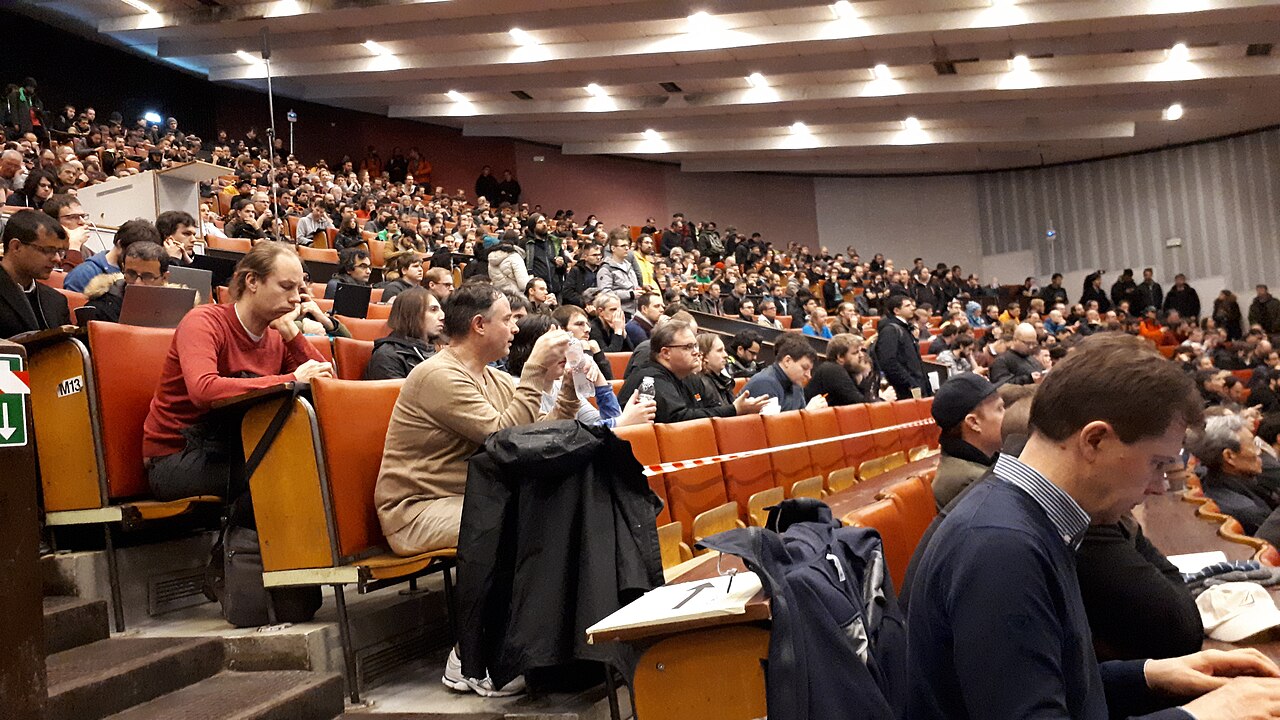
Image context: the cover photograph shows the FOSDEM 2019 opening session in Brussels. It fits this article because Matrix is a protocol shaped by open-source infrastructure culture: public specification work, multiple implementations, conference rooms full of operators, and the awkward requirement that independently run systems must keep talking after the easy assumptions are gone.[8]
The room is the unit of replication
The Matrix specification describes clients emitting events into virtual rooms, while homeservers synchronize the room's communication history with other homeservers through the Server-Server API.[1][3] A user belongs to a homeserver; a room does not belong to the domain that appears in its room ID. The room is replicated across all homeservers whose users participate in it, which is why the spec says no single homeserver has control or ownership over a given room.[1]
That one design choice explains much of Matrix's shape. A room cannot be treated as a row in one authoritative database. It is a shared data structure whose participants may observe, receive, and append events in different orders. The spec models that history as a directed acyclic graph, not a linear log. Each event points back to one or more previous events, carries metadata such as depth, and is signed by the originating server in the context of the graph.[1]
For ordinary conversation, that machinery should disappear behind a client. For operators and implementers, it should stay visible. A federated room can experience network partitions, delayed traffic, backfill, server outages, spam waves, and moderation disputes. If the architecture is read as a chat database, these look like edge cases. If it is read as an event graph, they are the center of the system.
Events are the protocol surface
Matrix puts nearly all room activity into JSON events: messages, membership changes, power-level changes, room names, topics, bans, and application-specific extensions.[1][2] The user-facing result may look like chat, but the protocol surface is more general. The specification reserves the m. namespace for standard event types such as m.room.message, while custom event types can use Java-style namespacing.[1]
That gives Matrix a real extensibility story. Bridges, bots, widgets, application services, and custom collaboration features can attach meaning to events without waiting for one product owner to bless every workflow. The tradeoff is that event bodies are untrusted data. The spec explicitly warns implementations not to assume the expected fields or types are present.[1] Every client, bot, bridge, and moderation component has to validate what it consumes.
This is a useful boundary for engineering teams. Matrix is not only a UI choice; it is a data contract. The key APIs, event schemas, state events, authorization checks, and room versions matter more than the brand of web client placed in front of them. If a team cannot own schema validation, media policy, room membership semantics, and failure behavior, it has not adopted the architecture. It has only installed a chat stack.
Federation moves failure into state resolution
Federation is the part that makes Matrix worth discussing and difficult to operate. The Matrix.org concepts guide explains the local-copy model directly: when a user joins a room from another homeserver, that homeserver obtains a copy of the room and stays in sync with the others.[2] The Server-Server API then has to carry event exchange, authorization, backfill, device and key interactions, and room-state convergence across independently administered servers.[3]
The CAP tradeoff is explicit in the spec: Matrix optimizes for availability and partition tolerance at the expense of immediate consistency.[1] That is a sober choice. It lets conversations continue when one server cannot see another, but it creates merge work later. State events are the hardest part because they define persistent room facts: membership, topic, join rules, power levels, bans, aliases, and other values keyed by event type and state_key.[1]
When two servers disagree about state after a partition or race, Matrix needs deterministic resolution rather than operator preference. The state-resolution algorithm must produce the same answer regardless of local server state or arrival order.[1] That requirement is where the protocol stops being "chat" and starts looking like distributed systems engineering. The room is a replicated object. Membership and authority are part of that object. Conflict handling is not optional decoration.
Room version 12 is the architecture speaking
Project Hydra in 2025 made this concrete. Matrix.org's disclosure described State Resolution v2.1, room version 12, and related MSCs as a coordinated protocol update that addressed state-reset behavior and room-creation soundness issues.[4] The impact was scoped: the serious risk applied to servers federating with untrusted or potentially malicious servers, not to isolated private deployments.[4] That distinction is the architectural lesson.
A private Matrix server and a public federated Matrix server are not the same operating problem. Public federation means a homeserver accepts the burden of adversarial peers, delayed events, and room state that can be contested by more than one administrative domain. Room version 12 changes such as creator privilege and room IDs tied to create events show how deep the trust model goes.[4] The protocol has to decide who can recover control, how room identity is anchored, and how conflicting state gets replayed.
For teams evaluating Matrix, this is a good sign and a warning at the same time. It is a good sign because the ecosystem is still tightening protocol soundness in public. It is a warning because running Matrix as serious infrastructure means tracking room versions, server upgrades, security advisories, and room-upgrade paths rather than treating the homeserver as a static appliance.
Synapse exposes the operator boundary
Synapse, the most familiar Matrix homeserver implementation, makes the operational surface visible in its configuration documentation. The server_name is the public identity suffix for users and room addresses and cannot be changed later.[5] Federation discovery can involve /.well-known/matrix/server; listeners are separated by resource type, including client, federation, media, keys, openid, and metrics; options such as allow_public_rooms_over_federation, ip_range_blacklist, and default_room_version show how many protocol choices become operational choices.[5]
This is the practical adoption boundary. Matrix is friendliest when the team can decide its federation posture before launch. A closed internal deployment, a private federation among known organizations, and participation in the public Matrix network each imply different moderation, abuse, networking, storage, backup, and upgrade responsibilities.[4][5][6] The same homeserver binary can sit in all three contexts, but the risk surface is not the same.
The failure modes are concrete. A weak server_name choice becomes a long-lived identity problem. Casual public federation can expose small operators to spam, room-list scraping, unwanted media, and difficult moderation workflows. Large public rooms increase database and synchronization pressure. Bridges extend the event graph into other systems and bring their own policy mismatches. None of these are reasons to avoid Matrix. They are reasons to treat it as protocol infrastructure rather than a weekend chat install.
Moderation is part of the architecture
Open federation makes moderation more technical, not less. Matrix.org's 2025 safer-network update framed abuse response as an ecosystem problem involving reporting, room takedown, trust and safety tooling, policy rooms, server administrators, and client behavior.[6] That matters because Matrix decentralizes the control plane. There is no universal platform moderator who can erase a room from every homeserver in one database operation.
Power levels are one local mechanism. They decide who can speak, redact, invite, ban, change room settings, or upgrade a room.[2] But public-network safety also requires social and operational layers: server policies, room rules, admin cooperation, media quarantine, user reporting, client affordances, and sometimes defederation.[6] In Matrix, moderation is not just a content-policy department. It is a distributed systems concern with human consequences.
This also explains why Matrix keeps attracting government, institutional, and open-infrastructure attention. A 2025 systematic mapping study describes Matrix as decentralized, secure, and interoperable, with homeservers communicating through federation and users choosing their own server while still participating across the network.[7] That combination is rare. It is also demanding. The point is not that every organization needs public federation. The point is that Matrix gives organizations several points on the spectrum between local control and network participation.
Where Matrix fits
Matrix fits best when the communication boundary is itself part of the requirement. Open-source communities, public-interest organizations, research networks, inter-company collaboration spaces, governments, and teams with bridge-heavy workflows may benefit from a protocol that separates client choice, server operation, room identity, and federation policy.[1][3][7]
It fits less cleanly when the problem is only "we need office chat." A conventional SaaS chat product may be operationally simpler if one vendor, one admin console, one search system, and one compliance story are acceptable. Matrix earns its complexity when the team values inspectable protocol behavior, client diversity, local server control, or federation with outside parties enough to operate those properties deliberately.
The adoption pattern should start with architecture rather than branding:
- Decide whether the deployment is closed, privately federated, or public-federated.
- Choose
server_name, discovery, TLS, media, backup, and database posture before users arrive.[5] - Track room versions and security advisories as part of regular operations, especially for public federation.[4]
- Treat bridges and bots as protocol participants that need validation, policy, and incident plans.[1][6]
- Build moderation and abuse response into the operating model before opening public rooms.[2][6]
Matrix's durable idea is not that chat can be open source. The stronger idea is that conversation state can be shared across administrative boundaries without pretending those boundaries have disappeared. That is why the event graph matters. It is the place where messages, identity, authority, delay, moderation, and trust all become one engineering problem.
Sources
- Matrix Specification, version v1.18, architecture, events, event graphs, room structure, state events, and CAP framing.
- Matrix.org, "Rooms & Events," concepts guide covering events, local room copies, homeserver federation, and power levels.
- Matrix Specification, Server-Server API, federation API surface for homeserver-to-homeserver communication.
- Matrix.org, "Project Hydra: Improving state resolution in Matrix," August 2025 disclosure on State Resolution v2.1, room version 12, and related CVEs.
- Synapse configuration manual, server identity, federation discovery, listeners, room version, and public-room federation options.
- Matrix.org, "Building a Safer Matrix," February 2025 ecosystem update on abuse response and trust-and-safety work.
- Soares et al., "Matrix protocol: a comprehensive systematic mapping study," Journal of Cloud Computing, 2025.
- Wikimedia Commons, "FOSDEM 2019 Opening session.jpg," photograph by Geertivp.