Godot is easiest to misread when it is introduced only as the open-source alternative to Unity. That label is useful for orientation, but it hides the engineering question that matters for adoption: whether your team wants to build around Godot's scene tree, editor-first workflow, scripting tiers, and export model. In 2026, the engine's case is no longer just that it is free. The stronger case is that its project model is coherent enough to shape how teams compose game objects, tools, native extensions, and platform builds from the first week of production.[1][3][4][6]
As of 2026-04-22T19:05:27Z UTC, the public Windows download page lists Godot Engine 4.6.2 and the matching .NET 4.6.2 build, dated 2026-04-01, with export templates available for supported platforms.[2] The broader 4.6 release is framed by the project as a shift into polish, workflow quality, standards integration, and performance optimization after the earlier Godot 4 cycle.[1] That is the context for evaluating Godot now. The relevant question is less "Can this engine make a game?" and more "Does this engine's mental model fit the way this team needs to build, test, extend, and ship?"
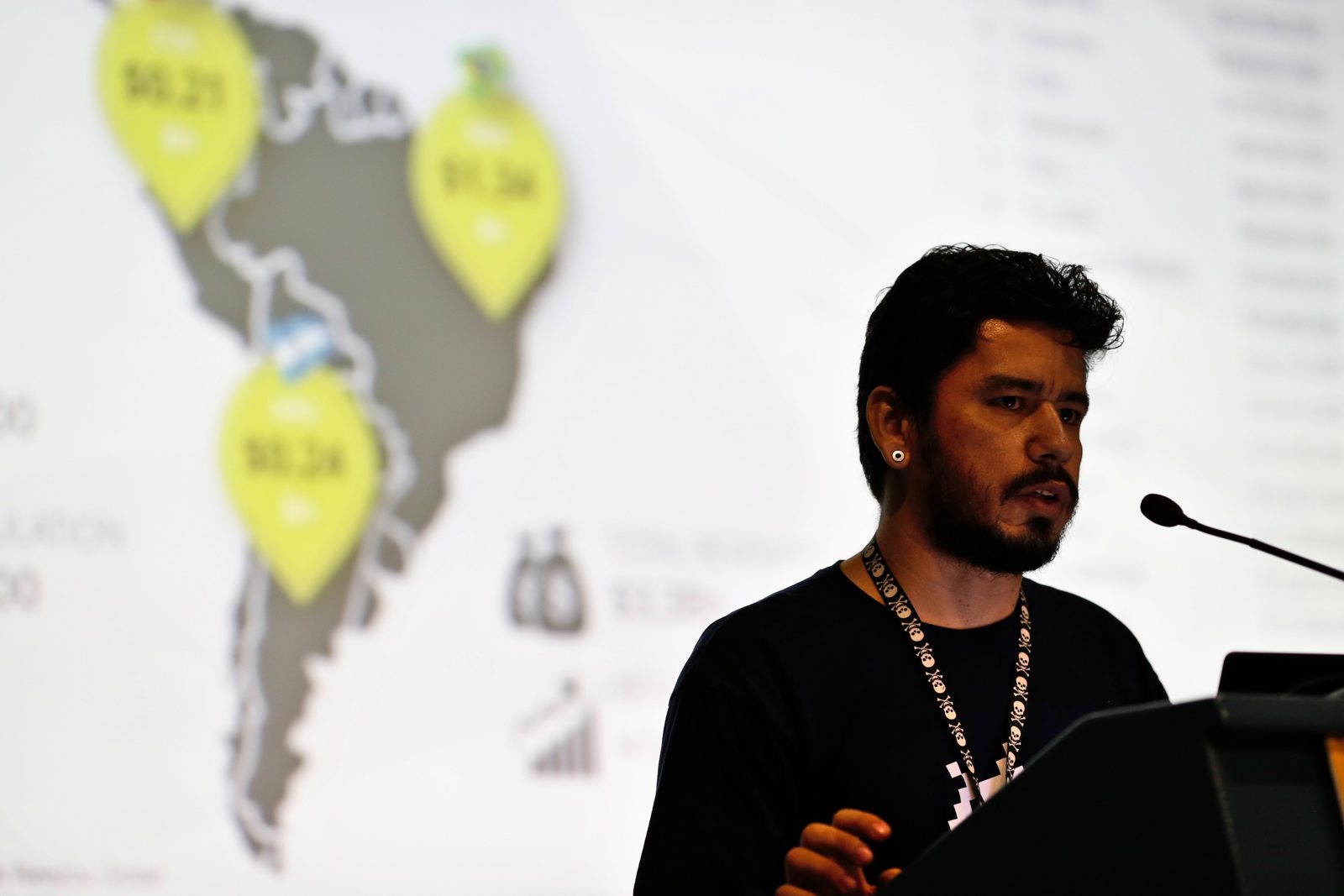
Image context: the cover uses a real photograph from a 2015 free-software conference session about presenting the Godot Game Engine. It is a historical community image rather than a diagram or generated visual, which fits the post's focus on Godot as an open-source project with a long teaching and contributor culture.[10]
The adoption primitive is the scene tree
Godot's most important idea is small enough to miss. The docs define a Godot game as a tree of scenes, and each scene as a tree of nodes.[3] Nodes are the base building blocks: they have names, editable properties, callbacks, extensibility points, and child relationships. When arranged into a tree and saved, that structure becomes a scene; once saved, scenes can behave like new node types inside the editor and can be instanced as children of other nodes.[3]
That means Godot adoption starts with composition discipline. A team is not merely choosing an editor. It is choosing a habit: build behavior by making small nodes, group them into scenes, and reuse those scenes as units that can be nested, instanced, edited, and promoted into larger assemblies. This is why Godot can feel unusually direct for small teams. The same unit can be a playable character, a UI panel, an enemy spawner, a pickup, a camera rig, or a tool-specific editor component.[3]
It also explains where early misuse begins. Teams arriving from prefab-heavy or ECS-heavy environments can try to make Godot behave like their previous engine. Sometimes that works. More often, the project becomes clearer when the team lets scenes and nodes stay central: make a few scene types, keep ownership readable, avoid hiding too much state behind global singletons, and treat the scene tree as production architecture rather than a beginner tutorial artifact.
The 4.6 release reinforces that interpretation. Unique Node IDs let the engine track nodes more reliably when scenes are reorganized or refactored, and the release notes call that a robustness turn for larger, more complex projects.[1] That detail matters because it touches the same boundary as adoption: scene structure remains Godot's core unit, so the engine's maturity depends on making scene refactors safer instead of pushing teams away from the scene model.
Language choice is tiered, not ideological
Godot's scripting story is better understood as a tiered system than as a language debate. The scripting docs summarize the official set as four languages and explicitly say teams can mix languages, using C or C++ for demanding algorithms while writing most game logic in GDScript or C#.[4] That is the useful mental model. GDScript gives fast editor-native iteration. C# gives teams a familiar statically typed lane when their codebase or hiring base points that way. C++ through GDExtension gives a native path for performance-heavy or integration-heavy work.[4][5]
The GDExtension boundary is especially important. The docs describe it as a Godot-specific system that lets the engine interact with native shared libraries at runtime, so native code can run without being compiled into the engine itself.[5] The interface is built around gdextension_interface.h, extension_api.json, and .gdextension files that tell Godot what to load.[5] In practical terms, this means a team can keep most gameplay in Godot-native code while putting narrow, demanding, or legacy-adjacent pieces behind native libraries.
That flexibility has a cost surface. GDExtension should be treated as an integration boundary, not as a reason to move the whole project into C++. Once native libraries enter the project, build matrices, ABI compatibility, platform-specific packaging, debugging, and release coordination become part of the job. The best adoption pattern is to keep the high-change gameplay layer close to the editor, then reserve native code for places where performance, platform SDK integration, or existing C/C++ code justifies the added operational weight.[4][5]
The 4.6 signal is workflow maturity
Godot 4.6 is not best read as a single marquee-feature release. Its theme is the reduction of daily production friction. The official release page points to a new Modern editor theme, Jolt Physics as the default for new 3D projects, movable and floatable docks, a new IK framework, a Screen Space Reflection overhaul, unique Node IDs, LibGodot, ObjectDB snapshots, export patch improvements, and many smaller editor changes.[1] Digital Production's independent readout makes a similar point from the CG side: the release emphasizes polish, predictable tooling, rendering and debugger improvements, and production-facing defaults more than spectacle.[9]
For an OSS evaluator, that is a stronger sign than a flashy feature list. Game engines live or die on iteration loops: open a scene, change the object, inspect runtime state, ship a test build, profile the result, and repeat. Godot 4.6's most adoptable improvements sit in that loop. Floating docks help multi-monitor workflows. ObjectDB snapshots help debug live object growth. Unique Node IDs reduce breakage during refactors. Delta-encoded patch PCKs make frequent updates less wasteful.[1]
LibGodot widens the boundary further. The 4.6 notes introduce LibGodot as a way to embed the engine directly into custom applications, with initial support across Linux, Windows, and macOS.[1] That does not turn every game team into an engine integrator. It does, however, show that Godot's shape is widening beyond a standalone editor executable: custom tools, simulation hosts, specialized editors, and non-game realtime applications can become more plausible without forking the whole engine.
Export is part of the production model
Godot's export system is another place where adoption becomes real. The export docs say the editor stores most export configuration in export_presets.cfg, which can be committed safely to version control, while confidential options such as passwords and encryption keys live in .godot/export_credentials.cfg and normally should stay out of shared repositories.[6] That split is exactly the kind of detail teams should care about before production. Repeatable builds require the preset; credential hygiene requires the secret file to remain separate.
The same docs make clear that exporting requires platform-specific setup and export templates, and that the command line can run exports with --export-release, --export-debug, or --export-pack once presets are defined.[6] That gives Godot a clean path into CI, but it also means teams should test export early. A project that runs beautifully inside the editor can still hit platform SDK requirements, asset packaging decisions, compression tradeoffs, and template setup during release work.[6]
Mobile raises the stakes. Godot's April 2026 mobile update says about 49% of Godot developers target mobile platforms, and it identifies mobile export work around repeatable builds, fewer device-specific surprises, and smoother testing.[7] The same post points to the practical sprawl of Android hardware, describing more than 12,000 Android devices, and reports that two Godot games with mobile crash data saw crash rates move from roughly 4% to below 1% after fixes around rendering and GPU API usage.[7] This is a useful signal because it is production-shaped rather than aspirational. The project is doing the unglamorous work of platform reliability, and teams still need to verify their own target devices.
Governance matters because engines are long bets
An engine is a long-lived dependency. Godot's governance page gives adopters several useful signals. The project is financially supported by the Godot Foundation, a Dutch nonprofit formed in 2022, but the foundation does not own Godot; copyright is held collectively by contributors, and the page states that Godot cannot be sold or purchased by any company.[8] Technical decisions are made through project leadership, area owners, teams, public pull requests, and public proposal discussions.[8]
That structure does not magically remove resourcing risk. It does make the risk legible. The Foundation can manage donations, contracts, events, hardware purchases, and contributor hiring, while technical authority remains attached to project leaders and area owners.[8] For a studio or tool team, this is a different risk shape from a proprietary vendor road map. You get public development, inspectable discussions, and a permissive open-source engine. You also inherit the need to track release support, test upgrades, and understand when your own platform requirements are ahead of the project's current contractors or maintainers.
The right adoption posture is therefore neither fandom nor suspicion. Treat Godot like a serious open-source engine with a clear core model and a public operating surface. It is strongest when your team values editor-native composition, open tooling, custom pipeline control, and the ability to own its build and extension strategy. It is weaker when you need a vendor-managed console pipeline, a mature proprietary asset marketplace, or a large commercial support machine absorbing every platform edge case.
Where Godot fits best
Godot fits especially well for small and mid-sized teams building 2D games, stylized 3D games, tools, educational software, simulation interfaces, and mobile or desktop projects where source availability and pipeline control matter. The scene-tree model rewards teams that prefer explicit composition over large opaque frameworks. The language stack rewards teams that can keep most iteration high-level and isolate native code to the few places where it is justified. The export system rewards teams that bring build discipline early rather than treating shipping as a final-week exercise.[3][4][5][6]
The mismatch begins when the team wants Godot mainly because it is free while still expecting the full institutional gravity of a commercial engine vendor. Godot lowers licensing and source-control barriers, but it does not remove the need for engine testing, platform validation, profiling, asset-pipeline discipline, and upgrade rehearsals. The 2026 adoption case is strongest when the team accepts the engine's own architecture: scenes first, editor loop central, native extensions at sharp boundaries, exports under versioned control, and governance understood as an open project rather than a vendor guarantee.
Sources
- Godot Engine, "Godot 4.6 Release: All about your flow" - official release page covering the 4.6 workflow, editor, node, physics, rendering, LibGodot, and export-patch changes.
- Godot Engine, "Download Godot 4 for Windows" - current 4.6.2 and .NET 4.6.2 download metadata, export templates, requirements, and distribution notes.
- Godot documentation, "Nodes and Scenes" - node and scene model, scene tree structure, instancing, and the main-scene concept.
- Godot documentation, "Scripting languages" - GDScript, .NET/C#, C++ via GDExtension, and mixed-language guidance.
- Godot documentation, "What is GDExtension?" - runtime native shared-library integration and
.gdextensionloading model. - Godot documentation, "Exporting projects" - export presets, export templates, command-line export, PCK/ZIP packaging, and credential file boundaries.
- Godot Engine, "Godot Mobile update - April 2026" - mobile target share, plugin work, Android device diversity, crash-rate improvements, testing, and workflow updates.
- Godot Engine, "Governance model" - Foundation role, contributor copyright, board and area-owner structure, open PR development, and proposal process.
- Digital Production, "Godot 4.6 Arrives With Major CG-Friendly Updates" - independent readout of the 4.6 release's workflow, rendering, debugging, and production-oriented changes.
- Wikimedia Commons file page for the 2015 Godot Game Engine conference photograph used as the article image.