
Lua is often introduced as a small scripting language, but that description is too vague to explain why it keeps turning up inside other systems. Roberto Ierusalimschy's DConf 2022 talk, Lua and Pallene, is useful because it frames Lua less as a miniature general-purpose language and more as an agreement between a host program and the code it wants to expose to users. The host remains in charge of the product, the event loop, the resource boundary, and the domain objects. Lua supplies a portable language core, a compact runtime, tables, functions, coroutines, and a C API that lets the host decide what the script is allowed to touch.[1][2][4]
That is the right way to watch the video in 2026. Lua is not competing with Python, JavaScript, Rust, or C# on the same axis. Its strongest lane is narrower: when a larger application wants user-programmable behavior without embedding a whole platform whose defaults fight the host. The Lua history paper traces that origin back to configuration and extension needs at Tecgraf in Brazil, not to a plan for a standalone language empire.[3] The CACM design article reaches the same center from the language side: Lua's economy comes from a small set of mechanisms that can be recombined rather than from a broad catalog of built-ins.[4]
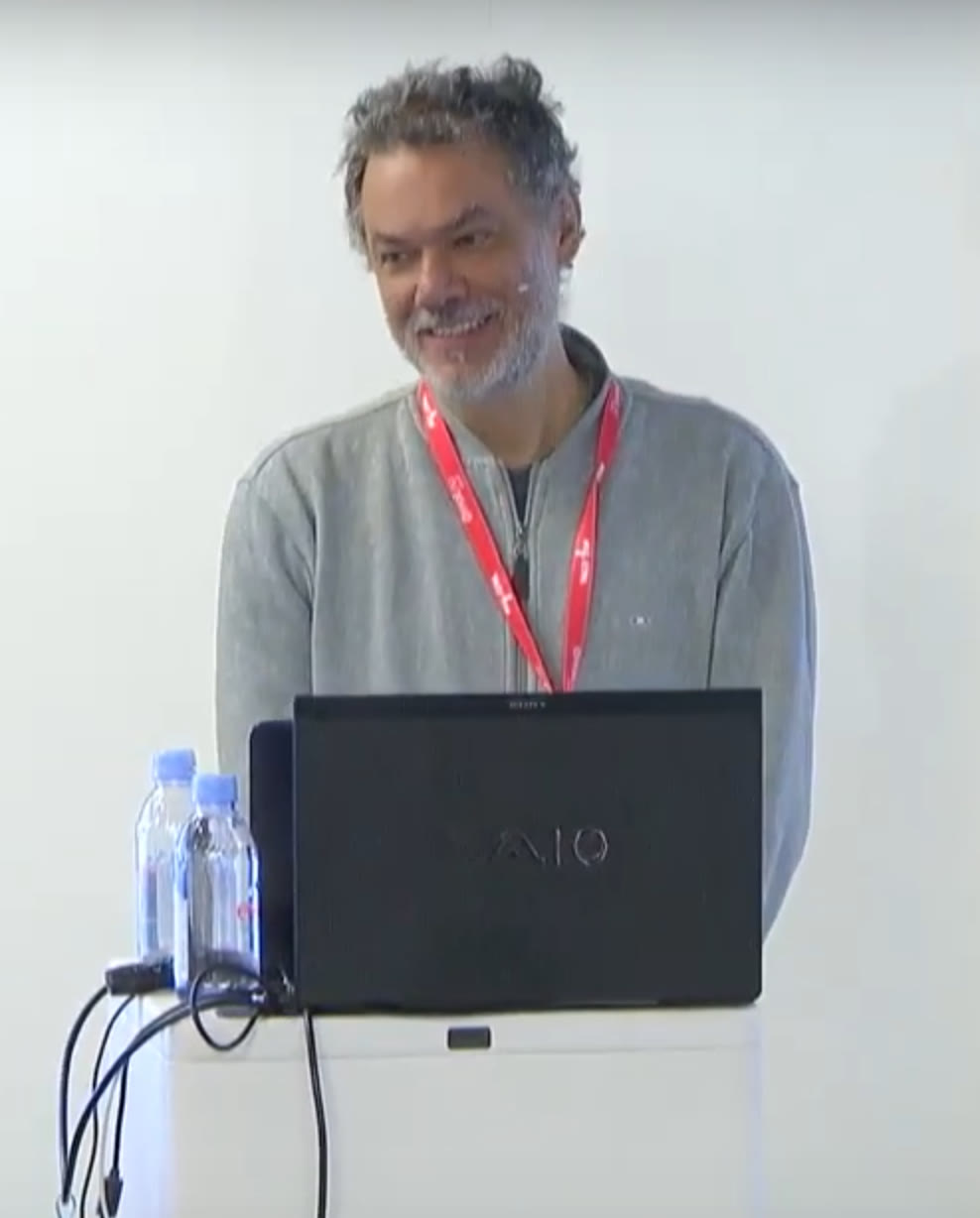
Image context: the cover uses a real 2017 conference frame of Ierusalimschy from Wikimedia Commons. It is photographic, source-grounded, and directly tied to Lua's public maintainer/explainer context rather than being a symbolic programming-language graphic.[9]
Around 3:40, portability is presented as product design
The early portability section matters because it stops Lua from sounding merely old-fashioned. Lua's reference implementation is written in carefully portable C, and the reference manual still treats the language, standard libraries, standalone interpreter, and C API as one documented unit.[2] That choice has product consequences. A game engine, network scanner, packet analyzer, editor, or embedded system can carry Lua without first buying into a heavyweight runtime distribution story.
The design lesson is that portability is not a deployment afterthought. It shapes the language boundary. If Lua is supposed to be embedded in applications with different memory models, build systems, operating systems, and release policies, the core cannot assume that it owns the world. It has to be modest enough to be linked, initialized, sandboxed, extended, and upgraded inside someone else's process.[2][4]
That modesty is also why Lua adoption can look scattered from the outside. The common thread is not one dominant framework. It is the recurring need for a small language layer that lets a host expose domain-specific behavior safely enough and cheaply enough. In that sense, Lua's portability is not nostalgia for C-era constraints. It is the feature that lets the host application remain the center of gravity.
Around 5:14 and 6:29, size and simplicity become maintainability controls
When Ierusalimschy moves from size to simplicity, the two points should be read together. A small implementation is easier to audit, port, teach, and keep consistent. A simple language model gives host applications fewer semantic surprises when they expose their own objects and functions to scripts. The CACM design article describes Lua's economy through a small number of general mechanisms, especially tables for data, functions for abstraction, and coroutines for control.[4]
That triad is more important than a checklist of syntax preferences. Tables do the work that many languages split across arrays, dictionaries, objects, modules, and records. Functions are ordinary values, which keeps callback and extension styles direct. Coroutines give cooperative control flow without forcing the host to surrender scheduling policy. The result is not that Lua is featureless. It is that its features are intentionally low-level building blocks.
This is also where Lua can frustrate teams that expect a batteries-included platform. The language does not try to standardize every package, type discipline, object model, concurrency model, or deployment convention. That absence is a real tradeoff. It is a strength when the host already has a domain model and wants scripts to fit it. It is a weakness when a team wants the language ecosystem itself to supply most application architecture decisions.
Embeddability is the C API, not a slogan
The most important technical boundary is the C API. Lua's manual devotes a full section to it, including the stack model, the registry, C closures, protected calls, error handling, yielding across C calls, and auxiliary-library helpers.[2] The point is not that every Lua user should write C. The point is that the host application has a disciplined way to exchange values with Lua and expose capabilities without pretending that Lua owns the process.
The stack model is an engineering compromise. It can feel indirect compared with passing native object references around freely, but it gives the runtime a consistent place to represent Lua values crossing the language boundary. That helps garbage collection, dynamic typing, and host integration remain explicit. If the host wants to expose a socket wrapper, document object, packet field, editor buffer, or game entity, it can decide which operations enter the Lua world and which stay private.[2][4]
This is why downstream examples are so revealing. Nmap's scripting-language documentation describes NSE around an embeddable Lua interpreter plus an Nmap library layer; scripts call into the nmap namespace and run inside scanning phases owned by Nmap.[7] Wireshark's developer guide describes an embedded Lua interpreter for dissectors, taps, and capture-file readers and writers.[8] In both cases, Lua is not the product. Lua is the programmable surface the product exposes.
Pallene shows the same boundary from the performance side
The second half of the talk turns to Pallene, and it should not be treated as a detour. Pallene is interesting because it accepts Lua's scripting architecture instead of trying to replace it. The Pallene repository describes it as a statically typed, ahead-of-time compiled sister language for performance-sensitive code that interacts with Lua, with a role currently often filled by C modules or LuaJIT.[5] The research paper makes the same architectural claim: Pallene is designed to interoperate with Lua, share its runtime, and stay familiar to Lua programmers.[6]
That matters because performance pressure is where embedding stories often break. A host can start with a clean scripting layer, then discover that hot paths require C extensions, JIT behavior, or whole rewrites. Pallene's design question is narrower and more Lua-shaped: can some performance-sensitive extension code stay close to Lua's data model and syntax while becoming typed and compiled?[5][6]
The practical lesson is not that every Lua deployment needs Pallene. It is that Lua's best performance answer may preserve the boundary rather than erase it. Keep dynamic Lua where flexibility, configuration, and user scripting matter. Move selected lower-level work into a companion layer when predictability and speed matter. Avoid making ordinary script authors appease a compiler or JIT in places where the host only needed a clear extension language.
What engineering teams should carry away
Lua is a strong fit when the host application is already real and the scripting layer needs to be small, portable, and subordinate to that host. That includes applications that want plugins, rules, probes, filters, game logic, configuration, or domain-specific automation without handing users a giant general platform. It is weaker when the team wants a standalone application ecosystem with a broad standard library, strict static types, or a package culture that decides architecture for them.
The adoption boundary is therefore concrete. Choose Lua when you can name the host-owned objects, lifecycle, resource limits, and APIs that scripts should see. Use the C API deliberately; treat the stack, registry, and protected calls as part of the integration design, not plumbing to hide later. Look at Nmap and Wireshark for the pattern: the host keeps the domain model, while Lua gives users a programmable surface inside that model.[7][8]
The video is valuable because Ierusalimschy keeps returning to the same design pressure from different angles. Portability keeps Lua easy to carry. Size keeps the implementation legible. Simplicity keeps the language mechanisms reusable. Embeddability keeps the host in charge. Pallene extends the argument into performance-sensitive companion code. Taken together, those points explain why Lua's open-source importance is not a fashion cycle. It is a boundary contract that has stayed useful because it is small enough to be invited into other people's software.[1][2][3][4][5][6]
Sources
- DConf, "DConf '22: Lua and Pallene -- Roberto Ierusalimschy," YouTube video.
- Lua.org, "Lua 5.4 Reference Manual" - official definition of the Lua language, standard libraries, standalone interpreter, and C API.
- Roberto Ierusalimschy, Luiz Henrique de Figueiredo, and Waldemar Celes, "The Evolution of an Extension Language: A History of Lua" - official hosted history paper on Lua's origin and early design path.
- Roberto Ierusalimschy, Luiz Henrique de Figueiredo, and Waldemar Celes, "A Look at the Design of Lua," Communications of the ACM, 2018 PDF hosted by Lua.org - design analysis of Lua's small core mechanisms and embeddability.
- Pallene project,
pallene-lang/palleneGitHub repository - project README on Pallene as a typed, ahead-of-time compiled sister language for performance-sensitive Lua extension code. - Hugo Musso Gualandi and Roberto Ierusalimschy, "Pallene: A companion language for Lua," Science of Computer Programming, 2020 PDF - research paper on Pallene's typed companion-language design and Lua runtime interoperability.
- Nmap Network Scanning, "Script Language" - Nmap Scripting Engine documentation on its embeddable Lua interpreter and Nmap library layer.
- Wireshark Developer's Guide, "Lua Support in Wireshark" - documentation for Wireshark's embedded Lua interpreter for dissectors, taps, and capture-file readers/writers.
- Wikimedia Commons, "File:Roberto Ierusalimschy.png" - source page for the real 2017 conference image of Roberto Ierusalimschy used as this article's cover image.