
Apache Flink is often introduced as a stream processor, but that label is too broad to explain why teams keep choosing it for jobs that cannot simply drop intermediate state and start over. The sharper way to read Flink is as a runtime for recoverable stateful computation: it partitions work across operators, keeps state close to that work, and regularly records enough of the job's position and state to recover after failure without turning every restart into a replay from the beginning.[3][4][5]
Dawid Wysakowicz's Flink Forward Global 2021 talk, Rundown of Flink's Checkpoints, is useful because it puts that recovery machinery in the center rather than treating it as an operations appendix. The conference agenda frames checkpoint-based fault tolerance as one of Flink's defining features and links it to scale, stateful upgrades, rollbacks, time travel, unaligned checkpoints, and finite-source behavior.[2] That is the right viewing lens: this is not a generic "what is streaming?" talk. It is a tour of the contract that lets a long-running stream job be stopped, failed, moved, upgraded, or repaired without losing the shape of its computation.[1][2]
The main engineering lesson is that checkpointing is not a save button. A save button suggests a simple snapshot taken from outside the system. Flink's checkpointing is a coordinated protocol inside a distributed dataflow. Sources, operators, state backends, barriers, sinks, and deployment topology all participate. If one of those pieces is misunderstood, the operational promise becomes weaker than the marketing phrase.
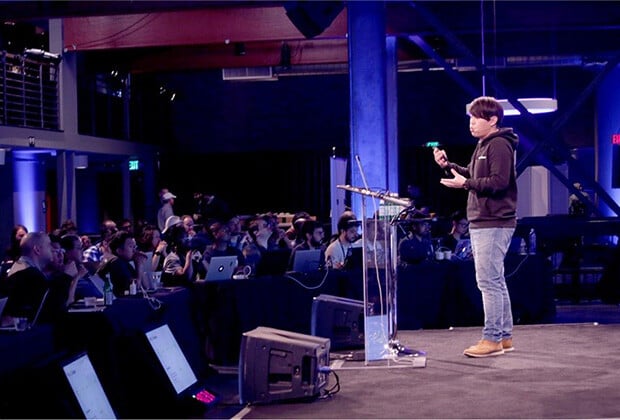
Image context: the cover uses a real Flink Forward conference photograph from the Global 2021 speakers page. It is photographic, event-grounded, and directly tied to the public technical setting around this talk rather than being a synthetic streaming graphic or checkpoint diagram.[9]
Checkpoints make stateful streaming operational
The first thing to watch for is the shift from stateless event handling to stateful recovery. Flink's own documentation describes it as a framework and distributed processing engine for stateful computations over unbounded and bounded data streams.[3] That phrase matters. If a job only maps each record independently, failure recovery is mostly a source-position problem. But once a job keeps keyed state, windows, timers, joins, aggregations, or deduplication records, recovery has to restore both the stream position and the computation's memory.
That is why checkpointing belongs in the architecture discussion, not just in an operations checklist. The Flink architecture docs separate the JobManager, which coordinates distributed execution, from TaskManagers, which execute tasks and exchange data.[3] The Confluent overview describes the same basic runtime anatomy from a platform-user angle: a JobManager coordinates the lifecycle while TaskManagers run tasks and provide task slots.[8] Those components are not just deployment boxes. They define where coordination, execution, buffering, and state movement can fail.
Seen that way, checkpointing is Flink's answer to a practical question: after a crash, what does it mean for a distributed stream job to resume the same logical computation? It is not enough to restart processes. The system has to know which input positions belong with which operator state, and it has to do that across parallel subtasks that may have observed different amounts of data before the failure.[5]
Barriers turn a flowing job into a recoverable cut
The talk's core idea is checkpoint barriers. In prose, the useful mental model is simple: a barrier is a marker that flows with the records and lets the runtime define a consistent boundary across the distributed job.[1][5] Operators can then snapshot their state relative to that boundary. When a job recovers, Flink can restart from the checkpointed state and reset compatible sources to the matching positions.[5]
This is the part new users often compress too aggressively. A checkpoint is not just "write RocksDB somewhere" or "remember a Kafka offset." Operator state without source position is not enough. Source position without operator state is not enough. Sink behavior matters too, because "exactly once" at the application level depends on how outputs are committed or made idempotent around the same boundary.[5]
The stateful-stream-processing docs help frame the consequence: Flink programs can maintain local state, and that state can be partitioned by key so parallel operators own separate slices of the computation.[4] That is powerful because it lets a job scale horizontally. It is also why checkpoints have to be coordinated. A keyed aggregation is not one global variable. It is many pieces of state distributed across subtasks, each with its own progress through the stream.
Backpressure changes the cost of coordination
The section to pay close attention to is backpressure. Backpressure is not merely "the job is slow." In checkpointing terms, it affects how quickly checkpoint barriers can move through the topology and how long operators wait before they can snapshot a clean boundary. Flink's documentation on checkpointing under backpressure distinguishes aligned checkpoints, where barriers may wait for alignment, from unaligned checkpoints, which can include in-flight data to avoid checkpoint duration growing with severe backpressure.[6]
That distinction is the practical heart of the talk. Aligned checkpoints are easier to reason about when data keeps flowing smoothly. Under sustained pressure, however, barrier alignment can become part of the problem: the runtime waits at congested edges, checkpoint times stretch, and recovery points become less regular.[6] Unaligned checkpoints change the tradeoff by snapshotting more of the channel state so the checkpoint can complete despite backpressure, but they do not make pressure disappear. They move cost into checkpoint size, storage, and recovery behavior.[6]
For engineering teams, this means checkpoint metrics are not separate from throughput and latency metrics. A job whose average processing rate looks fine can still be unhealthy if checkpoint duration, checkpoint alignment time, or checkpoint failure count is drifting upward. The recovery contract is degrading before the customer-visible pipeline fully fails.
Savepoints are related, but not the same promise
Flink's savepoint docs draw an important line: checkpoints are primarily for automatic fault recovery, while savepoints are user-triggered, externally stored snapshots used for planned operations such as upgrades, migrations, or maintenance.[7] The two ideas share state-snapshot DNA, but they answer different operational questions.
That distinction prevents a common adoption mistake. Checkpoints should be tuned as part of the running job's failure posture: interval, storage location, timeout, minimum pause, retained checkpoints, and source/sink compatibility all affect how the job behaves when infrastructure fails.[5] Savepoints belong to deliberate change management. Before a version upgrade, operator rewrite, state-schema change, or parallelism adjustment, the team needs a controlled point from which the job can resume if the deployment plan goes wrong.[7]
This is why Flink's checkpointing story should be read as an open-source operations surface, not a hidden runtime trick. The project exposes enough knobs and concepts that operators can make real decisions, but those decisions require discipline. A team that treats checkpoints and savepoints as interchangeable backup files will eventually discover that recovery semantics, state compatibility, and sink behavior are application design issues.
What to carry back to a production job
The post-video takeaway is concrete. If you run Flink, draw the state contract before tuning the cluster. Identify which operators hold state, which keys determine state partitioning, which sources can rewind to checkpointed positions, which sinks participate in end-to-end consistency, and what happens if a checkpoint fails repeatedly. Then connect that model to operational metrics: checkpoint duration, alignment behavior, state size, backpressure, restart time, and savepoint rehearsal.[5][6][7]
Flink is strongest when the team needs long-running computations that remember enough to be useful: windows, joins, aggregations, sessionization, fraud signals, inventory views, feature pipelines, and other jobs where "just replay it later" is not a serious recovery plan.[3][4][8] It is weaker when a team wants streaming as a simple queue-to-function wiring layer and has no appetite to own state, serialization, backpressure, and recovery behavior.
That is why Wysakowicz's talk remains worth embedding. It explains the mechanism that makes Flink more than fast event plumbing. Checkpoints turn a distributed flow into recoverable cuts. Backpressure determines whether those cuts stay cheap. Unaligned checkpoints adjust the failure mode under pressure. Savepoints turn state into an upgrade boundary. Together, these are the contract. The open-source value is not just that Flink can process streams; it is that it gives operators a language for deciding what should survive when a stream job inevitably stops behaving like a diagram.[1][2][5][6][7]
Sources
- Flink Forward, "Rundown of Flink's Checkpoints," YouTube video.
- Flink Forward Global 2021 agenda - talk abstract, speaker context, track, and checkpointing scope for "Rundown of Flink's Checkpoints."
- Apache Flink Documentation, "Flink Architecture" - official overview of Flink's distributed runtime, JobManager, TaskManagers, and deployment model.
- Apache Flink Documentation, "Stateful Stream Processing" - official concept guide for keyed state, operator state, and stateful stream computation.
- Apache Flink Documentation, "Checkpoints" - official operations guide for checkpoint configuration, retention, recovery, and consistency behavior.
- Apache Flink Documentation, "Checkpointing under backpressure" - official explanation of aligned and unaligned checkpoints and their tradeoffs under pressure.
- Apache Flink Documentation, "Savepoints" - official guide to user-triggered snapshots for planned operations, upgrades, and migrations.
- Confluent Documentation, "Understand Apache Flink" - independent platform documentation summarizing Flink cluster anatomy and API levels.
- Flink Forward Global 2021 speakers page - source page for the real conference-stage photograph used as this article's cover image.