The University of Minnesota episode is often compressed into a frightening but inaccurate sentence: researchers slipped experimental vulnerabilities into Linux. They did not. Three intentionally buggy patches were stopped before entering the kernel; a fourth experimental patch proved valid, was accepted, and was later removed because it had been submitted under a false identity.[1][2]
Yet the incident did cause real damage. Once maintainers learned that researchers had treated live patch review as an undisclosed experiment, they could no longer tell which Minnesota-linked contributions belonged to that exercise, which came from unrelated tool research, and which were ordinary good-faith fixes. The Linux Foundation Technical Advisory Board eventually re-reviewed 435 commits. The expensive part was not removing a planted backdoor. It was rebuilding provenance after truthful context had disappeared.[1]
That distinction makes this more useful than a morality tale. Linux's reviewers stopped every intentionally invalid submission, but the project still suffered a breach of trust large enough to trigger a repository-wide audit, paper withdrawal, institutional apologies, and new rules for research on open-source communities. Code review held; the assumptions that make code review scalable did not.
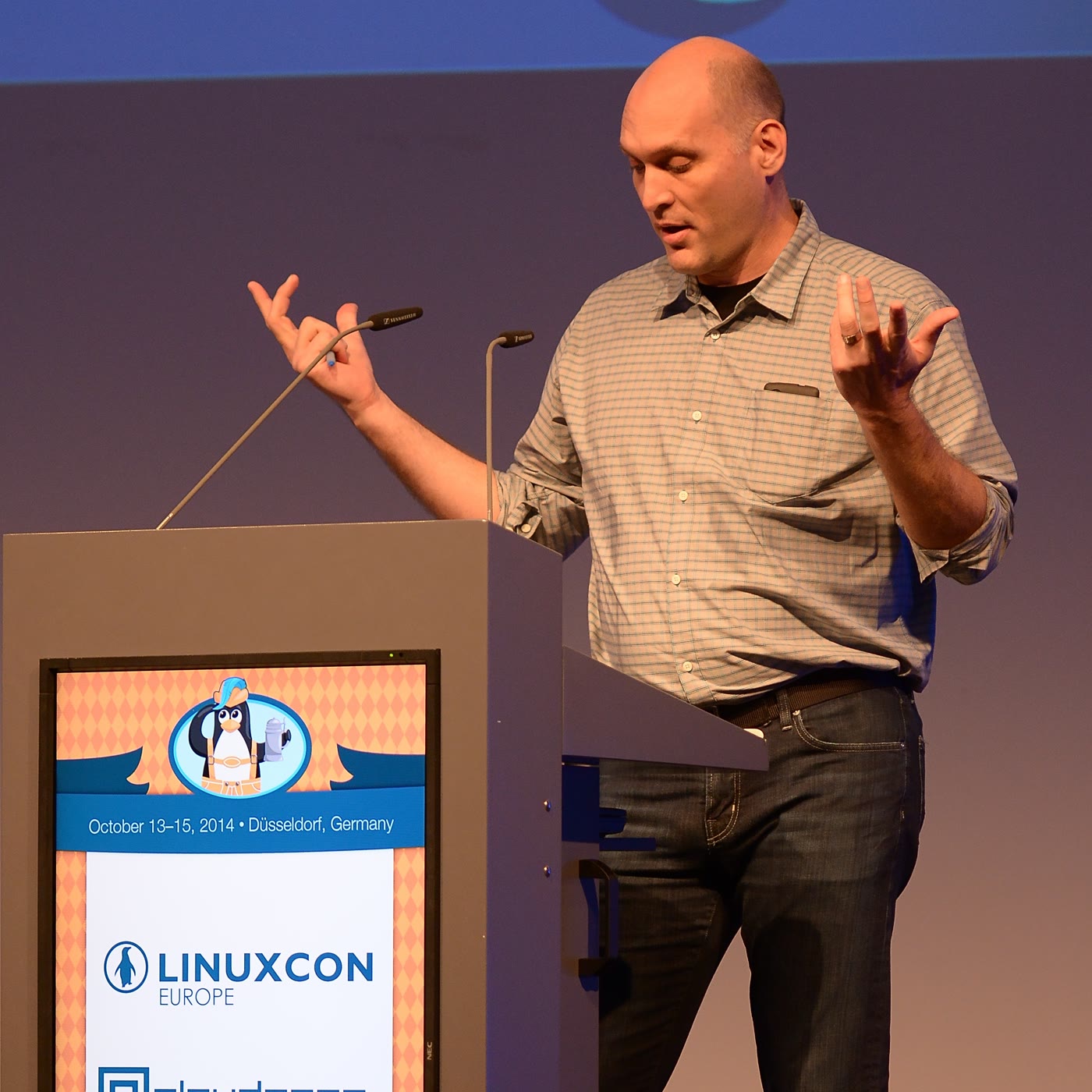
Image context: Kroah-Hartman did not make this photograph during the 2021 dispute. The 2014 conference scene shows the human institution behind “the kernel”: maintainers speaking, reviewing, and making judgments in public. His later emergency review request mobilized that institution, not an automated security gate.[1][6]
The alert arrived seven months after the experiment
In August 2020, two Minnesota researchers sent patches from two invented Gmail identities. Their later disclosure catalogued five submissions from those accounts. Four belonged to the case study: three were intentionally buggy and one, intended as a buggy example, was actually valid. A fifth was a legitimate fix from separate work, accidentally sent through an account configured for the experiment. Only the valid experimental patch entered the kernel; none of the deliberately buggy changes did.[1][2]
The public crisis did not begin then. On April 6, 2021, another developer in the same research group submitted a flawed NFS patch produced by a different static-analysis project. Reviewers questioned and rejected it. On April 20, Kroah-Hartman connected the poor patch stream with the earlier “hypocrite commits” paper and told the group to stop sending known-invalid changes. The following day he posted an initial 190-patch reversion series and asked subsystem maintainers to inspect Minnesota-authored work.[1][5]
The inference was understandable and partly wrong. The Technical Advisory Board said on April 22 that the recent patches appeared to have been submitted in good faith, and contemporaneous LWN reporting later separated the April tool project from the August deception study.[1][5] But that correction did not restore the missing inventory. Maintainers still lacked a complete, trustworthy account of the experimental identities, messages, and patches. Until the researchers disclosed those details, every related contribution carried an unresolved question: was this a mistake, an attempted fix, or another undisclosed test?
The response then moved quickly. The researchers apologized on April 24, withdrew the paper on April 26, and published a detailed disclosure on April 27 after obtaining consent from people whose mailing-list exchanges it reproduced. On May 5, the Technical Advisory Board released its audit. The final record limited the case study to the Linux kernel and to four patches sent between August 9 and August 21, 2020.[1][2]
The payload hid in plausible cleanup code
The experiment targeted a real review weakness: a small patch can appear to repair a leak or error path while subtly changing an object's lifetime. A reviewer sees a familiar cleanup call—put_device(), a reference decrement, or a resource release—and has to reconstruct whether anything below that call can still touch the object. The dangerous behavior is distributed across helpers, error labels, ownership rules, and uncommon paths rather than announced in one obviously malicious line.[2]
One submitted patch claimed to address a memory leak found with Syzkaller and KMEMLEAK. Maintainers recognized that an almost identical change had already been accepted and reverted in 2019 because it caused a use-after-free, so they rejected the new version. In another patch, adding put_device() could release chdev before a later dev_err(&chdev->dev, ...) dereference. The reviewer found a list-handling problem and another defect, though not that hidden use-after-free; because the submission already needed rework and the researchers did not send a corrected version, it stopped there. A third buggy patch contained a double-put risk, but review again rejected it for another issue.[1][2]
These outcomes support two conclusions at once. Operationally, the review pipeline protected the tree: every invalid experimental patch was caught, rejected, or abandoned. Scientifically, that does not prove reviewers detected the concealed vulnerability. Two submissions died because maintainers noticed different flaws, and the supposed fourth exploit was valid code. The IEEE Security and Privacy program committee later concluded that the experiment did not convincingly substantiate the paper's main claims and that parts of its description were ambiguous or misleading.[3]
The false identities made the test more than adversarial code review. Kernel patches carry a Signed-off-by line under the Developer's Certificate of Origin, connecting a change to a person who has the right to submit it. Review still has to test the code, but identity supplies accountability, discussion history, and a route back to the author. The case study treated those social inputs as variables to conceal. That made the experiment closer to falsifying a component's provenance record than merely asking whether a tricky diff would pass.[1]
The blast radius was measured in doubt
The final audit is easy to misread. Of the 435 commits examined, the board classified 349 as correct, 39 in the revert-and-correct bucket, 25 as already fixed later, 12 as irrelevant because the underlying code had disappeared, nine as predating the research group, and one as removed at its author's request. Those 39 were not planted vulnerabilities: the bucket covered ordinary erroneous fixes from the broader body of earlier work as well as the technically valid experimental patch removed because its false identity broke contribution rules.[1]
That broader review did find useful repairs, but it was also the incident's clearest cost. Dozens of subsystem experts had to revisit years of changes because the available metadata could no longer bound the suspect set. An email domain was too broad: many people at one university had contributed legitimately. It was also too narrow: the case study used invented Gmail accounts, and researchers had contributed under other affiliations. The board had to correlate names, addresses, research papers, Reported-by tags, and commits that referenced earlier changes.[1]
This is the provenance lesson for any open-source project. If an organization knowingly submits adversarial test changes through ordinary contribution channels, it creates a future scoping problem even when every test is blocked. Once disclosed, maintainers must ask whether the named experiment was complete, whether other identities or repositories were involved, and whether “good” prior work can still be trusted. The cost grows with contribution history, not with the number of malicious lines.
Blanket suspicion is a poor permanent control. It punishes unrelated contributors, consumes scarce review time, and discourages the academic collaboration that has improved Linux for decades. But selective trust requires truthful labels. Without them, maintainers can either accept an unverified assurance or expand the audit until they can defend the result. In 2021, they chose the defensible option.
Research review failed before kernel review began
The incident exposed a parallel control failure in academic publishing. The IEEE program committee said the paper initially received two “accept” and two “weak accept” scores, placing it among the top five percent of submissions. One reviewer briefly raised an ethical concern, but it did not receive sustained discussion. After public objections, the chairs sought an institutional review-board determination; the board concluded the work was not human-subjects research. IEEE later found that the IRB had received insufficient experimental detail and that IRB jurisdiction alone could not settle the broader ethics of deceiving developers or risking production software.[3]
That is a useful systems comparison. Kernel reviewers evaluated patches without knowing they were experimental. Academic reviewers evaluated a paper without initially escalating the experiment's ethical signal. In both pipelines, local checks processed the artifact in front of them while essential context remained elsewhere. Neither failure is fixed by asking each reviewer to become universally suspicious. It is fixed by carrying the missing context into the decision and giving ethical concerns a defined escalation path.
IEEE responded by adding a standing ethics-review process, explicit ethics checkboxes for authors and reviewers, and stronger call-for-papers language. The kernel community eventually published its own Researcher Guidelines. Those guidelines draw a crisp line: passive study of public artifacts is welcome, but active research on developer behavior requires explicit agreement and full disclosure. Intentionally flawed patches and misleading discussion are outside the consent developers give when they agree to review good-faith contributions.[3][4]
The corrective action is disclosure plus engineering
The kernel guidelines do more than forbid deception. For research-produced fixes, they ask authors to state the specific problem, how it can be reached, its effect, the tool or method that found it, the kernel version, the reason the fix is correct, build and runtime testing, the commit being fixed, and prior reviewers. First-time contributors are encouraged to have patches vetted privately; groups told that their patch stream needs stronger review are required to do so.[4]
Those fields turn research context into reviewable engineering evidence. A maintainer can distinguish a confirmed defect from a static-analysis hypothesis, understand whether hardware testing was possible, and see who inside the submitting organization has checked the result. For a small lab, the control can be one experienced kernel contributor who reviews outbound patches. For a large research organization, it needs a named approval path, an inventory of active experiments, accountable identities, and an escalation contact who can rapidly enumerate every affected project and message.
Projects need an interface too. A published research policy gives well-intentioned teams somewhere to ask before acting and makes non-consensual testing unambiguously out of bounds. A private Technical Advisory Board contact, as Linux now offers, lets researchers discuss sensitive methods without turning maintainers into unwitting subjects.[4] The failure mode to avoid is a policy that says only “do ethical research” while leaving consent, patch labeling, and incident disclosure undefined.
The Minnesota episode therefore should not be remembered as proof that Linux review was easily defeated, nor as proof that review alone was sufficient. The deliberately invalid patches did not land, but some were stopped for reasons other than their concealed payloads. The system protected the code and still incurred a major incident because code was only one asset at risk.
The other asset was confidence in who had submitted what, why they had submitted it, and whether their account was complete. Once that confidence failed, 435 old commits became incident scope. The durable control is not perfect suspicion. It is truthful participation backed by enough technical evidence that maintainers can review both the patch and the story attached to it.
Sources
- Linux Foundation Technical Advisory Board, “Report on University of Minnesota Breach-of-Trust Incident,” May 5, 2021 — primary chronology, patch findings, 435-commit audit, and corrective recommendations.
- University of Minnesota researchers, “A Full Disclosure of the Case Study of the ‘Hypocrite Commits’ Paper,” April 27, 2021 — patch-by-patch technical record and mailing-list exchanges.
- IEEE Symposium on Security and Privacy 2021 Program Committee, “Statement Regarding the ‘Hypocrite Commits’ Paper,” May 6, 2021 — technical, ethical, and conference-process findings.
- Linux kernel community, “Researcher Guidelines” — current consent boundary, disclosure expectations, patch evidence, and internal-review guidance.
- Jonathan Corbet, “An update on the UMN affair,” LWN.net, April 29, 2021 — independent contemporaneous reconstruction separating the August experiment from the April trigger.
- Krd, “LinuxCon Europe Greg Kroah-Hartman 01,” Wikimedia Commons — 2014 conference photograph used for this article.