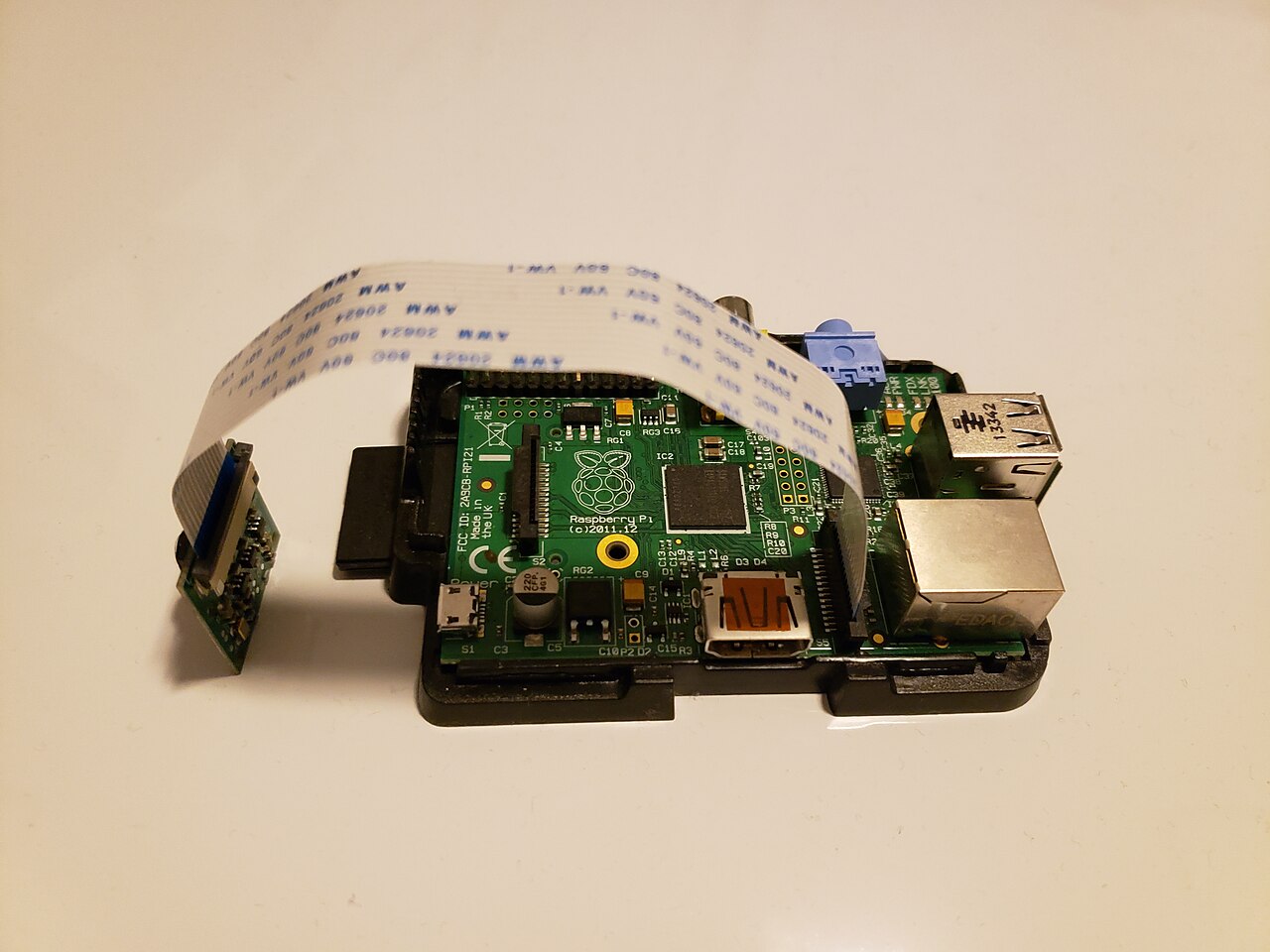

A camera application asks for a viewfinder stream, perhaps changes its size, attaches memory, and queues a capture. The hardware underneath may be a USB webcam that already emits usable frames, or it may be a sensor feeding a CSI-2 receiver, an image signal processor, several DMA paths, and a collection of controls whose ordering is specific to one system-on-chip. Those are not two versions of the same simple device.
libcamera's wager is that applications should not have to learn each topology, but the differences cannot simply be wished away. They have to be owned somewhere. In Laurent Pinchart's platform-support talk, that ownership is split between a pipeline handler, which understands how a particular hardware pipeline moves data, and an Image Processing Algorithm module, which turns image statistics into settings such as exposure and white balance.[1][2]
The useful way to watch the session is not as a recipe for one NXP board. It is a close look at where portability stops. libcamera offers applications a common request model; each platform implementation must then prove that it can translate that intent into valid configuration, buffer movement, controls, and completion events without leaking its device graph upward.
The Linux Foundation published this recording from Embedded Open Source Summit 2023 on its official channel. Pinchart, a libcamera founder and long-time Linux media developer, builds a minimal pipeline handler around the NXP i.MX8M Plus Image Sensing Interface and then follows the failure that remains after the code appears to stream.[1]
First, /dev/video0 stops being the whole camera
The talk's opening contrast is historical. A traditional webcam or TV grabber could present one capture node with a collection of controls. An application negotiated a format, queued buffers, and received frames. Modern embedded cameras distribute that work: a sensor produces raw data, a receiver accepts it, an ISP performs color and spatial operations, and multiple output paths may emit a preview, a full-resolution image, raw data, or statistics.
The Linux Media Controller and V4L2 APIs expose those pieces, which is essential for control but punishing as an application contract. The current libcamera documentation illustrates the problem with a real media graph containing sensors, subdevices, resizers, parameter queues, statistics queues, and video nodes. Its simpler application-side example can instead enumerate a Camera object and ask what streams it supports.[2] LWN's report from an earlier libcamera presentation captured the same design pressure: kernel interfaces made complex hardware addressable, but portable applications still needed another layer to coordinate it.[7]
That is the first boundary to retain from the video. libcamera is not replacing the kernel drivers, and it is not pretending every camera has identical capabilities. It is converting a hardware graph into a camera-level contract whose limitations can be queried and validated.
The pipeline handler is a translator with local knowledge
When Pinchart moves from the generic architecture into the i.MX8M Plus example, the pipeline handler's job becomes concrete. It must recognize the right media entities, create the camera and its streams, generate a plausible configuration, validate application changes, configure hardware, prepare buffers, start and stop devices, queue requests, and report completion.
Each verb carries platform knowledge. A requested width may need alignment. A pixel format used by libcamera may need conversion to the particular V4L2 representation expected by a device. Two output streams may compete for a shared block. A buffer may have to travel through an internal pool between receiver and ISP before it reaches application-visible memory. The current writer's guide consequently makes configuration validation pipeline-specific: the handler may accept a request, adjust it to a supported result, or reject it as invalid.[4]
This explains why a pipeline handler is neither a second kernel driver nor a bag of product quirks. The kernel driver exposes devices and operations. The handler composes those operations into the higher-level lifecycle promised by libcamera. If the hardware silently changes the format after validation, for example, the handler should treat that as its own broken contract rather than pass the surprise to the application.[4]
The request is the unit of intent
The application's stable unit is not "read the camera file." It is a Request. At minimum, a request associates a stream with a FrameBuffer; it may also carry controls for that capture. Applications normally keep several requests in flight so that the pipeline continues working while completed buffers are consumed and recycled.[3][4]
That structure solves more than API tidiness. A multi-stream camera can associate the preview and still-image buffers that belong to one capture operation. Per-frame controls can travel with the memory they affect. Completion can be partial at the buffer level and final at the request level. Metadata can remain attached to the result instead of being inferred from global state after the fact.[3]
The pipeline handler translates that intent downward. It finds each stream's buffer, applies any request controls at the correct hardware point, and queues the buffer to the devices that will produce the frame. When the hardware finishes, the handler translates upward again: it marks individual buffers complete, and only marks the request complete after every buffer it contains is done. libcamera preserves request-completion order for the application even though the work below may involve multiple devices and asynchronous events.[3][4]
The most instructive moment is a capture that never completes
Near the end, the demonstration looks finished. The handler matches the camera. Configuration succeeds. The device begins streaming. The cam utility announces that it will capture five frames—and then waits.
This is the talk's best engineering lesson because no spectacular crash identifies the missing piece. The forward path exists: allocate or import buffers, turn the stream on, queue work. What is absent is the return path. The capture device's bufferReady signal has not been connected to a callback that recovers the owning request and calls the pipeline handler's completion functions. Once that event path is wired, the same command reports five frames at roughly 60 frames per second.[1]
A frame is therefore not complete merely because photons reached silicon, a DMA engine wrote bytes, or a file descriptor became readable somewhere. It is complete when the abstraction's accounting closes: the correct buffer is associated with the correct request, metadata is final, all required streams have finished, and the application receives the completion signal. The current guide preserves this exact distinction with completeBuffer() and completeRequest() as separate operations.[4]
That distinction suggests better tests. A new handler should exercise cancellation and shutdown, not only steady capture. It should test multiple in-flight requests, multiple streams where supported, format adjustment, queue errors, device stop with outstanding work, and whether every buffer returns exactly once. A successful first frame proves surprisingly little about lifecycle correctness.
IPA modules keep image judgment out of device plumbing
The second extension boundary appears when the talk follows statistics from the ISP into the Image Processing Algorithm module. The pipeline handler owns device sequencing; the IPA computes image-processing decisions. A typical feedback loop sends statistics produced for one frame to algorithms for auto-exposure, auto-gain, or auto-white-balance, then applies the resulting parameters to later frames.
Separating those roles matters because transporting pixels and judging images evolve differently. A platform may share an ISP design across more than one SoC, while camera modules require different tuning data. Some vendors will publish their algorithms; others may provide proprietary modules. libcamera defines a serializable interface between handler and IPA so the interaction can cross a process boundary. Its current guide requires post-start calls in that real-time path to be asynchronous and lets generated proxies hide whether the module runs in-process or isolated.[5]
The boundary is useful, but it is not alchemy. Sandboxing a closed module limits what that code can touch; it does not make its tuning inspectable or guarantee good image quality. Conversely, an entirely open algorithm still needs sensor characterization and hardware-specific tuning. Raspberry Pi's 2020 integration shows the stronger version of the model: V4L2 drivers, a libcamera pipeline handler, and open 3A algorithms replaced much of a formerly proprietary control path while leaving a documented platform seam.[6]
What to verify before calling a platform supported
The talk ends with a working capture, not with a claim that five frames constitute production support. The design itself points to a more demanding review:
- Enumeration: does matching select only the intended media graph, including systems with multiple cameras or similar entities?
- Negotiation: do generated configurations describe real capabilities, and do validation results make every adjustment visible?
- Memory: can buffers come from the application or another device when the use case needs zero-copy exchange, and are internal pools bounded and released?
- Per-frame behavior: do controls apply to the intended frame despite sensor and ISP delays, with corresponding metadata returned?
- Completion: do success, error, cancellation, stop, and restart close every outstanding request exactly once?
- Algorithm isolation: is the handler–IPA protocol serializable, asynchronous on the capture path, and equally correct with isolation enabled?
The lc-compliance suite mentioned in the session is a start; visual inspection and platform-specific stress tests still matter.[1] libcamera's abstraction is valuable precisely because it concentrates these obligations. Application portability is not produced by hiding all differences. It is produced by making one platform-owned component translate those differences into explicit configurations, requests, and completion semantics.
Look again at the cover photograph after the video. The sensor sits at the end of a ribbon cable; the processor, memory, and connectors occupy a different board.[8] Between those physical objects and an application's Request lies the work the talk makes visible. A libcamera frame is not just an image. It is evidence that every layer agreed on what the image was supposed to be—and that the agreement made the full trip back.
Sources
- The Linux Foundation, "Learn How to Support Your SoC and ISP in Libcamera — Laurent Pinchart, Ideas on Board," Embedded Open Source Summit 2023, YouTube video.
- libcamera documentation, "Introduction" and current camera-stack overview.
- libcamera documentation, "Using libcamera in a C++ application," current application writer's guide.
- libcamera documentation, "Pipeline Handler Writer's Guide," current device-integration and completion model.
- libcamera documentation, "IPA Writer's Guide," current handler–algorithm protocol and isolation model.
- David Plowman, "An open source camera stack for Raspberry Pi using libcamera," Raspberry Pi, May 4, 2020.
- Jonathan Corbet, "Access to complex video devices with libcamera," LWN.net, July 25, 2019.
- ZippeyKeys12, "Raspberry Pi with Camera Module," Wikimedia Commons, photographed April 17, 2020, CC BY-SA 4.0.