Ladybird is tempting to describe as "the new independent browser." That description is true enough, but it is still too small. The more useful way to read Ladybird in 2026 is as a governance signal: an open-source project trying to prove that browser-engine independence can be built without inheriting Chromium, Gecko, or WebKit code, and without turning the user into the business model.[1][2][3]
That makes the project interesting before it is ready for ordinary users. The homepage says Ladybird is a brand-new browser and web engine, backed by a nonprofit, with a first alpha for Linux and macOS targeted at early adopters in 2026.[1] The same page says the project currently has 8 paid full-time engineers, alongside volunteer contributors, and frames the browser around three promises: independent engine work, singular focus on the browser, and no search deals, crypto tokens, or other user monetization.[1]
Those promises are not marketing decoration. In a browser, governance and architecture meet early. A rendering engine has to chase the living web, accept security pressure, survive compatibility politics, and still give developers confidence that changes are reviewed by people with the right incentives. Ladybird's claim is therefore harder than "we wrote a lot of C++." It is trying to make a new trust surface for the web platform.
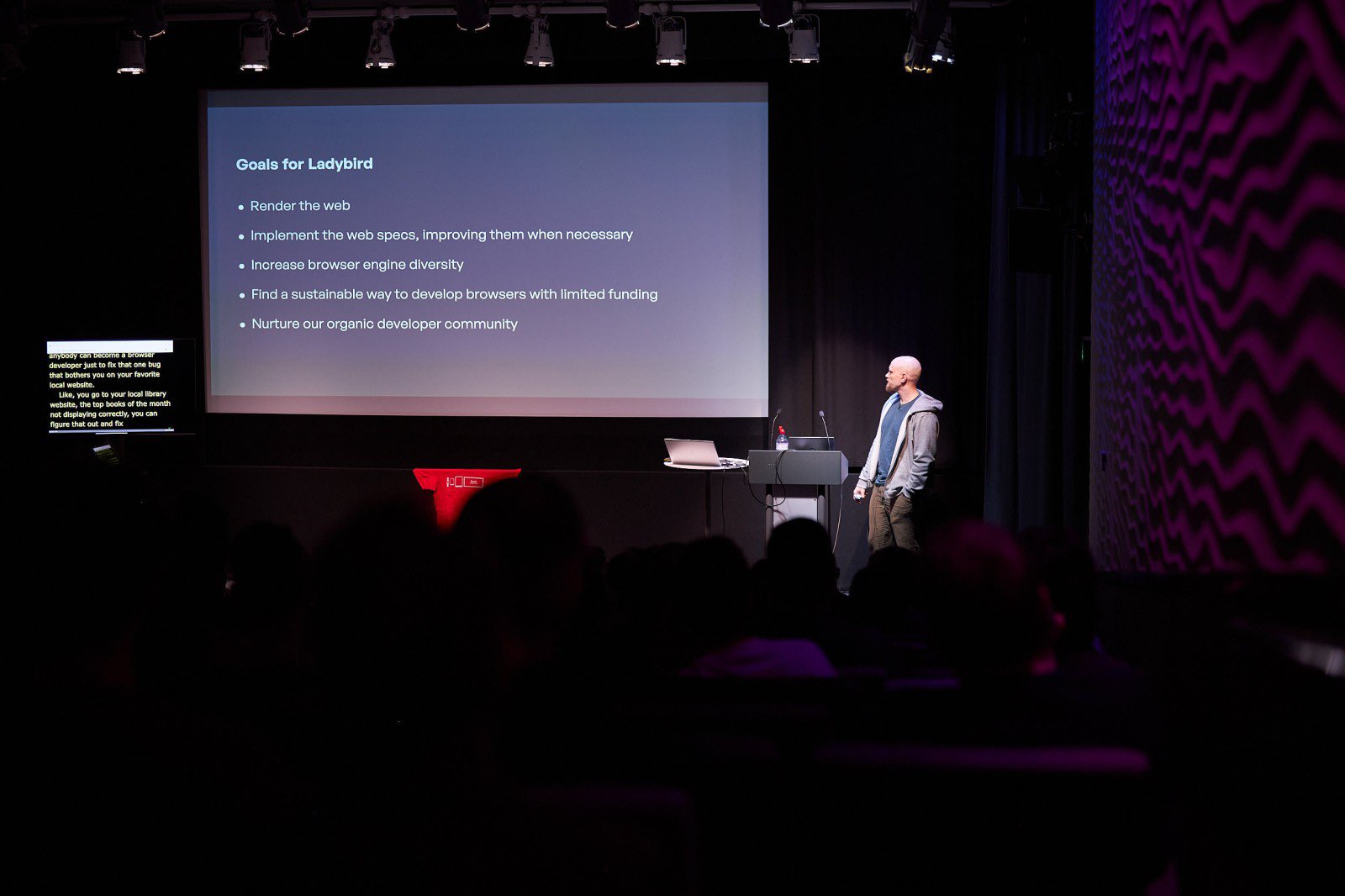
Image context: the cover photo comes from Ladybird's own March 2025 newsletter and shows the project being presented at State of the Browser in London. It is a real conference photograph rather than a diagram because the subject here is not an isolated API. The subject is whether a small public team can make a browser engine legible enough for the wider web community to take seriously.[9]
The funding model is part of the technical design
The July 2024 announcement made Ladybird's governance claim explicit. Andreas Kling wrote that the project had created the Ladybird Browser Initiative, a US 501(c)(3) nonprofit, to drive browser work and make sponsorship easier. The announcement also said the nonprofit would rely on unrestricted donations and sponsorships rather than user monetization, with the source code available freely.[2]
That matters because browser economics usually arrive disguised as defaults. Search placement, ad ecosystems, telemetry incentives, bundled services, app-store politics, and enterprise distribution all shape what a browser can prioritize. Ladybird's refusal of user monetization gives it a clean story, but it also removes the easiest recurring revenue lever.[1][2]
The practical governance question is therefore not whether donation funding sounds noble. The question is whether it can support the long, repetitive work of web compatibility: CSS corner cases, JavaScript performance cliffs, media pipelines, accessibility, security handling, release engineering, packaging, and thousands of regressions that users will experience as "the site is broken." A nonprofit can align incentives, but it still has to buy time.
This is where Ladybird's current shape is unusually transparent. The organization page lists the initiative's mission, public charity status, leadership, address, EIN, and public records.[8] That does not solve the funding problem by itself, but it makes the governance object visible. For a project whose central promise is independence, visibility is not optional infrastructure.
The engine claim starts with process boundaries
The GitHub README is blunt about maturity: Ladybird is pre-alpha and suitable only for developers.[3] That boundary should stay in the foreground. The project is not asking mainstream users to switch browsers today; it is asking engineers, standards people, and open-web funders to evaluate whether the build path is credible.
The architecture claim is concrete enough to inspect. The README describes a multi-process design with a main UI process, several WebContent renderer processes, an ImageDecoder process, and a RequestServer process. It says image decoding and network connections are out of process, each tab has its own sandboxed renderer, and many core support libraries still come from the SerenityOS lineage: LibWeb, LibJS, LibWasm, LibCrypto and LibTLS, LibHTTP, LibGfx, LibUnicode, LibMedia, LibCore, and LibIPC.[3]
That collection tells you both the strength and the burden. The strength is that Ladybird is not merely skinning an existing engine. The burden is that a browser engine is a stack, not a single module. Rendering, JavaScript, media, Unicode, IPC, crypto, networking, layout, painting, platform UI, and process isolation all have to mature together. A weakness in any one layer can become the reason the whole browser feels unserious.
The W3C breakout minutes from September 2024 show the same tension in public. Participants discussed the "from scratch" engine claim, funding by sponsorships, the lack of current binary releases at that time, and security architecture questions around process separation, site isolation, worker processes, and OS-level sandboxing.[7] Those notes are useful because they show Ladybird already being questioned in the place where a browser project should be questioned: among standards and browser people who understand that independence is valuable only when it survives interoperability and security scrutiny.
The recent progress signal is engine work, not surface polish
Ladybird's March 2026 newsletter is a good snapshot because it reads less like a cosmetic product update and more like an engine log. The project reports 352 merged pull requests from 49 contributors, including 19 first-time contributors.[4] The same update lists partial Media Source Extensions work, persistent bookmarks, CSS feature additions, improved style invalidation, Web Platform Tests crossing 2,003,690 passing subtests, and a set of JavaScript engine changes that move real performance boundaries.[4]
The JavaScript details matter most. March brought AsmInt, a hand-written assembly bytecode interpreter for LibJS targeting x86_64 and AArch64, with benchmark gains reported across Kraken, Octane, and SunSpider. The same month also brought a rewritten ECMA-262 regular expression engine in Rust, parser work on worker threads, object property storage changes, faster JS-to-JS calls, and AST-size reductions for large bundles.[4]
Read that as a maintenance signal. A browser project gets serious when its newsletters stop saying "we added tabs" and start saying "we reduced invalidation scope, rewired IPC, moved parser work off the main thread, and crossed another WPT threshold." None of that guarantees success. It does show the team is spending scarce engineering time on the layers that decide whether a browser can survive real websites.
The Register's February 2026 coverage framed the same point from the outside: Ladybird is one of very few projects attempting a modern browser and engine from scratch, while the mainstream browser world is still clustered around Gecko, WebKit, and Blink lineage.[6] That external framing helps keep the scale honest. The reason Ladybird attracts attention is not that another desktop app exists. It is that new independent browser engines are rare enough that even incomplete progress changes the conversation.
Rust is the first big trust exercise
The February 2026 Rust announcement is the project's sharpest current test. Kling wrote that Ladybird had been looking for a memory-safe successor language to C++, had explored Swift, and was now rewriting parts of the browser in Rust because Rust's systems ecosystem and safety guarantees fit the project better.[5]
The first target was deliberately bounded: the LibJS frontend pipeline, including lexer, parser, AST, scope collector, and bytecode generator.[5] That was a smart place to start because the output can be compared. The post says the translation used Claude Code and Codex under human direction, not autonomous generation; the result was about 25,000 lines of Rust produced in roughly two weeks, with byte-for-byte identical output required from both C++ and Rust pipelines.[5]
The verification numbers are the point, not the AI novelty. The post reports identical AST and bytecode output, zero regressions across 52,898 test262 tests and 12,461 Ladybird regression tests, no tracked JavaScript benchmark regressions, and lockstep browsing checks where both pipelines ran simultaneously.[5] March then closed the loop for that first slice: the old parser, AST, lexer, and bytecode generator pipeline was removed, cutting roughly 20,000 lines of C++ and switching FFI header generation to cbindgen.[4]
This is a trust exercise in two directions. The project has to show that Rust can reduce long-term memory-safety risk without becoming a rewrite theater. It also has to show that AI-assisted translation can be reviewed at browser-engine standards, where "looks equivalent" is not good enough. The Register noted the same distinction: the approach was supervised, reviewed, and constrained around identical output rather than treated as hands-off code generation.[6]
The boundary remains important. The Rust post says broader porting will run for a long time and coexist with C++ through explicit interop boundaries.[5] That means adopters should not read the LibJS frontend port as "Ladybird is now a Rust browser." It is more precise to say the project has found a narrow, testable migration pattern and has enough confidence to delete one old compiler pipeline. That is meaningful because it is specific.
Where the adoption signal is strong, and where it is still fragile
For engineers and platform teams, Ladybird is worth tracking when the question is browser diversity, standards pressure, and small-team systems engineering. The project gives a public case study in building a web engine with modern process boundaries, donation-backed governance, visible monthly progress, and a pragmatic language transition under heavy tests.[1][3][4][5]
It is not yet a practical browser adoption choice for ordinary organizations. The README says pre-alpha; the homepage points to an early-adopter alpha target; the W3C discussion noted that people had to build from source at that time; and the project's own updates still describe experimental flags, performance issues, and incomplete subsystems.[1][3][4][7] Treat it as infrastructure in formation, not as a near-term replacement for production browser fleets.
The strongest monitoring questions are straightforward. Can the nonprofit funding model keep enough full-time engineering capacity without compromising the no-monetization promise? Can WPT gains translate into real-site compatibility without creating an unmanageable security surface? Can the Rust migration continue in well-bounded slices rather than absorbing the whole project? Can release engineering and vulnerability handling catch up before broader binaries arrive?
Ladybird matters because it places those questions in public. If it fails, the failure will still teach something about the cost of engine independence. If it succeeds even partially, it gives the web a rare counterexample: a browser project whose economic model, governance surface, and engine architecture were designed to be argued about in the open.
Sources
- Ladybird homepage and FAQ - project definition, no-monetization promise, current paid-team count, and 2026 alpha target.
- Andreas Kling, "Announcing the Ladybird Browser Initiative" - nonprofit launch, funding model, board context, and free-source-code commitment.
- GitHub,
LadybirdBrowser/ladybirdREADME - pre-alpha status, multi-process architecture, sandboxed renderer processes, support libraries, and BSD-2-Clause license. - Ladybird, "This Month in Ladybird - March 2026" - PR/contributor counts, JavaScript engine work, Rust regex engine, benchmark movement, WPT total, and removal of the old JS compiler pipeline.
- Andreas Kling, "Ladybird adopts Rust, with help from AI" - Rust decision, LibJS frontend port scope, AI-assisted translation process, tests, and C++/Rust interop boundary.
- Liam Proven, The Register, "Indie web browser Ladybird flutters toward Rust with a little help from AI" - independent secondary coverage of the Rust shift and browser-engine context.
- W3C TPAC breakout minutes, "Ladybird: A new, independent browser engine - written from scratch" - public discussion of from-scratch scope, funding, roadmap, security architecture, and standards questions.
- Ladybird organization page - nonprofit mission, leadership, public charity details, public records, and contact information.
- Ladybird, "This Month in Ladybird - March 2025" - source page for the State of the Browser conference photograph used as the article image.