
Kubernetes is old enough now that its hardest problem is no longer proving that container orchestration matters. The project has already won that argument in production, in vendor roadmaps, and in the shape of the wider cloud-native ecosystem. Tim Hockin's KubeCon North America 2023 keynote is useful precisely because it does not celebrate that victory for very long. It asks the colder question: what does a project this widely depended on have to refuse in order to stay useful?[1][2]
The talk's central idea is a "complexity budget." Hockin is not using the phrase as a slogan for minimalism. Kubernetes cannot become small in any simple sense; it runs too many workloads, supports too many environments, and carries too much compatibility history. The sharper point is that complexity is a finite resource. Every API, extension mechanism, conformance promise, and special case spends some of that resource. If the project keeps accepting local wins without accounting for global cost, it gradually loses the freedom to evolve.[1][6]
That makes the keynote worth watching as a governance artifact, not just a roadmap talk. The official schedule framed it as a project-wide look at decisions that shaped Kubernetes and possible avenues for the next decade.[2] The 10-year retrospective later put numbers and history under that framing: a first commit in 2014, version 1.0 in 2015, CRDs becoming GA in 1.16, the painful 1.22 beta API removals, Dockershim's removal, and the long migration of in-tree cloud provider code out of core.[3] Read together, the video and written record show the same pattern. Kubernetes survives by adding power, then paying down the shape of that power before it hardens into unmovable mass.[1][3]
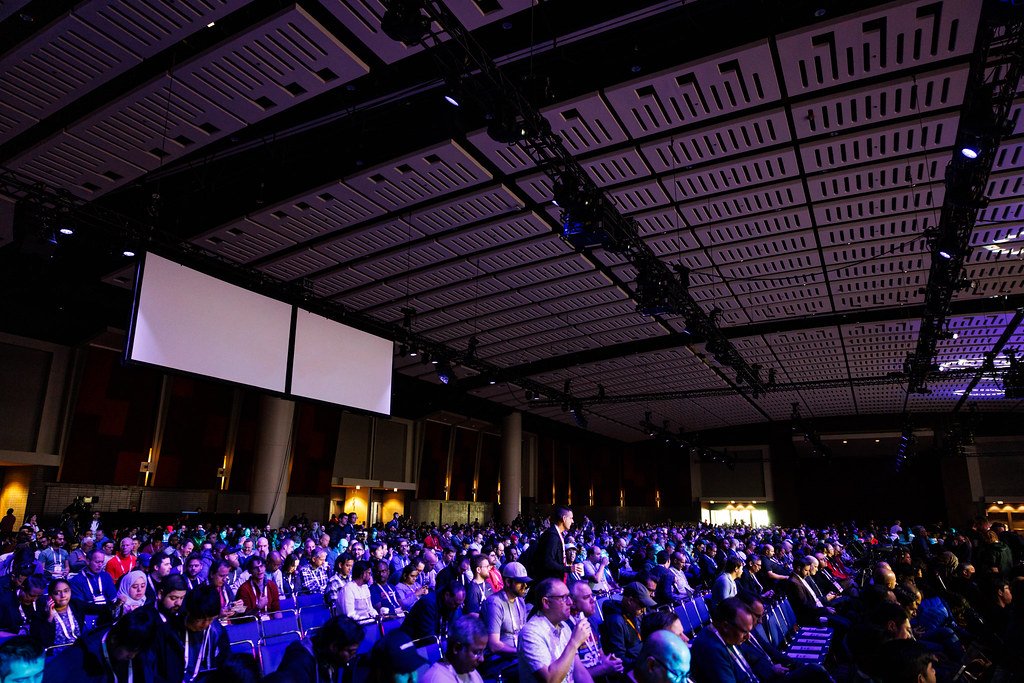
Image context: the cover uses a real CNCF Flickr auditorium photograph from KubeCon + CloudNativeCon North America 2023, taken during the same event where this keynote appeared. It replaces the earlier slide-dominant stage frame with an audience-grounded scene, keeping the post documentary and immersive while the prose and sources carry the technical analysis.[7]
The budget is spent at the API boundary
The most practical way to read Hockin's warning is through Kubernetes APIs. Around the early middle of the keynote, he turns from anniversary framing toward the tension between new use cases and accumulated project cost.[1] That tension is visible in the API conventions themselves. Kubernetes APIs are not just data shapes; they are long-lived contracts with naming rules, spec/status separation, declarative intent, defaulting behavior, and compatibility expectations.[4] A small field can become a permanent maintenance obligation once clients, controllers, admission policies, dashboards, and operators start depending on it.
That is why a complexity budget is stricter than an "is this useful?" test. Many proposed features are useful. The harder question is whether the usefulness belongs in Kubernetes core, in an extension API, in a SIG-owned adjunct project, or outside Kubernetes entirely. CRDs were one answer to that pressure: they let the ecosystem add Kubernetes-shaped APIs without forcing every domain into the core repository.[3][4] But even CRDs do not make complexity free. They move some cost outward to operators, platform teams, and authors of controllers who must now own schemas, upgrades, validation, status behavior, and lifecycle promises.
This is the strongest engineering lesson in the keynote. Kubernetes should not be judged by whether it can absorb another capability. A platform this extensible can absorb almost anything if enough people are willing to carry the burden. It should be judged by whether the new surface leaves future maintainers with enough room to simplify, deprecate, document, and repair. A feature that helps one class of user but adds persistent ambiguity for everyone else is not just a feature. It is a withdrawal from the shared budget.
Deprecation is how the budget gets audited
The deprecation policy shows the other side of the same argument. Kubernetes promises compatibility in graduated APIs, and it defines conditions under which API elements can be deprecated and removed.[5] Those rules are not bureaucracy for its own sake. They are the accounting system for a project whose users build automation around every exposed behavior. If Kubernetes could remove surfaces casually, it would be unstable. If it could never remove surfaces, it would become a museum of every past compromise.
That balance is exactly where Hockin's warning gets its force.[1] The 10-year retrospective points to two instructive episodes: widely used beta APIs removed in 1.22, and Dockershim's removal in 1.24.[3] Both caused real user pain. Both also illustrate why "just keep everything forever" is not a serious platform strategy. Kubernetes had to learn how to communicate better, but the deeper need remained: core abstractions have to be corrected when early assumptions stop matching the project's scale.[3][5]
For platform teams, the takeaway is uncomfortable but useful. If your internal Kubernetes platform depends on every old beta, side behavior, annotation convention, and provider-specific shortcut surviving forever, you are spending your own complexity budget without admitting it. The project's deprecation policy gives you notice windows and stability signals; it does not turn old surfaces into permanent entitlements.[5] Good platform engineering treats upstream deprecation as routine maintenance input, not as betrayal.
"No" is a technical contribution
The New Stack's report on the keynote captured the social edge of Hockin's argument: maintainers sometimes need to say no to ideas that are not bad ideas.[6] That point matters because Kubernetes governance is not only about code review mechanics. It is about deciding where responsibility should live. A maintainer who rejects a core API addition may be preserving future operability as much as a maintainer who lands a performance patch.
This is where the video is more valuable than a summary. Hockin's delivery makes the constraint feel institutional rather than personal.[1] He is not arguing for a smaller Kubernetes because smaller is aesthetically pleasing. He is arguing that a large, successful, user-shaped project has to keep deciding which kinds of growth preserve agency and which kinds turn maintainers into caretakers of historical accidents. The difference is subtle. Kubernetes can keep growing while still resisting the assumption that every new need deserves a core abstraction.
That lesson travels beyond Kubernetes. Mature open-source infrastructure usually faces the same sequence: adoption, ecosystem explosion, compatibility pressure, and then a period where the project must develop stronger muscles for refusal. Kubernetes happens to be a vivid case because its API surface is so consequential and because its ecosystem is so good at finding new places to attach.[3][4] A project with weak extension points says no by being incapable. A project with strong extension points has to learn to say no deliberately.
The best reading of the keynote, then, is not "Kubernetes is too complex." It is more precise: Kubernetes must keep treating complexity as a budgeted design material. APIs should earn their permanence. Extensions should carry their own lifecycle obligations. Deprecations should be read as maintenance accounting. And "no" should be understood as part of how an open-source platform remains alive enough to serve its next decade.[1][3][5][6]
Sources
- CNCF, "Keynote: A Vision for Vision - Kubernetes in Its Second Decade - Tim Hockin," YouTube video.
- KubeCon + CloudNativeCon North America 2023 schedule, "Keynote: A Vision for Vision - Kubernetes in Its Second Decade" - talk description and session metadata.
- Kubernetes Blog, "10 Years of Kubernetes" - project history, milestone timeline, CRDs, Dockershim, beta API removals, and in-tree cloud-provider migration.
- Kubernetes community repository, "API conventions" - Kubernetes API design rules and compatibility-oriented shape.
- Kubernetes documentation, "Kubernetes Deprecation Policy" - API deprecation and removal expectations.
- Joab Jackson, "Tim Hockin: Kubernetes Needs a Complexity Budget," The New Stack, November 10, 2023.
- Cloud Native Computing Foundation, "KC+CNCNA231109daily01007," Flickr photograph from KubeCon + CloudNativeCon North America 2023.