Krita is easy to describe badly. Calling it a free Photoshop alternative is convenient, but it hides the more interesting open-source signal. Krita's durability comes from a narrower promise: build a professional digital painting and 2D animation tool around the working habits of artists, then keep the technical platform honest enough that those habits survive rewrites, ports, and funding cycles.
As of 2026-06-07T08:02:04Z UTC, the current public release line is Krita 5.3.1 for productive work and Krita 6.0.1 as the more experimental Qt6 build.[1] That split is the governance signal. The project did not pretend that a platform migration was invisible just because the feature set was largely shared. It told artists to use the stable Qt5 build for real work, while using the Qt6 branch to cross into Wayland color management, HDR support on Linux, fractional scaling, and the dependency future that Linux distributions are already forcing.[1][2]
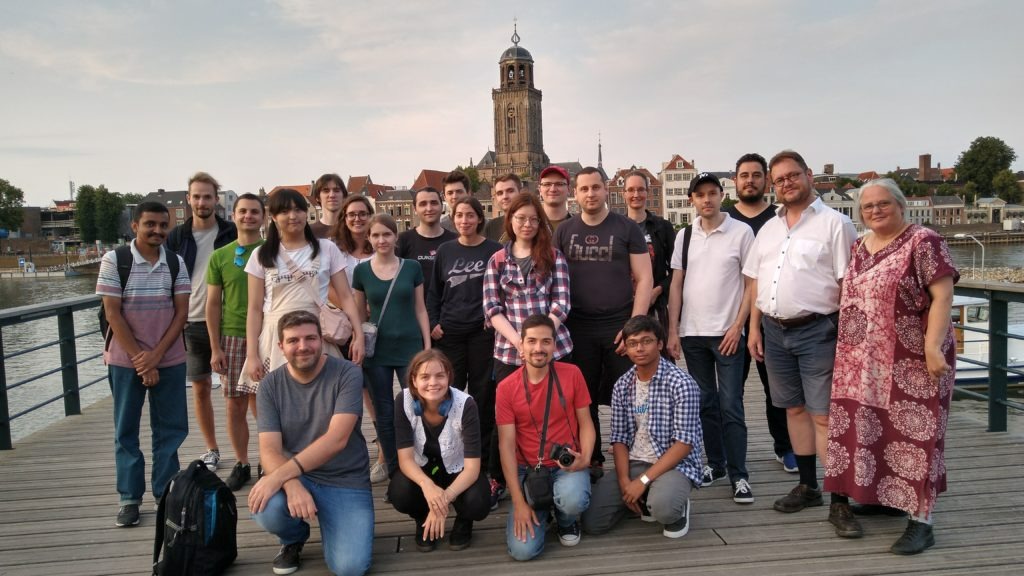
Image context: the cover is from the 2019 Krita sprint in Deventer. It is not decorative conference filler. The sprint report describes a week where artists, developers, and artist-developers discussed stability, testing, workflow bottlenecks, text-tool pain, dockers, animation, brushes, outreach, and funding in the same process that produced future work items.[5] That is the article's core claim in photographic form: Krita's product direction is shaped by people who draw with it, not only by people who compile it.
Artist Feedback Is Part of the Architecture
The most useful historical clue comes from a 2014 Linux Magazine interview with longtime Krita maintainer Boudewijn Rempt. He described the project's turning point as the moment developers had to admit that real professional artists could not yet use the application daily, then changed course by sitting with artists and learning what they actually needed from a painting workflow.[6] That history matters because Krita's current release notes still read less like generic feature marketing and more like accumulated workflow debt being paid down.
The 2019 sprint report makes the same pattern operational. The attendees did not merely celebrate a tool they liked. They named regressions, testing gaps, discoverability problems, text-tool limitations, animation wishes, brush-engine ideas, support load, and fundraising needs.[5] The report also records a proposed release-testing loop: merge fixes into a stable branch during a defined window, publish what changed inside Krita, point users at portable builds, collect testing feedback, then release after regression checks.[5] That is governance through artist feedback. It turns user pain into a maintenance system instead of leaving it as forum atmosphere.
This is why Krita should be evaluated differently from a small utility. A painting application has a huge subjective surface: brush feel, tablet behavior, color management, text placement, layer organization, animation timing, file import, UI discoverability, and the emotional cost of losing flow. A healthy project has to convert those subjective complaints into technical work without flattening them into "add the feature competitors have." Krita's strongest signal is that it has spent years building that conversion channel.[5][6]
The 5.3 Release Is a Workflow Release
Krita 5.3 is not interesting because one headline feature landed. It is interesting because the release repairs several places where digital painting, comics, texture work, and animation rub against the application boundary.
The rewritten text tool is the clearest example. The 5.3/6.0 release notes describe on-canvas text editing, IME support, wrapped text, text inside shapes, text on paths, a text properties docker, OpenType and variable-font support, style presets, a glyph palette, and SVG 2-oriented text behavior.[2] That is not "we added text." It is a recognition that comic panels, multilingual lettering, typography, and vector shape work are part of the same creative surface as brush strokes. CreativeBloq's 2026 coverage read the update similarly, emphasizing why the release matters for comic creators rather than treating it as a generic editor refresh.[8]
The tool work reinforces the same direction. Krita 5.3 adds comic panel editing, gap closing for the fill tool, a selection toolbar, a faster liquify transform mode, pixel-art smoothing, assistant improvements, propagate-colors filtering for game texture workflows, HDR-related blending fixes, real-time recorder capture, brush texture refinements, marker blend mode, Radiance RGBE support, richer JPEG XL support, PSD text and shape support, and Python API improvements for brush strokes.[2] The list is broad, but the pattern is coherent: reduce the little interruptions that make artists leave the flow to repair edges by hand.
The public features page shows why that breadth is not accidental. Krita presents itself around brushes, brush stabilization, vector and layer tools, resource management, animation, drawing assistants, color management, GPU acceleration, PSD handling, HDR painting, Python scripting, and training resources.[4] A release like 5.3 has to touch many surfaces because professional painting is not one feature. It is a chain of small decisions, and a weak link in text, color, tablet input, export, or file compatibility can break the whole session.
The Qt6 Bridge Is Honest
The Qt6 transition is where the governance signal becomes sharper. The 5.3 release announcement says the same source can produce Krita 5.3 with Qt5 or Krita 6.0 with Qt6, and that both versions are almost functionally identical, with Krita 6 bringing more Wayland functionality.[2] But the project also says Krita 6 is experimental, that 5.3 should be used for real work, and that the focus will be making Krita 6 stable.[1][2]
That caution is not weakness. It is how open-source creative infrastructure should handle platform risk. Artists do not experience a toolkit port as a clean dependency upgrade. They experience it as menus opening slowly, stylus behavior changing, drag-and-drop failing, text fields blocking movement, color management behaving differently, or a day's work feeling subtly wrong. Krita 5.3.1 and 6.0.1 arrived a week after 5.3.0/6.0.0 largely to fix exactly that kind of real-world fallout, including a Windows slowdown triggered by other applications querying accessibility abilities and Qt QML recursion through screen objects.[1]
The deeper point is that Krita is crossing a platform bridge while preserving an artist contract. Qt6 matters because Linux distributions are moving, Wayland is central to the modern Linux desktop, and HDR painting needs display-server color information that older assumptions could not reliably provide.[2] The project is moving, but it is also telling users where the stable ground is. For a tool people use to make paid work, that honesty is more valuable than a triumphant major-version headline.
Funding Is Part of the Product
Krita's foundation structure is also a maintenance signal, not background trivia. The Krita Foundation says it was created in 2012 as an independent nonprofit public organization to develop free graphics software, provide services for Krita users and developers, and support artists and studios.[3] The same page connects donations to paid development, including named sponsored developers and past fundraiser work that improved stability, canvas performance, brush usability, OpenGL behavior, training materials, and other artist-facing needs.[3]
That funding story does not make Krita invulnerable. It does make the maintenance model legible. Users can see that the project is not only a volunteer code repository on KDE Invent, even though the source remains public there.[7] There is an institution collecting money, describing goals, funding developer time, and tying that money back to concrete work. For creative software, that matters because maintenance is not just security updates and build fixes. It is support for tablet regressions, file compatibility, brush performance, color management, documentation, training material, community channels, and the slow repair of workflows that only working artists can explain.
The healthier interpretation is not "Krita has solved open-source funding." The healthier interpretation is narrower: Krita has enough institutional shape that a user can ask whether funding, artist feedback, and release work still line up. That is a better governance question than asking whether the project has a corporate owner.
Adoption Boundary
Krita is strongest when the team or individual adopting it cares about painting-first workflow, local file ownership, customizable brushes, open formats where possible, animation and comic tooling, scriptability, and Linux-friendly creative work.[2][4] It is also unusually attractive when a studio wants open-source software with visible human maintenance rather than an anonymous SaaS roadmap.
The boundary is just as important. Krita is not a lightweight image-cropping utility, not a fully managed cloud collaboration platform, and not a tool whose platform migration can be ignored. Teams standardizing on it should test tablets, displays, color-managed workflows, PSD interchange, text-heavy comic files, animation export paths, and plugin expectations before mandating a new release. On Linux, the Qt6/Wayland/HDR path is promising but still young; on Windows and Android, 5.3.1's fixes show that real device and integration bugs can appear in places the core team does not use daily.[1][2]
That is not an argument against adoption. It is the right adoption posture for serious creative OSS. Krita's 2026 signal is strong precisely because the project is candid about the boundary: use the stable branch for production, help harden the platform bridge, and keep artist workflow at the center of feature work. The project looks healthiest when read as a maintained creative institution rather than a free clone of anything else.
Sources
- Krita, "Krita 5.3.1 Released!" - current 5.3.1 and 6.0.1 release announcement, bug-fix notes, platform downloads, and productive-work warning.
- Krita, "Krita 5.3 and 6.0 Release Notes" - Qt6 transition, Wayland color management, text-tool rewrite, tools, brushes, files, filters, dockers, and Python API changes.
- Krita Foundation, "Krita Foundation" - nonprofit goals, funding model, sponsored development, and foundation role.
- Krita, "Features" - official overview of brushes, resources, animation, assistants, layers, color management, HDR painting, PSD support, and Python scripting.
- Krita, "Krita 2019 Sprint" - sprint report and source page for the Deventer group photograph used as the article image.
- Bruce Byfield, "Krita: KDE's Powerful Graphics Editor Takes on Photoshop and GIMP," Linux Magazine, 2014 - independent interview with Boudewijn Rempt on Krita's history, artist feedback, funding, and project direction.
- KDE Invent,
graphics/krita- public source repository for Krita. - CreativeBloq, "The latest Krita updates are a game changer for comic creators," 2026 - independent coverage of the Krita 5.3/6.0 release and its comic-creation workflow implications.