Julia's 2026 open-source signal is not that the language suddenly became new. The useful signal is almost the opposite: Julia is now old enough that its governance, release, package, and language-design boundaries matter more than the original "fast dynamic language" pitch. For teams in scientific computing, modeling, data engineering, and numerical software, the question is no longer whether Julia is clever. The question is whether the project has enough discipline to keep a high-performance, multiple-dispatch language usable while the ecosystem keeps moving.
The answer is strongest where Julia is least theatrical. Its official governance page does not describe a corporate product hierarchy or a foundation with a tight technical steering board. It describes a large collaborative project with code, people, committers, triage members, an informal consensus process for pull requests, and a standing triage call for contentious issues.[1] That is not the cleanest governance story to market. It is, however, a realistic description of how a language with deep compiler work and broad package authorship actually operates.
The same page separates technical authority, community safety, and money. Julia Stewards handle conflict reporting and community standards; they are explicitly not a technical steering body.[1] NumFOCUS handles fiscal sponsorship, donations, project funds, and JuliaCon finances, while JuliaHub and the Julia Lab are described as important contributors without official governance control.[1] That separation is the governance signal. Julia is not pretending that one company, one lab, or one conference committee is the language. It is defining where each source of influence stops.
The release lanes are the real contract
Julia's release process is unusually clear about branches. Feature work happens on the main development branch. After a feature freeze, an unstable release branch gets active bug fixing and performance work. Once the minor release lands, that branch becomes stable and receives applicable backports. Separately, a long-term support branch gets extra backport effort while it remains the LTS line.[2] That structure gives operators a vocabulary for risk instead of forcing everyone into one update tempo.
As of the current official download page, the latest stable release listed is v1.12.6, dated April 9, 2026, and the long-term support release listed is v1.10.11, dated March 9, 2026.[3] The page tells almost everyone to use latest stable, while reserving LTS for organizations where upgrades are prohibitively expensive and new language features or packages are not needed.[3] That is a good maintenance posture: do not romanticize old versions, but give conservative users a named lane.
The independent endoflife.date Julia tracker summarizes the same operating pattern from outside the project: minor releases arrive approximately every four to five months, each minor is supported until the next one, and LTS versions are selected occasionally for longer critical-fix support.[8] Treat that as a secondary confirmation, not as the source of authority. The official release docs define the model; the independent tracker shows that the model is legible enough for downstream planning.[2][3][8]
Juliaup turns release policy into daily behavior
Release policy only helps if users can actually select the right lane. Juliaup is the practical bridge. Its README defines system channels such as release, which points at the latest stable version, and lts, which points at the latest long-term supported version. It also supports beta, release-candidate, nightly, minor-version, and specific-version channels, plus directory overrides for project-level selection.[7]
That matters more than it sounds. A language can publish careful release notes and still leave teams with messy local installations, stale binaries, and unclear upgrade habits. Juliaup makes the support model executable: use release for normal work, pin a project or directory to lts when certification or operational conservatism requires it, and test future behavior through beta, RC, or nightly channels without rewriting the whole workstation setup.[3][7]
The strongest adoption pattern follows from that: do not let every developer improvise their own Julia version story. Pick a channel policy per project. Keep CI explicit. Use LTS only when the organization really values certification stability over newer packages. Otherwise, run current stable and let the project's compatibility promise do the work it was designed to do.[2][3][7]
Multiple dispatch is still the architectural center
Julia's language model is not just a performance claim. The official methods documentation explains dispatch as the process of choosing which method to call, and Julia allows that choice to depend on the number and types of all arguments. That is multiple dispatch.[5] This design is why Julia packages often compose in ways that feel less bolted together than wrapper-heavy scientific stacks: the operation does not have to "belong" to one class or object owner before other packages can participate.
That power also creates a governance burden. If many packages can extend shared functions across types, then method ambiguities, compatibility bounds, inference behavior, and documentation quality become ecosystem concerns rather than private library details. Julia's governance signal is therefore not only committees and money. It is also the language's willingness to expose a compositional model and then ask package authors to behave responsibly inside it.[1][5][6]
The 1.12 highlights show the project still investing at that boundary. Julia 1.12 added an experimental --trim feature for building smaller compiled artifacts when unreachable code can be removed safely, new tracing tools for inspecting compilation, multi-threading improvements, profiler work, Pkg features, and compiler/runtime changes.[4] Those are not random conveniences. They are pressure relief for the same long-running problem: make a dynamic, generic, high-performance language easier to package, inspect, and operate in real projects.[4][5]
Pkg is the discipline layer under the ecosystem
Pkg is where Julia's openness becomes manageable. The Pkg documentation identifies Project.toml and Manifest.toml as central files that record dependency information, versions, UUIDs, and environment state.[6] The package manager also uses registries to find packages, versions, dependencies, and download locations, with the General registry installed by default when no other registries exist.[6]
For teams, this is the part that should prevent casual notebook drift from becoming production ambiguity. A Julia project should have an environment. The environment should be activated deliberately. The manifest should be treated as a reproducibility artifact when exact dependency resolution matters. The registry and [compat] surface should be reviewed as part of dependency intake, not discovered only after an upgrade fails.[6]
That is also where Julia differs from a language that merely has impressive internals. Multiple dispatch makes composition attractive; Pkg environments make composition accountable. Without the second piece, the first becomes a source of spooky interactions. With both, a team can say: these methods, packages, versions, and Julia channels form the project boundary.[5][6][7]
The adoption boundary
Julia fits best when a team needs mathematical expressiveness, fast numerical kernels, package-level composability, and enough control to reason about versions and environments. Good fits include scientific models, simulation, optimization, array-heavy analysis, research software that is becoming production-adjacent, and teams that are tired of splitting prototype and performance code into different languages.
It is weaker when the organization wants a language with a single corporate roadmap, a huge pool of generic enterprise developers, or a support model where "use the old version forever" carries no ecosystem cost. Julia's own documentation is candid that LTS is for conservative organizations with expensive upgrade paths, not for everyone.[3] That is the boundary to respect.
The reason to care about Julia in 2026 is therefore not hype. It is the way the project has made several hard edges visible: consensus rather than corporate command, fiscal sponsorship rather than hidden ownership, stable and LTS release lanes rather than one-size-fits-all upgrades, Juliaup channels rather than installer folklore, multiple dispatch rather than class ownership, and Pkg environments rather than ambient dependencies.[1][2][3][5][6][7] Those edges are boring in the right places. They are what let an ambitious language survive ordinary engineering work.
Sources
- JuliaLang, "Julia Governance" - official governance structure, committers, triage, stewards, NumFOCUS fiscal sponsorship, and related-organization boundaries.
- JuliaLang, "Julia's Release Process" - branch model, stable release branch, unstable branch, LTS branch, backports, and risk personas.
- JuliaLang, "Manual Downloads" - current stable and LTS release listings and guidance on when to use latest stable versus LTS.
- Julia contributors, "Julia 1.12 Highlights" - 1.12 release overview,
--trim, tracing tools, threading, profiler, Pkg, and compiler/runtime changes. - Julia Documentation, "Methods" - official explanation of dispatch and multiple dispatch across all argument types.
- Pkg.jl Documentation, "Project.toml and Manifest.toml" - dependency metadata, versions, UUIDs, and environment files used by Julia's package manager.
- GitHub,
JuliaLang/juliaupREADME - Juliaup channels, aliases, directory overrides, and version-selection behavior. - endoflife.date, "Julia" - independent summary of Julia's minor-release cadence, patch support, and LTS pattern.
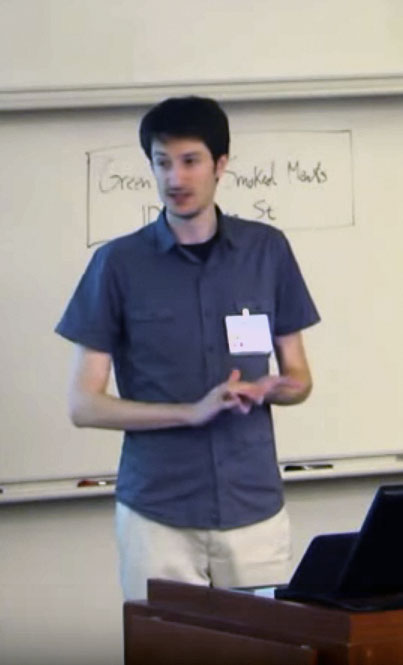
- Wikimedia Commons, "File:Jeff Bezanson.jpg" - source page for the real JuliaCon 2014 still image used as the article cover.