If your company relies on Homebrew in 2026, the useful question is no longer whether the project is popular. Popularity is obvious. The harder question is whether the project looks governable enough to sit underneath developer laptops and CI runners without asking infrastructure teams to trust pure volunteer goodwill. Homebrew's strongest signal is that it keeps turning maintainer labor into rules: measurable activity thresholds, promotion gates, modest but explicit stipends and grants, and a security program that publishes unfinished work instead of pretending everything is solved.[1][2][3][4]
That combination matters because Homebrew occupies an awkward layer of the stack. It is familiar enough to feel casual, but operational enough to affect supply-chain trust, workstation drift, and the everyday shape of "shadow IT" in companies that let package installation happen informally.[5][8] A mature project at that layer does not need to look glamorous. It needs to look schedulable.
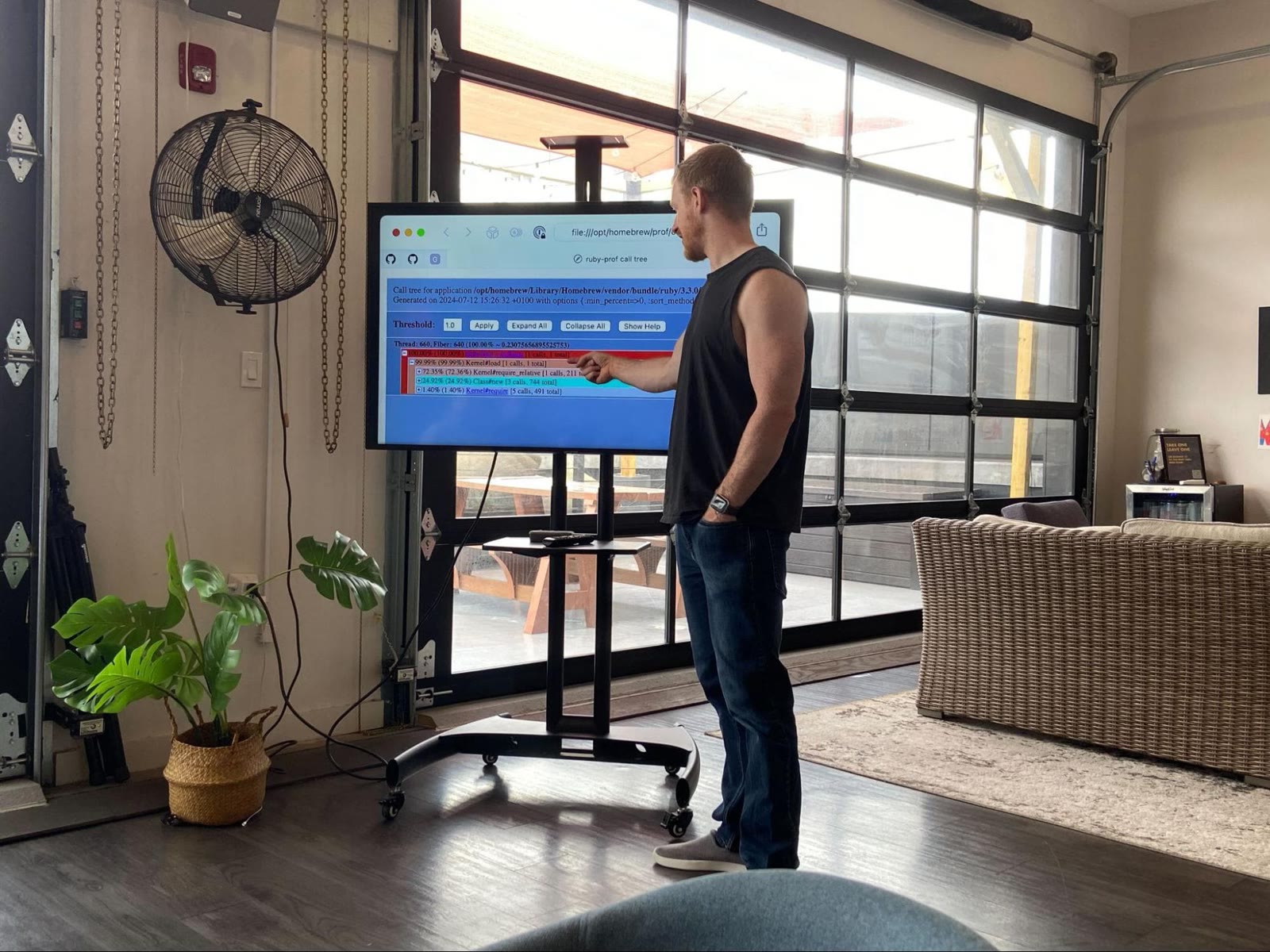
Image context: the cover uses an official photographic image from Homebrew's Summer 2024 Hackathon rather than a logo or terminal screenshot. That is the right visual here because the article is about maintainership as visible coordination work: people in a room triaging performance and security debt, not abstract package-manager branding.[6]
The project makes "active maintainer" a measurable condition
The governance document is unusually clear about what good standing means. A maintainer is expected to produce around 50 meaningful maintainer contributions per quarter to Homebrew's primary repositories, or to do other work the Project Leader considers essential.[1] Missing that threshold for one quarter triggers a private warning. Missing it for two consecutive quarters means immediate removal from the Maintainer role.[1]
That is a strong signal because it cuts against one of open source's recurring weaknesses: the social reluctance to say when a role has turned honorary. Homebrew does not leave the question vague. It defines the quarter, defines what counts as a meaningful contribution, and defines the consequence of sustained inactivity.[1]
The promotion path is equally revealing. Lead Maintainers need 3 years of continuous maintainer status, must meet the quarterly activity criteria across the prior year, and must also have made at least 25 meaningful contributions per quarter in each of at least two primary repositories.[1] The governance page also requires attendance at at least one in-person AGM or another official event, unless identity is otherwise verified in person by another Lead Maintainer.[1] Inference from these rules: Homebrew is deliberately trying to avoid two failure modes at once, role inflation and anonymous authority.
Leadership is operational, not ceremonial
The leadership-responsibilities page reads less like a mission statement than an operating checklist. The Project Leader is explicitly responsible each quarter for checking maintainer activity and asking inactive maintainers to step down.[2] Leadership also handles technical disputes, AGM organization, hardware-grant votes, travel-expense approvals for hackathons, conferences, and the AGM, and Code of Conduct responses.[2]
That list matters because it shows where Homebrew's governance actually lives. The project's center of gravity is not a foundation bureaucracy or a giant paid team. It is a small leadership structure that makes repeated operational decisions in public documentation: who remains active, which travel gets funded, who resolves disputes, and who carries emergency access on critical repositories.[1][2] For teams assessing risk, that kind of visible responsibility is far more useful than generic language about community health.
Small money, formal rules
Homebrew's maintainer-compensation page is refreshingly plain. The stipend is $300 per month, paid through Open Collective via a $900 quarterly invoice, with reviews in December, March, June, and September.[3] Maintainers do not receive the stipend for months in which they are already doing paid project work.[3] The same page records the history: the project leadership voted in November 2022 to begin paying a minimal monthly stipend via GitHub Sponsors, switched in August 2023 to quarterly Open Collective invoices, and updated the governance references after the December 2025 replacement of the Project Leadership Committee by the Lead Maintainers.[3]
The dollar amount is not enough to pretend Homebrew has become a heavily staffed software company. That is exactly why it is a good signal. The project is not claiming more institutional weight than it has. Instead, it is acknowledging that some maintenance labor and some travel are valuable enough to budget for directly.[3]
The same page also lays out grant categories for hardware, conferences, AGM travel, and hackathons, all subject to pre-approval by Lead Maintainers.[3] Hardware grants require a year of tenure plus stipend eligibility across the last four quarters, and conference travel is framed as support for work that advances Homebrew's goals rather than as vague community celebration.[3] This is what mature open source looks like at the low-budget end: not abundance, but explicit prioritization.
Security hardening is treated as a queue, not as branding
Homebrew's published 2023 security-audit summary is another strong signal because it refuses the easiest public-relations move. The page does not simply announce that an audit happened. It says the Trail of Bits engagement found 25 items, of which 16 were fixed, 3 were in progress, and 6 were acknowledged by maintainers at publication time.[4] That is useful engineering transparency. It tells readers that the project understands security work as a backlog with states, not as a one-day badge.
The later releases and event writeups show that the backlog kept moving. Homebrew 4.3.0 introduced SBOM support and initial bottle-attestation verification.[5] In February 2025, the project began moving BrewTestBot commits from PGP-based signing to SSH-based signing and published the new public key and discovery path through GitHub's API.[7] Then the Summer 2024 Hackathon in Philadelphia was explicitly framed around remaining Trail of Bits findings plus performance work; 12 of 16 applicants were accepted, and the writeup names sandboxing, GitHub Actions security, and privilege-escalation prevention among the issues tackled in person.[6]
That sequence is more persuasive than any abstract claim about security culture. Audit, publish, allocate travel, meet in person, ship follow-up controls: that is a concrete governance loop.[4][5][6][7]
Why this matters now
The external signal is that Homebrew has become important enough for others to build a business around controlling it. TechCrunch's November 19, 2024 coverage of Workbrew described the pitch as reducing the risks of "shadow IT" around Homebrew deployments.[8] That is not proof that Homebrew itself is problem-free. It is evidence that Homebrew now sits in a layer of enterprise operations where governance quality affects downstream products, procurement decisions, and internal platform standards.[8]
This is also the right boundary on the thesis. Homebrew looks healthy because its public rules keep shrinking ambiguity around labor, authority, and security work. The article's argument would weaken if those rules stopped being enforced in practice: if quarterly activity checks turned symbolic, if stipend and grant flows dried up, or if future audit findings accumulated without the same public burn-down discipline.[1][2][3][4]
Bottom line
Homebrew's maintainer signal in 2026 is strong for a very specific reason. The project does not ask users to believe in a purely social idea of community. It specifies activity thresholds, promotion gates, stipend mechanics, expense approvals, and security follow-through in enough detail that an engineering manager can reason about them.[1][2][3][4][5][6][7]
That does not make Homebrew low-risk in every sense. It does make the risk surface more legible, and legibility is what mature OSS governance is supposed to buy.
Sources
- Homebrew Docs, "Homebrew Governance" — activity thresholds, promotion criteria, emergency powers, and security-team structure.
- Homebrew Docs, "Homebrew Leadership Responsibilities" — quarterly activity checks, dispute handling, and grant/travel approval duties.
- Homebrew Docs, "Maintainer Stipends and Grants" — stipend amount, quarterly invoice process, grant categories, and policy-history notes.
- Homebrew Blog, "Homebrew Security Audit" — 2023 Trail of Bits findings and remediation status summary.
- Homebrew Blog, "4.3.0" — SBOM support and initial bottle-attestation verification.
- Homebrew Blog, "Homebrew's Summer 2024 Hackathon" — official event writeup and the source of the article image.
- Homebrew Blog, "Homebrew's new git signing key" — transition from PGP-based signing to SSH-based signing for BrewTestBot commits.
- Rebecca Szkutak, "Workbrew makes open source package manager Homebrew enterprise-friendly." TechCrunch, November 19, 2024.