The Haskell Foundation is creating a committee with unusually direct power for an open-source funding body. Its new Technical Leadership Committee is expected to shape a technical vision, surface projects, spend money with a lower procedural bar than its predecessor, and help manage the work it funds. The August 2026 call sought three to five volunteers for initial three-year terms, each contributing at most a few hours a week. The committee will answer to the Foundation board and work with a permanent board observer.[1]
That sounds like a new center of technical authority. It is not—or at least, the published design should not be read that way. The TLC can choose and resource work, but it does not thereby decide what Haskell syntax means, approve a change to base, merge a patch into GHC, or put a feature into a supported release. Those decisions still pass through different bodies and delegated roles with different records and failure modes.[3][4][5][6][10]
This separation is Haskell's strongest governance signal in 2026. The Foundation is trying to make technical funding faster without pretending that a budget vote is the same thing as language design or upstream acceptance. For maintainers, sponsors, and companies depending on GHC, the practical question is therefore not merely what did the TLC prioritize? It is which gate comes next, who owns it, and what evidence shows that the handoff happened?
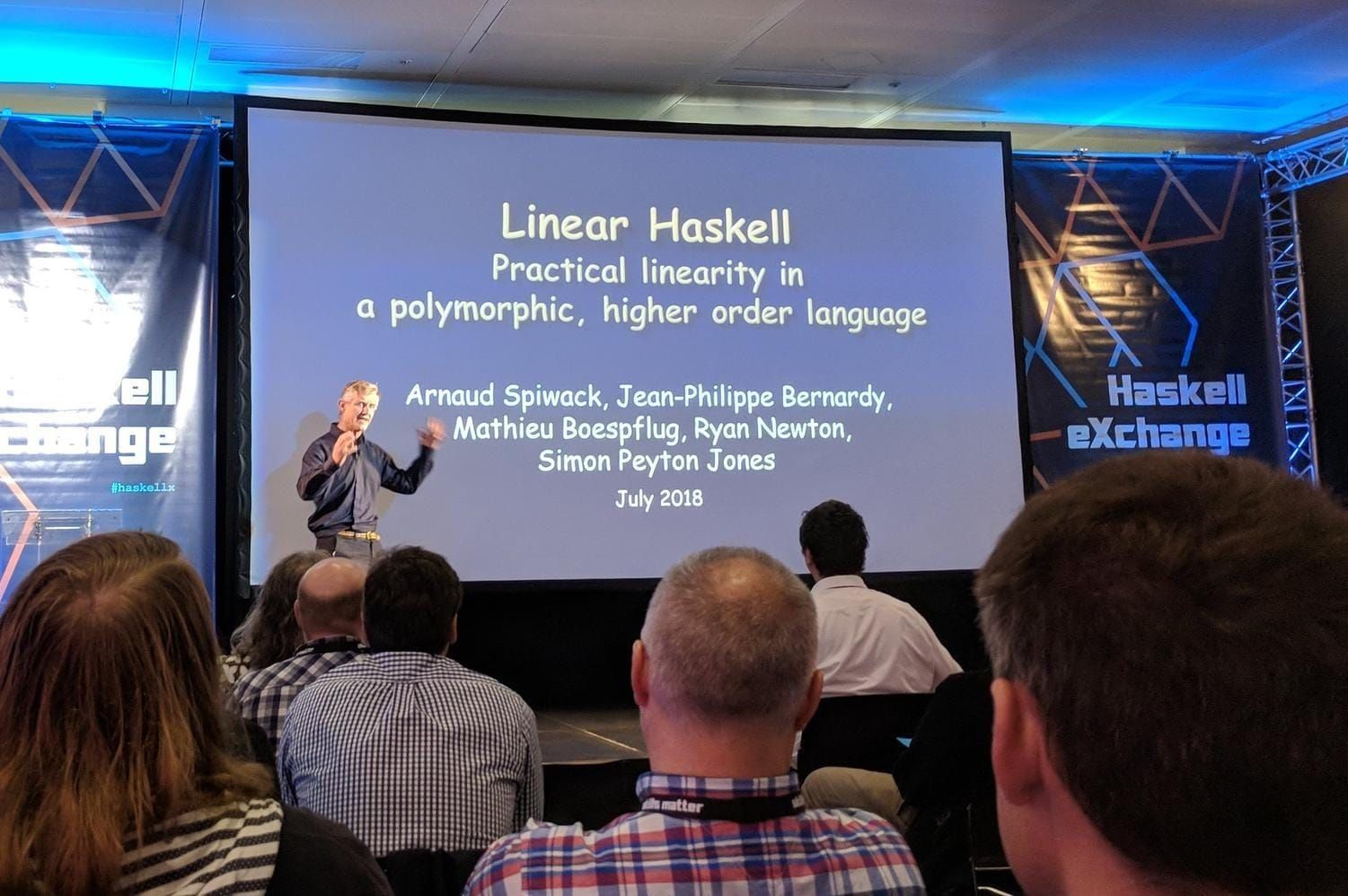
Image context: the cover shows Simon Peyton Jones presenting Linear Haskell at Haskell eXchange in 2018. The photograph captures an idea in its persuasive phase: named authors, an audience, and a research claim on a conference screen. GHC's proposal process exists to turn that kind of energy into a durable public specification before implementation and release make it part of somebody else's compatibility budget.[3][9]
The TLC owns a portfolio, not the language
The Foundation announced the larger reset in May. It said that most of its financial resources would be directed toward technical work, that members should see a clearer causal connection between contributions and ecosystem improvements, and that a new committee would direct resources toward a unified technical vision. It also chose to remain without an executive director for the foreseeable future, dividing those duties between the board and a new part-time role focused on financial sustainability.[2]
The August call made the committee's shape more concrete. The TLC is described as an evolution of the Technical Working Group, but smaller, quicker, more willing to explore, and explicitly empowered to spend. Its volunteers are expected to find projects, discuss them with the community, communicate decisions, and manage work in progress. Accountability runs upward to the Foundation board.[1]
That is real authority. A small group can decide which maintenance problem receives scarce paid attention and which waits for another cycle. It can make an unglamorous compiler, package, documentation, or infrastructure task possible when no single company can justify buying the whole result. It can also create a coherent portfolio instead of scattering grants across whichever proposals arrive with the best-connected champion.
But neither announcement transfers the mandates of Haskell's existing technical bodies. The useful reading is narrower: the TLC decides where Foundation resources go. If a funded project changes the language, base, GHC internals, or a release branch, the relevant upstream gate still applies. The committee's credibility will come from making those dependencies visible, not from treating funding as a fast lane around them.
A language proposal can be accepted and still remain unshipped
The GHC proposal process draws its boundary with unusual clarity. It covers changes to Haskell syntax or semantics, major user-visible compiler behavior, and substantial compiler features. It normally excludes declarations in base, changes to other core libraries, the GHC API, compiler internals, ordinary bug fixes, and minor work that does not justify the process. Those matters go to the Core Libraries Committee, library maintainers, or the normal GHC merge-request workflow.[3]
For work that is in scope, a pull request begins an open-ended community discussion. When the author believes the text is ready, the committee secretary appoints a shepherd. The documented target is one week for that appointment, two weeks for the shepherd's recommendation, and four to five weeks for committee discussion. Labels such as Pending shepherd recommendation, Pending committee review, Needs revision, and Accepted keep responsibility for the next move visible.[3]
Acceptance is deliberately not shipment. It says that a conforming, well-engineered implementation is eligible to enter GHC, subject to documentation, code quality, compatibility, and interactions discovered during implementation. The proposal documentation then makes the boundary explicit: implementation is outside the Steering Committee's purview and may wait indefinitely in a volunteer-driven project.[3] A TLC grant could close that gap by paying an implementer. It still could not make a weak patch mergeable by declaration.
The Steering Committee itself is roughly ten volunteers drawn, by design, from GHC development, education, research, industry, writing, and tooling. Official business is mostly on a publicly archived mailing list; ordinary terms last three years.[4] This is not direct democracy. Existing unexpired members select replacements through ranked voting, the public cannot directly add or remove members, and the bylaws retain a special renewal rule for two historically important members. The model asks legitimacy to come from visible reasoning, refreshed membership, and technically credible outcomes rather than a community-wide ballot.[4]
That concentration is the strongest counterweight to the rosy interpretation. A precise workflow can still move slowly. Public discussion can still be easier for insiders to navigate. A committee with historical continuity can preserve judgment or preserve blind spots. The TLC should not erase those tensions by placing a funded project on a roadmap; it should budget for proposal writing, shepherding, implementation review, and downstream testing as distinct forms of work.
base has a different owner and a harder question
A language extension and a standard-library function may reach users in the same GHC download, but they do not have the same decision path. The Core Libraries Committee says that extensions and compiler warnings belong in the GHC proposal process, while changes to the performance, behavior, or structure of base belong with the CLC.[5]
Its current process starts with a GitHub issue, scales the required detail to the proposal, and makes a downstream impact assessment mandatory for breaking changes. The proposer is normally responsible for finding an implementer, writing tests, preparing migration material, and bringing a GHC merge request far enough that the committee can judge actual code. After a vote, the CLC and GHC team coordinate the approval label, merge review, changelog, target base version, and release tracking.[5]
The scope is stricter than “ask only when adding an API.” The CLC document says that even a bug fix that changes a wrongly implemented function to match its specification, or a performance improvement that always improves performance, falls under its base policy. That sounds fussy until the dependency surface is considered: a tiny semantic or timing change in a library imported by almost every Haskell program can have a larger compatibility radius than a conspicuous opt-in language extension.[5]
The recent separation of base from ghc-internal shows why independent authority matters. The Haskell project describes base as a stable API curated by the CLC and ghc-internal as the compiler-facing layer that may move with GHC. The split, achieved in GHC 9.14, is intended to let compiler internals evolve without forcing every user-facing library contract to move in lockstep.[7] Well-Typed's earlier implementation report records the handoff in practice: the CLC and GHC team agreed on the package boundary, then compiler engineers performed the extraction and integration work.[8]
No single meeting produced that result. It needed a stability goal, a library-policy decision, compiler changes, Cabal work, testing, and release integration across several years.[7][8] That is precisely the class of cross-cutting maintenance the TLC could accelerate—as long as its project plan names every upstream owner instead of compressing them into a generic “Haskell” box.
Release management is another gate inside the GHC team
Even accepted and merged work has not reached users until a release carries it. GHC's governance document treats release managers as an essential part of the GHC team, while the smaller GHC HQ group can delegate or withdraw authority for processes such as release management. This is not a fourth legislature beside the Steering Committee, CLC, and Foundation. It is an operational gate inside the project that has to turn accepted code into artifacts users can obtain and maintain.[10]
GHC's published release policy distinguishes a roughly six-month major-release cadence from designated long-term-support lines. The LTS plan promises at least two years of updates, aims for three, provides overlapping support windows, and excludes new-feature backports after the initial release.[6]
The release-management policy makes the coordination point concrete. A release manager produces official releases and prereleases and makes them available through GHCup. A GHC or CLC proposal intended for a release should be decided and merged before that release branch is forked, and the CLC must receive enough time to consider library changes.[11] Release preparation is therefore downstream of design, but it can expose an upstream schedule failure early.
That creates a resource boundary. A release manager must coordinate branches, builds, tests, migration information, library versions, candidates, and safe backports. Funding a feature does not fund all of that automatically. Nor does a merged feature establish when a conservative adopter should deploy it.[11]
GHC2024 offers a compact example of the chain. The Steering Committee selected a recommended set of language extensions; the GHC team then implemented the set for GHC 9.10, with the question of when it should become the default left separate.[8] Design acceptance, code integration, default selection, and release availability were observable as different events. That is slower to describe than “Haskell added a feature,” but far more useful to an engineering team planning an upgrade.
The same discipline should apply to TLC announcements. “Funded” means that resources were allocated. “Accepted” means the relevant design or policy body approved a bounded change. “Merged” means code entered an upstream branch. “Released” means users can obtain it. “Supported” means someone has committed to maintain a particular line. A healthy governance report will not use those verbs as synonyms.
The test is whether money survives the handoffs
The planned TLC begins with an attractive theory: a smaller committee with a lower spending threshold can convert shared money into technical progress faster than a broad advisory group. Its failure mode is equally clear. Three to five part-time volunteers could select more projects than upstream reviewers can absorb, fund implementations without a release owner, or publish a vision whose work queue is legible only inside the Foundation.[1]
Board oversight helps with fiduciary accountability. It does not answer whether a language proposal is coherent, whether a base break is justified, whether an MR is maintainable, or whether an LTS backport is safe. Those judgments belong where the technical context lives. Conversely, an upstream committee can say “yes” to a valuable idea while lacking anyone with paid time to implement it. Neither money nor legitimacy substitutes for the other.
The durable version of this experiment would leave a public chain for every material project: the problem and success condition; the amount or kind of support; the named implementer; the GHC proposal, CLC issue, or ordinary MR that governs acceptance; the reviewer or maintainer group; the intended release surface; and the maintenance owner after Foundation funding ends. Review latency and downstream breakage matter more than the number of projects announced.
For adopters, the boundary is practical. Treat the TLC's portfolio as a signal of where paid attention is moving, not as a support contract or release forecast. Watch the proposal labels for language work, CLC issues and impact assessments for base, GHC merge requests for implementation, and the published release/LTS plan for deployment timing.[3][5][6] A small team can reasonably adopt from an LTS line without following every governance thread; a platform team building on the GHC API or compiler plugins should track the upstream artifacts directly, because those surfaces remain intentionally less stable.[3][6][7]
The falsifier is simple. If Foundation-funded work routinely cannot name its next upstream gate, sits without reviewers, or appears on a technical agenda without a credible path to a release, then the new committee has centralized prioritization without improving delivery. If each grant makes the chain easier to inspect—and pays for the neglected handoffs as well as the exciting implementation—the TLC will have done something subtler than taking control of GHC. It will have made distributed authority capable of finishing work.
Sources
- Haskell Foundation, “Call for Applications to the Technical Leadership Committee,” August 5, 2026 — committee size, term, workload, spending authority, project-management remit, and board accountability.
- Laurent P. René de Cotret on behalf of the Haskell Foundation Board, “Haskell Foundation 2026 Update,” May 20, 2026 — restructuring, technical-funding goal, membership voice, board changes, and the decision to operate without an executive director.
- GHC Steering Committee, “GHC Proposals” — scope boundaries, public lifecycle, review targets, acceptance conditions, implementation boundary, and proposal-status records.
- GHC Steering Committee, “Bylaws” — composition, constituencies, public communication, three-year terms, member selection, key-member exception, and accountability model.
- Haskell Core Libraries Committee, “Proposals” —
baseremit, impact assessments, implementation and voting workflow, merge coordination, stale approvals, and policy scope. - Andreas Klebinger, “GHC LTS Releases,” The Haskell Programming Language's blog, July 7, 2025 — planned LTS duration, overlap, backport boundary, and non-LTS major-release cadence.
- Simon Peyton Jones, “Making GHC upgrades easy,” The Haskell Programming Language's blog, 2026 —
base/ghc-internalseparation, CLC authority, Template Haskell boundaries, remaining maintenance work, and cross-organization implementation history. - Well-Typed, “GHC activities report: December 2023–February 2024” — independent implementation account of the
basepackage split, CLC/GHC coordination,GHC2024, release work, and integration boundaries. - Denis Oleynikov, “Best Haskell Conferences to Attend,” Serokell, June 28, 2019 — provenance page crediting Marcelo Lazaroni for the real Haskell eXchange photograph used as the article image.
- GHC HQ, “GHC governance,” updated July 10, 2026 — GHC Team merge authority, release managers as part of the team, GHC HQ delegation, and the separate remits of the Steering Committee and CLC.
- GHC HQ, “Release management policy” — release-manager responsibilities, GHCup publication, proposal timing before branch forks, and coordination with the Core Libraries Committee.