HAProxy is often described as a fast load balancer, which is true but still too vague to be useful. The more revealing way to read it in 2026 is architectural. HAProxy's real trick is that it keeps the packet-and-connection hot path narrow while making traffic policy unusually legible: client-facing behavior lives in frontends, server-facing behavior lives in backends, ACLs decide when traffic crosses from one to the other, and the reload boundary is explicit rather than magical.[1][2][3]
That combination is why the project still matters. The current starter guide describes HAProxy as an event-driven, non-blocking engine with a priority-based, multi-threaded scheduler, then says that once started it does essentially three things: process incoming connections, periodically check server status, and exchange information with peers.[1] The project homepage shows that the current stable 3.3 branch reached 3.3.9 on 2026-05-06, so this is not a frozen historical design being admired from a distance.[4] It is a live system that still makes a very opinionated trade: keep routing, health, and availability decisions close to the proxy, but express them through a small number of durable primitives.
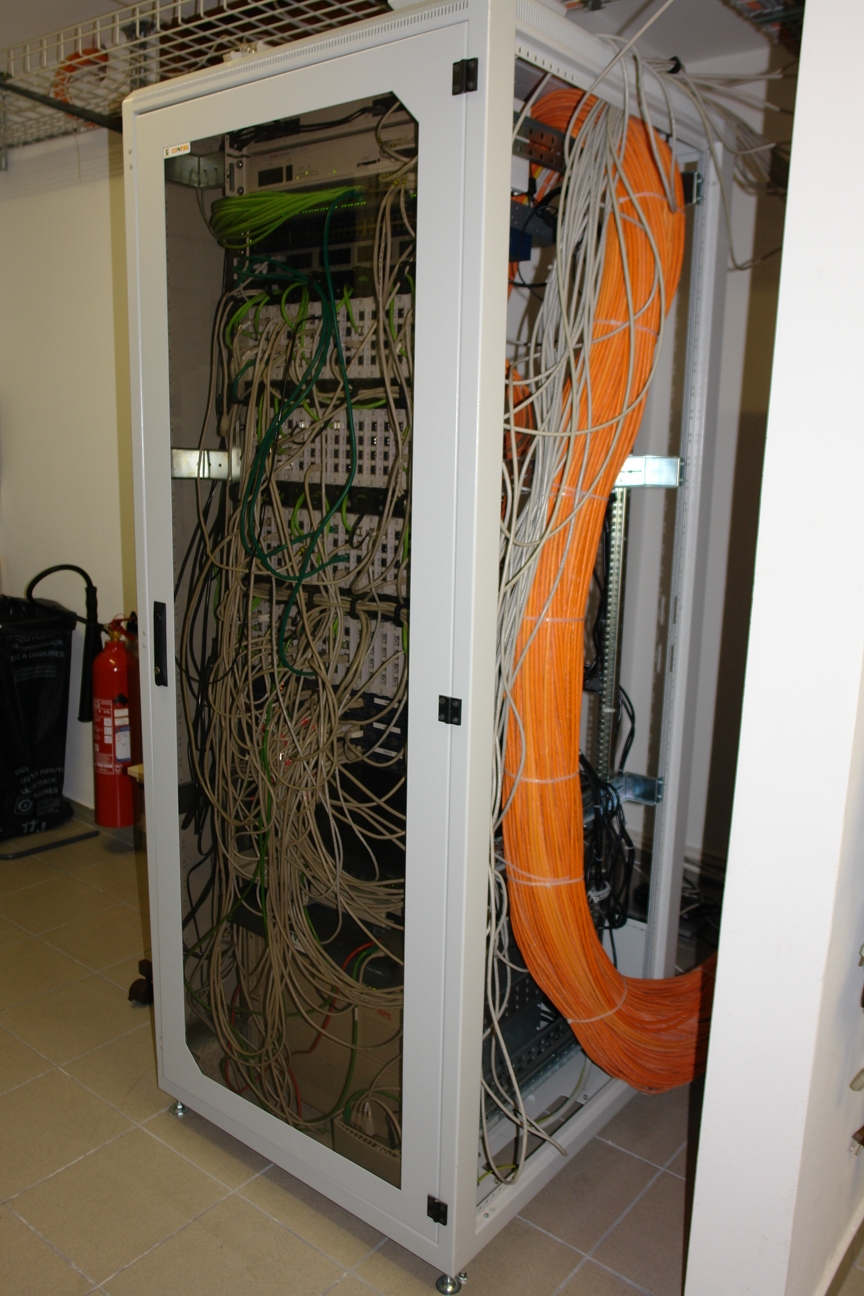
Image context: the cover uses a real photograph of a network rack with switches and patch panels. That is the right visual here because HAProxy's design only clicks when you picture real ingress points, real cables, and real upstream pools instead of a generic "cloud traffic" icon.[6]
Frontends and backends are the core unit
The most important sentence in the official docs is not about benchmarks. It is the one explaining the split between proxy sections. The configuration manual says a frontend section describes listening sockets that accept client connections, a backend section describes the servers that will receive forwarded traffic, and a listen section combines both halves in one place, mainly for simpler TCP cases.[2] The starter guide sharpens the same idea: frontends and backends are "half-proxies," because the frontend only cares about clients and the backend only cares about servers.[1]
That is HAProxy's real mental model. A lot of infrastructure software hides its architecture behind a single giant config surface, then forces operators to infer where the actual boundaries are. HAProxy does the opposite. It makes the split visible. Client admission, TLS termination, request inspection, and early denial can sit in the frontend; balancing, retries, health state, queueing pressure, and server selection sit in the backend.[1][2] When a system is behaving badly, that separation gives operators a much cleaner question than "is the proxy slow?" The better question is "did the request fail on the client-facing side, in the decision layer, or in the server pool?"
This matters because many real load-balancer incidents are classification failures before they are capacity failures. If you do not know whether a symptom belongs to edge admission, routing policy, or backend availability, you end up tuning everything at once. HAProxy's section model is valuable because it narrows that search space.
ACLs are where routing stops being guesswork
Once the frontend/backend split is clear, the next piece is ACLs. The docs devote a large section to ACLs and the conditions built from them because that is where HAProxy stops being a round-robin appliance and becomes a traffic-decision engine.[2] Requests arrive on a frontend, HAProxy fetches samples from the connection or HTTP data, and ACL conditions decide what should happen next: deny, redirect, rewrite, stick, or hand the request to a different backend.[1][2]
That is why HAProxy still scales across very different use cases without becoming conceptually bloated. The underlying pattern does not change much whether you are routing by host header, path prefix, source network, request rate, maintenance state, or tenant marker. The primitives are still "accept a connection," "inspect specific facts," and "send it to the backend that matches the policy." In architectural terms, ACLs keep complexity declarative. You can build intricate traffic behavior, but the decision layer still has a recognizable grammar instead of a sprawling plugin marketplace.[2]
There is a practical consequence here for teams choosing between HAProxy and more controller-heavy proxies. HAProxy works best when you want routing policy to be inspectable in the config itself. If your organization wants every rule to read like infrastructure text rather than to disappear into a separate service-discovery control plane, HAProxy's style is a feature, not an old limitation.
Health checks and runtime control keep failure close to the server pool
The other reason HAProxy remains legible is that it does not pretend availability is just a routing problem. The starter guide says the proxy periodically checks server status, and the configuration manual shows how concrete that becomes with option httpchk, http-check connect, and http-check expect rules.[1][2] Those checks are not side decoration. They are how the backend half learns whether it should still trust a server enough to send traffic there.
This is a strong design choice because it keeps most failure handling near the pool that is actually failing. If one upstream starts returning the wrong status code, timing out on TLS, or failing a specific HTTP path, HAProxy can mark that as backend state instead of discovering it only after users complain.[2] That in turn keeps the frontend simpler. The edge still accepts traffic; the backend decides whether the pool is healthy enough to serve it.
The docs also show that HAProxy does not force every operational change through a full topology reload. The starter guide notes that administrators can change weights and rate limits on the fly and can disable a specific frontend to release a listening port.[1] That is an underappreciated boundary. Topology changes and policy rewrites still belong to configuration, but some availability controls belong to runtime state. HAProxy is strongest when teams respect that distinction instead of treating every small server-state change as a reason to rebuild the whole proxy process.
The reload boundary is explicit, which is both a strength and a limit
The last architectural feature that matters is the reload story. HAProxy's management guide is refreshingly direct: it distinguishes a hard stop from a graceful stop, says SIGUSR1 unbinds listening ports while allowing existing connections to continue, and explains that in master-worker mode the master reacts to SIGUSR2 by reexecuting itself, parsing the configuration, and forking new workers.[3] The same documentation also exposes operators to the knobs that shape this behavior, including nbthread for thread count and hard-stop-after for the maximum clean soft-stop time.[2][3]
This is exactly the sort of boundary good infrastructure software should make obvious. A reload is not hand-wavy "hot config." It is a well-defined replacement process with old and new workers coexisting for a while. That honesty is one reason HAProxy stays dependable. It does not hide the fact that long-lived traffic changes the cost of graceful reloads. Red Hat's OpenShift guidance on HAProxy reloads and long-lived connections is useful precisely because it names the operational symptom directly: frequent reloads combined with long-lived connections can lead to connections being terminated unexpectedly or old router processes hanging around and consuming CPU and memory.[5]
That is the main architectural limit to keep in view. HAProxy is excellent when the connection lifecycle, reload frequency, and policy surface are all understandable enough that graceful replacement remains graceful. If your environment is full of very long-lived websockets, database-style sessions, or constant config churn, the reload boundary stops being a background detail and becomes part of the product design. The answer is not that HAProxy is broken. The answer is that the architecture is honest about where process replacement still costs something.[3][5]
Best fit in 2026
The cleanest reason to choose HAProxy in 2026 is not "it is fast." Many proxies are fast enough. The better reason is that it gives you an unusually readable control surface for the classic proxy job: accept connections, classify them with explicit policy, send them to a server pool whose health is continuously tested, and reload with a behavior model that operators can actually reason about.[1][2][3]
That makes it strongest for teams that want a durable, text-first edge layer and are willing to think clearly about their connection patterns. The mismatch appears when teams want the proxy to behave like a hidden substrate that can absorb arbitrarily frequent topology mutation and arbitrarily long-lived traffic without architectural consequences. HAProxy has never really promised that. What it promises, and still delivers, is something narrower and in practice often more valuable: a fast event-driven proxy whose section boundaries, rule language, health model, and reload semantics all stay visible enough that operators can debug them under pressure.[1][2][3][4][5]
Sources
- HAProxy Starter Guide for version 3.3 - project definition, event-driven multi-threaded engine, the "three things" HAProxy does after startup, frontend/backend half-proxy framing, and on-the-fly operational controls.
- HAProxy Configuration Manual for version 3.3 -
frontend/backend/listensection definitions, ACL and condition model,http-check connect,http-check expect,nbthread, andhard-stop-after. - HAProxy Management Guide for version 3.3 - graceful vs hard stop,
SIGUSR1,SIGUSR2, andmaster-workerreload behavior. - HAProxy home page - current branch table,
3.3.9as the latest3.3release, and the2026-05-06changelog date. - Red Hat Customer Portal, "OCP4: Haproxy reloads and long-lived connections deep dive" - external operational framing of frequent reloads interacting badly with long-lived connections in HAProxy-based ingress.
- Wikimedia Commons file page for "Computer rack with switches and cables.jpg" - source page for the real rack photograph used as the article image.