GNOME is easiest to discuss as a desktop environment: Shell, Mutter, GTK, Libadwaita, Files, Settings, Calendar, Orca, apps, extensions, and the general feel of a Linux workstation. That surface matters, but it is not the strongest 2026 signal. The more useful read is organizational. GNOME makes a large user-facing platform governable by splitting authority across module maintainers, a release team, and a nonprofit foundation, then forcing the whole thing through a public release calendar.[1][2]
As of 2026-05-25T18:32:04Z UTC, GNOME's calendar lists 50 as the stable branch, 49 as old stable, and 51 as unstable. It also publishes the next development freezes: API/ABI, feature, UI, and string-announcement freezes all begin on 2026-08-01, with the string freeze following on 2026-08-22 and GNOME 51.0 scheduled for September 2026.[2] That is the governance signal: not that the project avoids churn, but that it makes churn arrive on a clock.
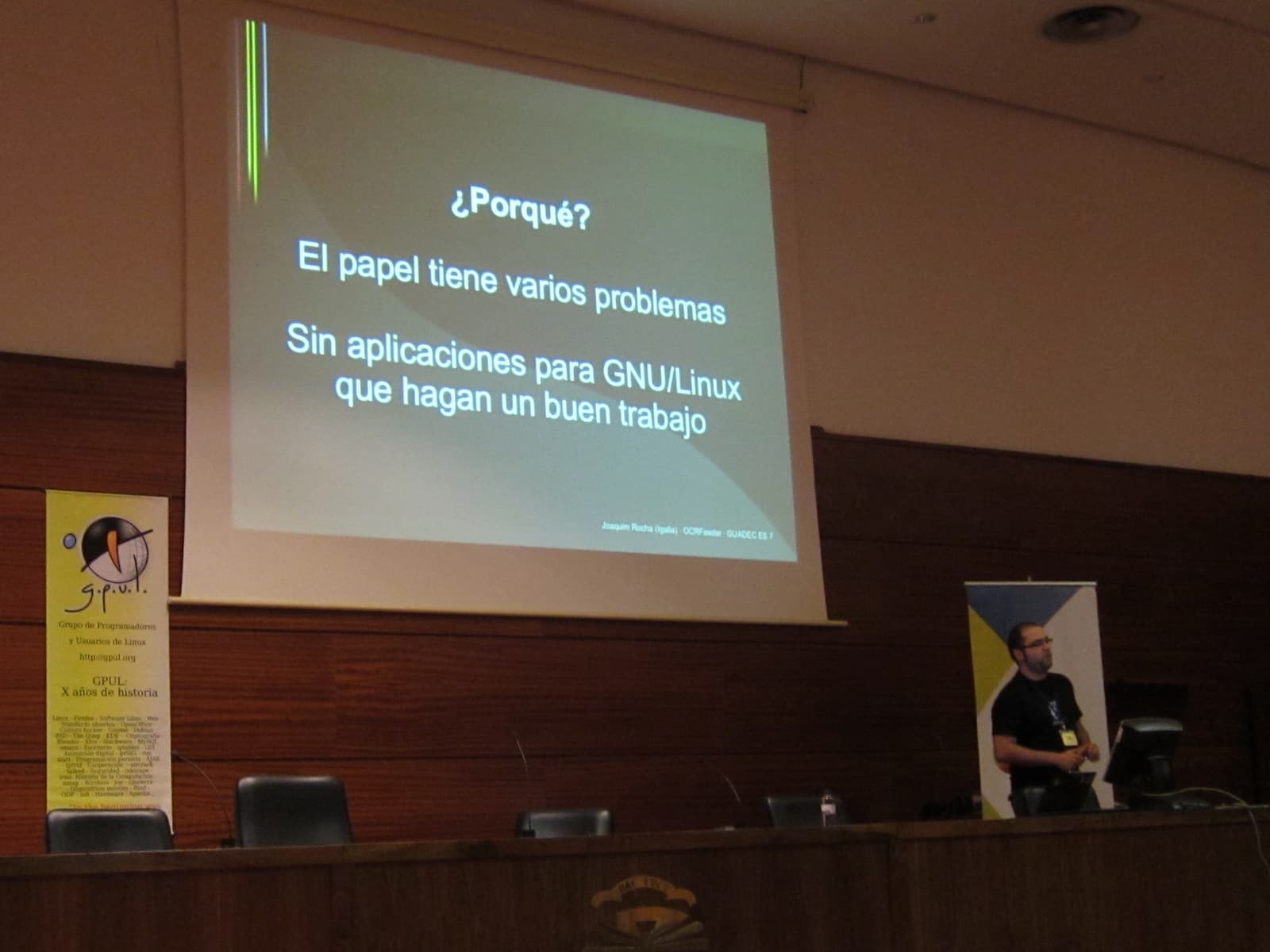
Image context: the cover uses a real photograph from GUADEC-ES in 2010, showing Joaquim Rocha presenting OCRFeeder. It is deliberately not a logo, screenshot, diagram, or generated image. The point is the human layer: GNOME's technical platform is sustained through talks, maintainers, release coordination, foundation operations, and local events as much as through merge requests.[7]
The release calendar is a product contract
GNOME's release calendar reads like infrastructure, not marketing. It shows branch states, tarball due dates, assigned release managers, freeze windows, past release dates, and old-stable end-of-life timing in one place.[2] That matters because desktop platforms sit between fast-moving libraries and conservative downstream distributions. If GNOME did not publish the clock, Fedora, Ubuntu, Debian, openSUSE, Arch, downstream app developers, extension authors, accessibility maintainers, translators, and documentation teams would all be negotiating the same uncertainty at different times.
The calendar also shows how much discipline sits behind the familiar six-month story. Stable 50 and old-stable 49 coexist while 51 is the unstable branch. The old-stable line has a visible final release point, and the development branch has named freeze gates before the next major stable release.[2] Those gates are not bureaucratic decoration. UI freeze protects documentation and screenshots. String freeze protects translators. API and ABI freeze protect app and library developers. Feature freeze protects release quality by changing the conversation from "what else can land?" to "what still has to be made reliable?"
For adopters, this turns GNOME from a moving target into a planning object. A distribution can decide whether to absorb 50 now, stay on 49 until the old-stable window closes, or begin testing 51 before the freezes harden. An app maintainer can watch GTK, Libadwaita, portal behavior, and platform expectations evolve without treating every upstream change as a surprise. The cadence does not remove upgrade work. It makes the work schedulable.
Technical authority is deliberately layered
The GNOME Project Handbook is unusually clear about where technical authority lives. GNOME components are treated as modules, each with one or more maintainers listed in its .doap file. Those maintainers are responsible for bug fixing, responding to reports, making releases, and deciding which changes land in their module.[1] That is the first layer: local ownership close to the code.
The second layer is the Release Team. The handbook says the Release Team makes each GNOME release, organizes the development schedule, decides which modules belong in a GNOME release, and functions as the closest thing GNOME has to a technical governing body.[1] That role is important precisely because GNOME is not one repository. A desktop release has to coordinate Shell, Mutter, GTK, settings panels, core apps, accessibility pieces, platform libraries, translations, and documentation. Module autonomy is healthy until the platform needs a coherent release boundary; the Release Team is the boundary keeper.
The third layer is the GNOME Foundation. The handbook describes the Foundation as the project's legal entity: it owns trademarks, manages finances, employs staff for critical project functions, and is governed by an elected Board of Directors.[1] This creates a useful separation. Technical maintainers do not have to become the whole legal and financial apparatus. The Foundation can handle money, infrastructure, events, trademarks, and staff support while maintainers and release coordinators keep technical authority close to the project.
That layered model is more robust than a single charismatic-maintainer structure. It does not guarantee perfect decisions, and it can still be slow. But it gives downstreams something to inspect: module ownership for specific code, a release team for platform coherence, and a foundation for legal and operational continuity.[1]
GNOME 50 shows the scale of the coordination problem
GNOME 50, released on March 18, 2026, is a useful stress test for this model because it is not a single-feature release. The user-facing notes span parental controls, accessibility improvements in Orca, document annotation, Files performance and interface changes, Calendar improvements, Settings updates, remote desktop changes, display handling, VRR and fractional scaling improvements, color-management protocol work, HDR screen sharing, new Circle apps, and new wallpapers.[3]
That list is exactly why governance matters. Parental controls touch accounts, policy, settings, and future web-filtering foundations. Accessibility work touches Orca, toolkit behavior, app interfaces, and testing habits. Remote desktop changes pull in graphics acceleration, VA-API, Vulkan, explicit sync, HiDPI handling, camera redirection, Kerberos authentication, and gnome-headless-session behavior.[3] Display improvements rely on Mutter, Wayland protocol work, graphics-driver realities, and downstream defaults.[3]
The developer notes widen the picture further. GNOME 50 brought Builder improvements, Mutter Devkit features for simulating monitor setups, GTK 4.22 with native SVG support through GtkSvg, Libadwaita 1.9, new sidebar widgets, GTK_DEBUG=builder diagnostics, and automatic support for the reduced-motion preference in most widgets.[4] This is not a desktop skin. It is an app platform, compositor stack, toolkit stack, accessibility stack, and developer workflow moving together.
An independent Phoronix readout reached the same broad conclusion from the outside: GNOME 50 landed on schedule and was positioned for major distributions, with improvements across Files, parental controls, accessibility, HDR, color management, VRR, fractional scaling, NVIDIA performance, GTK, Mutter, and remote desktop.[6] The independent source is useful not because it replaces GNOME's own notes, but because it confirms the external adoption frame: these releases matter when distributions have to ship them.
The Foundation makes invisible work visible
GNOME's 2023-2024 annual report explains why the Foundation layer matters. The report says the Foundation provides infrastructure such as GitLab, continuous integration, forums, chat, email, web servers, and Nextcloud; coordinates events including GUADEC, GNOME.Asia, and Linux App Summit; supports outreach programs; and facilitates development funding.[5] It also reports two major funding streams for that year: more than $1 million from Germany's Sovereign Tech Fund for development work and a $250,000 grant from Endless to support Flathub and parental-controls work.[5]
Those numbers are not decoration. They explain how work that looks like "community" becomes operational. A modern desktop needs CI capacity, issue infrastructure, design coordination, travel and event support, accessibility labor, translations, app-developer support, and funding routes for otherwise unfunded work. The annual report's description of GNOME's AWS migration is another governance signal: infrastructure can become a project risk if it sits outside a visible operating plan.[5]
The same report links the Foundation's events program to project continuity. GUADEC, GNOME.Asia, and Linux App Summit are not just morale events. They are places where maintainers, app developers, designers, translators, downstreams, and sponsors make decisions legible to one another.[5] A project that spans libraries, apps, shell behavior, accessibility, and distributions needs those human synchronization points.
Circle is an app boundary, not a trophy shelf
GNOME Circle is easy to misread as a showcase. In the GNOME 50 notes, Circle appears as a list of community-created apps that use the GNOME platform, including Gradia, Sudoku, Constrict, and Sessions.[3] The important governance signal is not that these apps are "nice." The signal is boundary management.
Core GNOME cannot absorb every useful app without becoming impossible to release, translate, test, and support on one clock. At the same time, a platform needs a healthy app ecosystem that follows its design language, toolkit expectations, and distribution paths. Circle gives GNOME a middle lane: community apps can be recognized and supported without being treated as core release blockers.[3]
That boundary makes the release system more credible. Core modules can keep the six-month platform cadence. Circle apps can grow the ecosystem around that platform. The Foundation can support app developers without pretending that every app belongs in the same governance tier. For a desktop project, that distinction is practical survival.
What adopters should watch
GNOME's 2026 signal is strong, but it has clear boundary conditions. The thesis weakens if release freezes stop holding, if old-stable support becomes unclear, if module maintainers lose the ability to make decisions without creating bottlenecks, or if Foundation finances and infrastructure work become opaque. It also weakens if the platform/app boundary blurs so much that downstream distributions cannot tell what is core, what is Circle, and what is external.
The positive watch items are equally concrete. Watch whether the 51 freeze sequence lands as scheduled in August 2026.[2] Watch whether GNOME 50's accessibility, remote desktop, display, and developer-stack changes keep getting point-release polish rather than only launch-day attention.[3][4] Watch whether the Foundation continues to disclose funding, staffing, infrastructure, and event work with enough specificity to show where operational capacity is coming from.[5]
The practical adoption conclusion is not "GNOME is perfect." It is narrower and more useful: GNOME remains one of the few open source desktop platforms whose coordination machinery is visible enough to plan around. Module maintainers define local ownership. The Release Team turns many modules into one scheduled platform. The Foundation handles the legal, financial, event, and infrastructure layer. GNOME 50 shows why all three are needed. The desktop is the surface; the governance model is what keeps the surface shippable.[1][2][3][5]
Sources
- GNOME Project Handbook, "Governance" - module maintainers, Release Team authority, and the Foundation's role as legal and operational entity.
- GNOME Release Notes, "GNOME Release Calendar" - stable/old-stable/unstable branch states, freeze dates, release assignments, and historical release schedule.
- GNOME Release Notes, "Introducing GNOME 50, 'Tokyo'" - March 18, 2026 release notes and user-facing changes across apps, accessibility, display, remote desktop, and Circle.
- GNOME Release Notes, "What's new for developers" - GNOME 50 developer-stack changes including Builder, Mutter Devkit, GTK 4.22, GtkSvg, and Libadwaita 1.9.
- GNOME Foundation, "2023-2024 Annual Report" - Foundation activities, infrastructure, events, grants, releases, GNOME Circle, and finances.
- Michael Larabel, "GNOME 50 Released With Many Fantastic Improvements." Phoronix, March 18, 2026 - independent release readout and downstream distribution framing.
- Wikimedia Commons, "File:Joaquim Rocha presenta OCRFeeder.jpg" by Alberto Garcia - source page for the real photographic GUADEC-ES cover image.