Blender is easy to praise in the wrong register. The visible product is a full 3D creation suite: modeling, sculpting, animation, rigging, rendering, compositing, video editing, Python scripting, asset workflows, and a large add-on ecosystem. But for a studio, school, tool builder, or technical artist deciding whether Blender can carry real work, the stronger 2026 signal is not another feature demo. It is the governance machinery that keeps a fast creative tool from becoming an unstable creative dependency.
The useful reading is this: Blender has become an open source production platform because the project now exposes several clocks and boundaries at once. It has a predictable release train, a stricter LTS lane, a reviewed extension packaging surface, a development fund that pays for maintenance work, a public lab for experiments that should not destabilize the main release path, and a leadership handoff that has been prepared rather than sprung on the community.[1][2][5][6][7] That does not make Blender low-risk in every pipeline. It does make the risk inspectable.
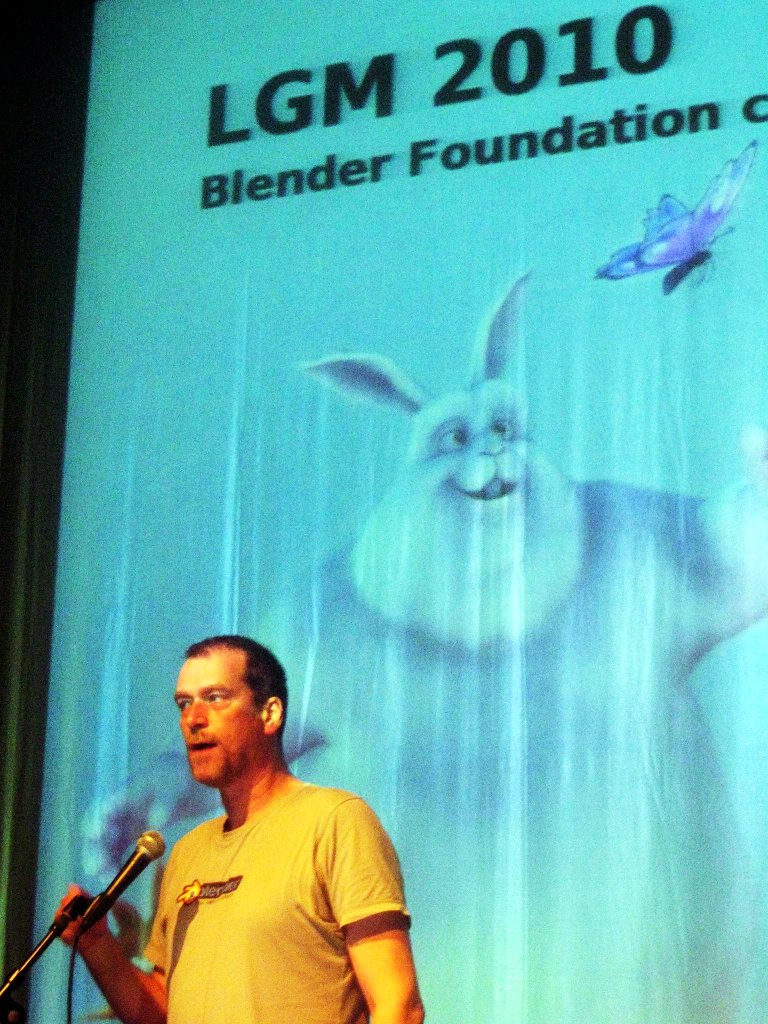
Image context: the cover uses a real photograph of Ton Roosendaal at the Libre Graphics Meeting in Brussels in 2010. It is not a logo, screenshot, diagram, or generated visual. The choice matters because this article is about the human and institutional layer behind Blender: conferences, maintainers, funding, release discipline, and the gradual move from founder-led coordination into a broader foundation structure.[8]
The release train is a production contract
Blender's developer handbook states the operating cadence plainly: the Foundation aims to publish three stable releases per year, with one of them receiving long-term support for two years. A new version is targeted every 4 months.[1] That cadence is not just a calendar nicety. It tells downstream packagers, studio pipeline teams, trainer-authors, add-on maintainers, and documentation writers how much churn to expect.
The release mechanics are more important than the headline number. Work happens across main and a blender-v{VERSION}-release branch. The release branch is available 6 weeks before release for bug fixing, while main opens for the next release and gives developers roughly 17 weeks to add and improve features for the following cycle.[1] This overlap is the real governance signal. Blender is not pretending that innovation and stabilization are the same job. It gives each job a branch and a time box.
For adopters, this changes the evaluation question. The question is not "Does Blender change quickly?" It does. The question is whether those changes arrive through a pattern that can be rehearsed. A small studio can test the next stable build during beta, freeze its own production environment on the LTS line, and decide which add-ons or scripts need migration before artists are blocked. The release train does not remove upgrade cost. It turns upgrade cost into something that can be scheduled.
LTS is where artistic output gets protected
Blender's long-term support policy is stricter than "old version with bug fixes." The LTS page says the program started with Blender 2.83 and is meant to give long-lasting projects a stable version with bug fixes across a 2-year span.[2] The backport rules then draw a conservative boundary: fixes must first be tested in main, Blender's output should not change, the Python API should not change, Blend File Compatibility should not change, and libraries update only to address CVEs.[2]
That list is exactly what production users need to hear. In a creative pipeline, a "minor" change can be expensive if it changes render output, script behavior, file compatibility, or bundled library assumptions. Blender's LTS policy acknowledges that production stability is not just crash reduction. It is repeatability of images, repeatability of automation, and confidence that a file opened next month still means what it meant this month.[2]
The monthly rhythm matters too. The LTS documentation says LTS releases happen on a fixed schedule, currently once each month if there are backports, and that blender.org/download/lts offers the latest LTS releases, up to two in parallel.[2] That gives studios a maintenance lane that is neither "never patch" nor "chase every feature release." The hard part for adopters is still local testing: a pipeline with custom Python, renderer assumptions, add-ons, or farm images should treat LTS updates as controlled changes. But the upstream project has at least made the boundary explicit.
Extensions make add-ons a reviewed boundary
Blender 4.2 LTS made the add-on ecosystem more legible by moving most add-ons that used to ship with Blender onto the Extensions Platform, where users can browse, install, and update them from inside Blender.[3] That move matters because add-ons are both Blender's strength and one of its risk surfaces. A creative suite that invites Python extension can grow fast, but it also needs a way to distinguish packaged, declared, reviewed extension work from arbitrary scripts copied into a user folder.
The extension documentation shows how Blender is trying to make that boundary concrete. An extension is shared as a .zip archive with a blender_manifest.toml file. The manifest carries required metadata such as name, maintainer, type, version, minimum Blender version, and license information. Licenses are expressed with SPDX identifiers. Extensions can also declare permissions such as files, network, clipboard, camera, or microphone, with reasons attached.[4]
The moderation step is equally important. The manual says a submitted extension is held for review and published once the moderation team approves it.[4] That does not make every extension safe, performant, or well maintained. It does create a clearer trust boundary than the old mental model of "download a zip from somewhere and hope." For pipeline owners, the best practice is still local: pin extension versions, test updates against production scenes, and keep an allowlist. But Blender's governance has improved the default surface by making extension packaging, metadata, license declaration, and review part of the official path.[3][4]
Funding is no longer background scenery
Blender's funding model is not a decorative support page. The Development Fund page says contributions finance Blender team operations, including development, documentation, and bug fixes. It also names the maintenance surface around online initiatives: blender.org websites, documentation, benchmarking, and feedback or discussion forums.[5] That is the work users usually notice only when it fails.
This is why the Development Fund is a governance signal rather than a donation widget. Blender is a professional tool with public infrastructure needs: release notes, manual updates, build systems, bug triage, platform testing, developer coordination, and enough staff continuity to keep an enormous codebase moving. The Fund page also says Blender Foundation annual reports give an overview of projects, supported people, income, and expenses, and that developer grant decisions are made by the Foundation with support from project administrators.[5] That public accounting is not the same as a commercial SLA, but it gives users a way to inspect the maintenance base under the software.
The boundary condition is obvious. Donation-backed infrastructure can be more exposed to sentiment, macro cycles, and corporate budget shifts than a license-fee vendor model. A company betting serious work on Blender should not confuse free access with zero dependency cost. The practical response is to budget for Blender like a platform dependency: support the fund where possible, keep local expertise, maintain a tested internal environment, and avoid assuming that community goodwill alone will pay for every invisible chore.
Blender Lab keeps experiments off the release train
One danger in a mature creative tool is that reliability can crowd out invention. Blender's own "Introducing Blender Lab" post frames the problem directly: Blender has become a powerful and complex piece of software, with a demanding user community, technical debt, and complex dependencies; shipping features and improvements requires more coordination over time.[6] The Lab is the project's answer to that tension.
The important detail is that Lab activities are meant to be independent of Blender releases, while remaining public and visible on blender.org/lab with objectives, timelines, participants, and intermediate builds for testing and feedback.[6] The first batch listed in the announcement includes work beyond mouse and keyboard for touch and pen, VR/XR, volume rendering, and light transport, with possible future areas such as USD authoring and AI or ML technologies, starting with a Blender MCP server.[6]
That structure is healthy. It gives experimental work a visible place without forcing every uncertain idea into the main release cadence. It also gives users a more honest signal: some work is production-bound, some work is research-shaped, and the two should not carry the same compatibility promises. For an OSS project serving artists, researchers, studios, educators, and hobbyists at once, that separation is not bureaucracy. It is how a creative tool avoids letting either caution or novelty dominate the entire roadmap.
The leadership handoff is the governance test
The clearest 2026 governance test is leadership transition. Blender Foundation announced that Ton Roosendaal would step down as chairman and Blender CEO on January 1, 2026, passing those roles to COO Francesco Siddi. The same announcement added board positions for Sergey Sharybin as head of development, Dalai Felinto as head of product, and Fiona Cohen as head of operations. Roosendaal moved to the newly established Blender Foundation supervisory board, and the announcement says the transition had been prepared since 2019.[7]
An independent CG Channel report framed the same transition around the end of Roosendaal's role as the public figurehead for more than three decades and identified the new board functions as development, product, operations, and executive leadership.[9] That outside confirmation matters because open source founder transitions are high-risk moments. Projects can lose direction, fragment authority, or discover that the founder had been quietly doing too many invisible jobs.
Blender's handoff does not prove success by itself. The proof will come through boring continuity: releases still arrive, LTS policy still holds, extension review remains credible, funding reports stay legible, Lab work stays public, and the new leadership can make product decisions without treating Roosendaal's supervisory-board role as either a shadow CEO position or a symbolic retirement plaque. The best sign is not drama. It is the absence of mystery around who owns which layer of the project.
What adopters should watch
The positive adoption case is strong when a team wants an open creative suite with visible release discipline, a serious LTS lane, source availability, a large extension ecosystem, and an institution that discloses more of its operating model than many commercial vendors disclose. Blender is especially compelling when pipeline ownership is part of the team's culture: technical artists, tools developers, educators, small studios, and research groups can inspect, extend, package, and teach the tool without asking a vendor for permission.
The mismatch begins when a team expects Blender to behave like a fully vendor-managed product while also relying on unpaid ecosystem assumptions. Blender lowers licensing friction, but it does not remove responsibility for upgrade testing, extension selection, Python API migration, file compatibility checks, render validation, hardware support, training, or internal support. The fact that the software is free makes those responsibilities easier to miss, not less real.
The watch items are concrete. Watch whether the four-month release rhythm remains predictable.[1] Watch whether LTS backports keep respecting output, API, and file-compatibility boundaries.[2] Watch whether the Extensions Platform keeps review and metadata meaningful as the ecosystem grows.[3][4] Watch whether the Development Fund and annual reports continue to show the maintenance base behind the project.[5] Watch whether Blender Lab stays public enough to separate experiment from promise.[6] And watch the post-Roosendaal leadership model: Blender's next phase depends on proving that its governance is now stronger than any one person's role.[7][9]
The conclusion is not that Blender is risk-free. It is that Blender's most important 2026 strength is readable governance. The project has clocks, lanes, review surfaces, funding signals, experimental boundaries, and a planned leadership structure. For an open source creative platform, that is the difference between enthusiasm and operational trust.
Sources
- Blender Developer Documentation, "Release Cycle" - official release cadence, release branch timing, beta/release-candidate phases, and
mainoverlap. - Blender Developer Documentation, "Blender LTS" - two-year LTS program, backport rules, API/output/file-compatibility boundaries, and LTS distribution policy.
- Blender Developer Documentation, "Blender 4.2 LTS Release Notes" - 4.2 LTS release context and migration of most bundled add-ons to the Extensions Platform.
- Blender 4.2 LTS Manual, "How to Create Extensions" - extension archive structure, manifest metadata, SPDX license field, permissions, upload, and moderation review.
- Blender Development Fund, "About" - funding role for development, documentation, bug fixes, online infrastructure, annual reports, and development grants.
- Francesco Siddi, "Introducing Blender Lab." Blender, November 7, 2025 - public lab structure, release-independent experimental work, listed project areas, and 2026 proposal guidance.
- Blender Foundation, "Blender Foundation announces new board and executive director" (September 17, 2025) - official leadership transition announcement.
- Wikimedia Commons, "File:Ton-Roosendaal-at-libregraphicsmeeting-2010.jpg" by Amjahed - source page for the real photographic cover image.
- Jim Thacker, "Ton Roosendaal to step down as Blender chairman and CEO." CG Channel, September 17, 2025 - independent reporting on the leadership transition and new board roles.