A simulated particle can lose energy inside a detector without producing an electronic signal that the experiment would record. Geant4's architecture makes that distinction explicit: it transports particles through materials, exposes the consequences of their interactions, and gives the application separate interfaces for collecting hits and modelling readout. Following those interfaces explains where a simulation acquires its meaning—and where a plausible result can go wrong.[1][6]
The open-source toolkit supplies reusable physics and transport machinery. The experiment supplies a particular world: its materials, dimensions, particle source, and definition of an observation.[1] A beautifully rendered detector is only the beginning of that description.
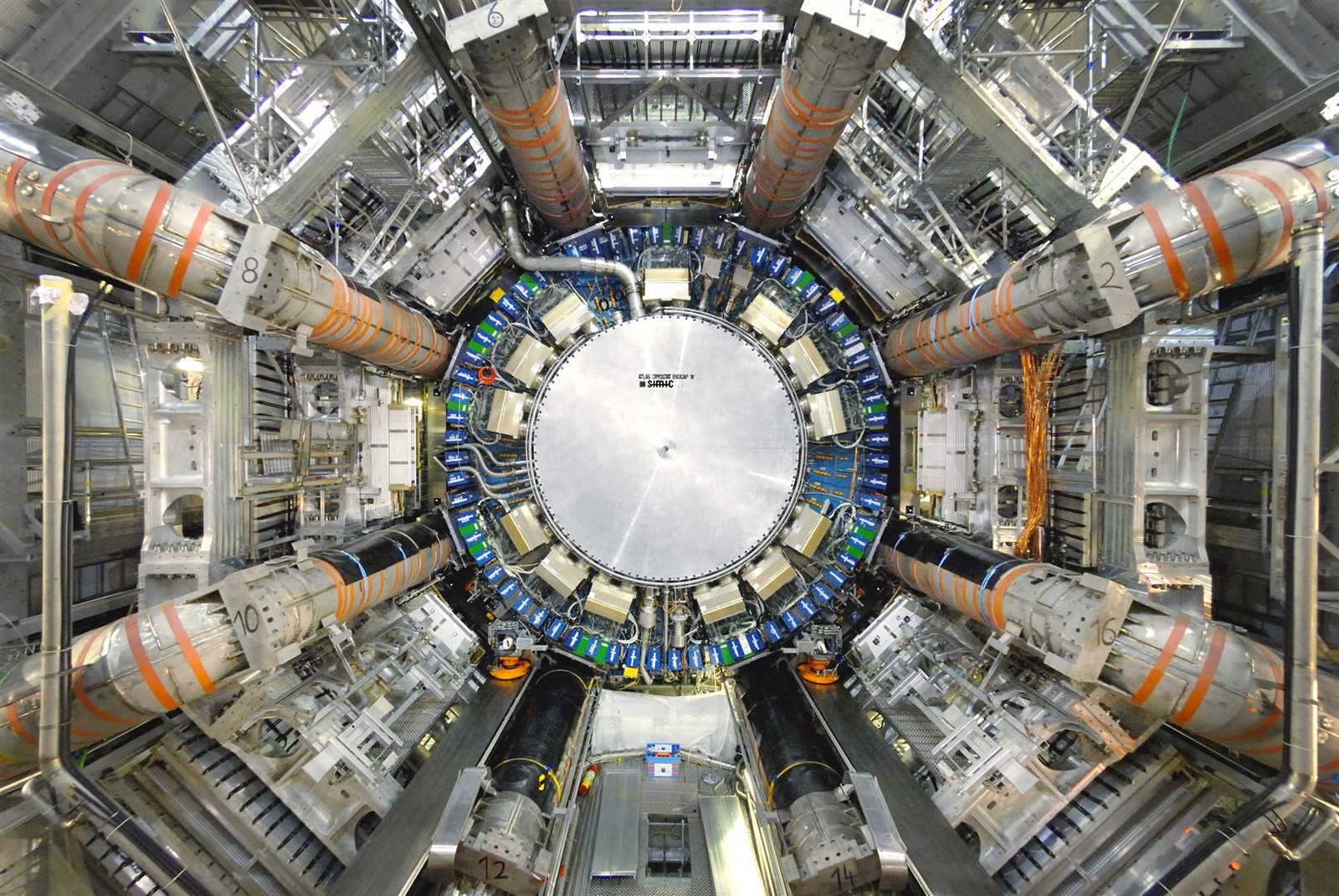
First, specify the world
A Geant4 application begins by registering three kinds of initialization with the run manager: detector construction, a physics list, and action initialization. Their base classes are G4VUserDetectorConstruction, G4VUserPhysicsList, and G4VUserActionInitialization. The actions include a primary generator, which supplies the starting particles for each event. The toolkit deliberately leaves these choices to the application.[2]
Imagine a small test setup: an electron beam aimed at a silicon sensor, with a support plate behind it. That is an illustrative example, not an ATLAS model. Geometry describes where the silicon and support sit; material definitions describe what they contain; the physics list specifies which particle interactions will be considered. The source defines the beam's initial conditions. Changing any one changes the experiment being simulated.
This division is useful before a single event runs. A wrong sensor thickness belongs in the detector description. A wrong beam direction belongs in the source. Treating both as an unexplained disagreement in the final histogram hides information the architecture already provides.
An event contains a family of particles
G4Event holds primary vertices and particles, together with containers for outputs such as hits and digits. An event can begin with multiple particles. The event manager converts primaries into tracks, passes tracks to tracking, and sends newly created secondary tracks to the stack manager.[3]
For the silicon example, the incoming electron therefore does not have to remain the sole character in the calculation. Interactions can create further particles, each with its own state and subsequent history. The event provides a common context in which their contributions can eventually be collected.
A G4Track holds a particle's current position, time, momentum, and energy. A G4Step records a transport increment with pre-step and post-step points. Processes propose limits, and the stepping machinery coordinates them with geometry boundaries. Step lengths emerge from those constraints; they are not simply fixed animation frames.[4]
There is a consequential accounting detail: the change in a track's energy is not the same as energy deposited locally. Energy can leave with secondaries. To collect deposited energy, the documented quantity is GetTotalEnergyDeposit(), rather than the difference between the track's initial and final energy for that step.[4] Otherwise, the sensor can appear to have absorbed energy that another particle carries away.
A sensitive volume needs a recording policy
Geant4 does not infer that our silicon slab is a sensor because it contains silicon. ATLAS physicist Zach Marshall made this point in his 2014 account of detector simulation: silicon in electronics and silicon in a sensing element need different treatment when deciding what to save.[8]
The application associates a G4VSensitiveDetector implementation with selected logical volumes in ConstructSDandField(). Its ProcessHits() method receives step information and can create application-defined hit records. A record might retain position, time, and deposited energy. The application decides which information matters.[5]
That choice is already a reduction of the simulated history. A study retaining only an event's total deposited energy cannot later recover exactly which sensor channels shared it. If channel occupancy is the intended measurement, the recording policy must preserve channel identity. This is an engineering consequence of choosing the hit schema, not a property that transport can repair afterward.
For simpler quantities, Geant4 also supplies primitive scorers. G4PSEnergyDeposit, for example, accumulates weighted step energy deposits in a cell.[5] It is useful when that quantity answers the question; a more elaborate hit object is justified by information the study actually needs.
Electronics enter through another interface
A hit still need not be what the instrument would report. Geant4's digitization interface creates digits from hits or other digits. Applications can use it to model charge or time conversion, readout, trigger logic, or overlapping signals. A G4VDigitizerModule is separate from the sensitive volume, and the application must call its Digitize() method: the kernel does not invoke it automatically.[6]
Consider two deposits assigned to one sensor channel. An illustrative electronics model might combine them within a time window, add noise, and apply a threshold. The output depends on those choices even when the underlying particle transport is identical. A file of energy deposits consequently needs a response model before it can represent that particular channel's electronic output.
This separation provides a useful debugging sequence. First inspect the retained hits. Then inspect what the digitizer produces from them. If the hit collection looks reasonable but every channel is silent, verify that digitization ran and inspect its settings before changing the physics list.
Production cuts answer a different question
A detector threshold decides whether a signal is recorded. A Geant4 production cut concerns the explicit creation of secondary particles. These cuts are specified in range and converted to energy thresholds for different materials; they are not a universal instruction to kill every existing track once its energy becomes small.[7]
The distinction has qualifications. Individual processes have their own capabilities, and some, including decay, do not use the recommended production threshold in the same way. Geant4 also supports separate user-imposed tracking limits.[7] Calling all these controls a single “minimum energy” setting conceals which approximation has changed.
For a small research team, my suggested starting point is a measured, simple geometry and one clearly defined observable. Keep the geometry, physics configuration, production cuts, and response settings with the results. Vary a transport approximation separately from a readout threshold, and compare each change with the same reference measurement. This requires someone who understands both the C++ application and the detector; successful compilation supplies neither validation nor a sensible recording policy.
The broader value of the toolkit is its reuse across experiments with different observables. In 2007, Physics World reported researchers building the MCHIT application on Geant4 for heavy-ion therapy studies—an early example of particle-physics software finding a different scientific setting.[9] My architectural reading is that such reuse depends on keeping the shared transport machinery distinct from the application's question. The software follows the particles; the experiment must still define what counts as an answer.
Sources
- Geant4, “Overview”—open-source licensing, particle transport, application responsibilities, and domain-specific configurations.
- Geant4, “How to Define the main() Program,” Book for Application Developers, documentation 11.4—run manager and mandatory initialization classes; consulted October 13, 2026.
- Geant4, “Event,” documentation 11.4—primary particles, track management, and event output containers.
- Geant4, “Tracking,” documentation 11.4—tracks, steps, process/geometry coordination, and deposited-energy accounting.
- Geant4, “Hits,” documentation 11.4—sensitive detectors, application-defined hit records, and primitive scorers.
- Geant4, “Digitization,” documentation 11.4—digitizer responsibilities and the application's obligation to invoke Digitize().
- Geant4, “Production Threshold versus Tracking Cut,” documentation 11.4—range cuts, process-specific qualifications, and separate tracking limits.
- Zach Marshall, “Defending Your Life (Part 2),” ATLAS, October 20, 2014—a simulation practitioner's account of detector descriptions, materials, and sensitivity.
- Paula Gould, “GEANT4 helps hadrons destroy tumours,” Physics World, January 16, 2007—independent reporting on the historical MCHIT application.
- CERN, “ATLAS”—institutional detector overview and the July 2007 photograph, image CERN-EX-0706038-02.