FFmpeg's newest governance artifact is a funding page with almost nothing on it. The Sovereign Tech Agency lists a €280,350 investment for 2026, describes the goal as advancing FFmpeg's infrastructure, and says the details are still to come.[7] The blank space is revealing. FFmpeg has spent decades making the path from patch to accepted code unusually explicit. Turning public money into scoped, reviewed, paid maintenance is a younger interface.
This is not the project's first attempt. A separate Sovereign Tech Agency entry records €157,580 for 2024–2025.[5] FFmpeg's report on that work says the money bought time for static-analysis fixes, FFV1 maintenance, libswscale improvements, and a libpostproc refactor. It also says the contract forced a globally distributed community to collaborate on a funding proposal for the first time and to invent non-technical processes it was still refining.[6]
The second investment is therefore a maintainer signal, not merely a larger donation. It asks whether FFmpeg can preserve its strongest rule—authority follows demonstrated work on public code—while building enough administrative machinery to pay for maintenance that markets routinely consume but rarely schedule. The project already has most of the pieces. What remains unproven is how reliably they fit together.
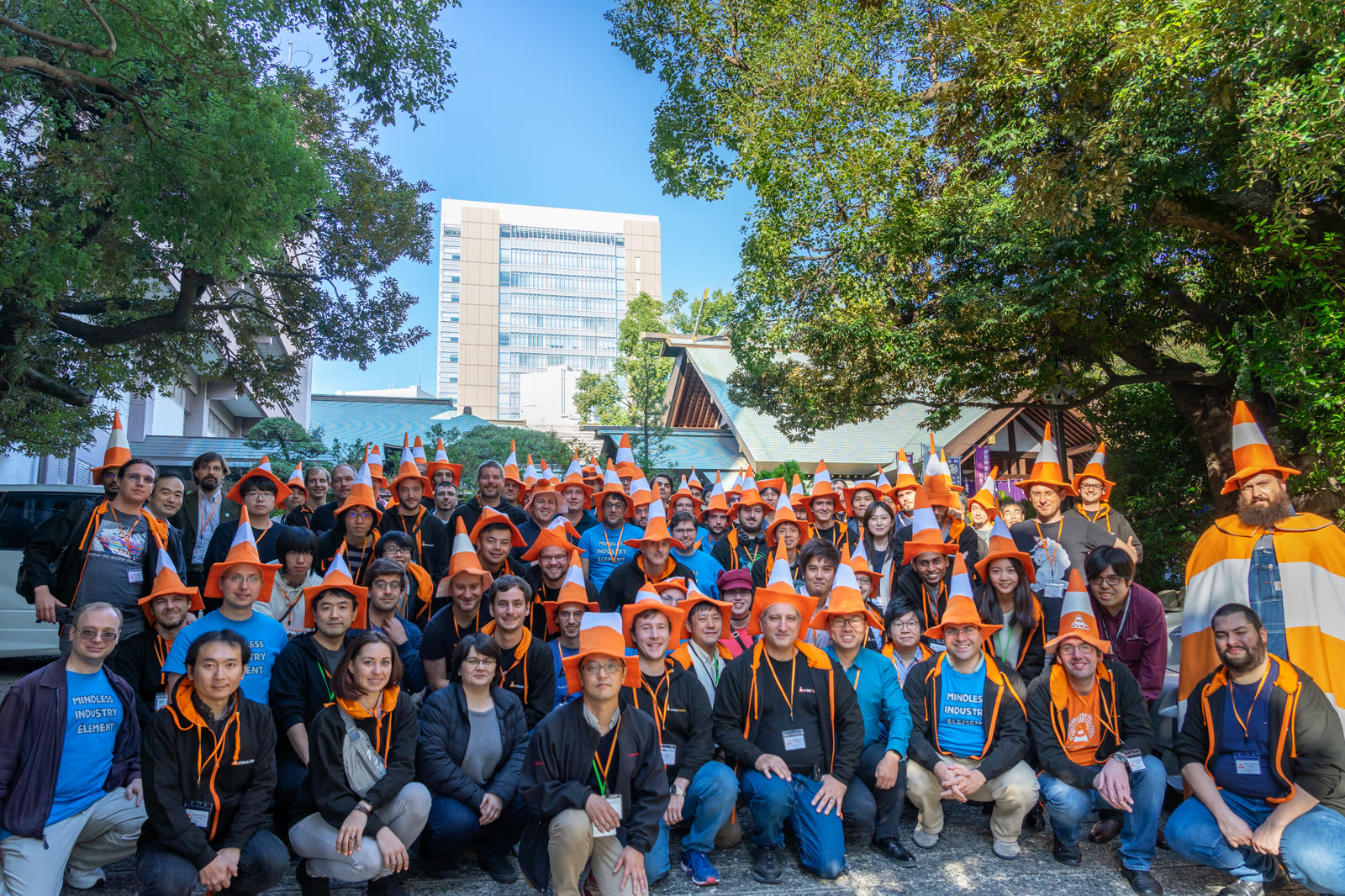
Image context: the cover comes from Video Dev Days 2019, a real gathering of the open-source multimedia community in Tokyo. The event explicitly centered frameworks including FFmpeg and GStreamer alongside codecs and playback libraries. That mixed room is more faithful to FFmpeg governance than a logo would be: the project coordinates specialists, employers, downstreams, and volunteers without placing them inside one company.[9]
The ordinary constitution lives in patches
FFmpeg does not begin technical authority with a board seat. It begins with a file or subsystem. The project's MAINTAINERS file maps applications, libraries, codecs, formats, filters, platforms, infrastructure, and release work to named people. Its status vocabulary is blunt: [0] means no current maintainer, [1] means a maintainer has little available time, and [2] means someone actively looks after the area.[3]
As read on July 14, 2026, that file exposes six [0] entries, including API tests, the libtheora encoder wrapper, the ADTS muxer, presets, Alpha, and Mac OS X on PowerPC.[3] That count is not a complete health score: most entries carry no status tag, an old target can matter less than a current unmarked subsystem, and the file is only as fresh as its maintainers make it. Its value is narrower and more practical. FFmpeg has a public place where ownership can be named, absence can be admitted, and a change of maintainer can itself be reviewed.
The developer guide turns that map into a workflow. Patches go to the project's Forgejo instance or the public development list. Review is open to everyone. A change should not be committed into another person's actively maintained code without permission; absent a response, the guide gives different waiting windows—12 hours for build failures and security fixes, three days for small changes, and one week for large patches—while allowing a maintainer to request more time.[2] Becoming a maintainer is deliberately mundane: add yourself to MAINTAINERS through a patch, then let the community review the claim.[2]
This is distributed authority with sharp local boundaries. A codec specialist does not need an executive vote to review a codec fix. A contributor cannot acquire broad power merely by landing one patch. Discussions and diffs remain inspectable, and responsibility travels with the code. The failure mode is equally visible: when the relevant expert is overloaded or absent, consensus can become latency. A granular ownership map distributes judgment, but it does not manufacture reviewer hours.
Escalation exists, but it is not product management
FFmpeg has a formal layer for decisions that cannot remain local. Its General Assembly comprises contributors who authored more than 20 patches during the previous 36 months, plus people admitted by vote; the automatically qualified list is refreshed every January 1 and July 1. The assembly uses ranked voting and elects two five-person bodies for one-year terms.[1]
The Technical Committee arbitrates technical conflicts. The governance document is explicit that it is not a steering committee: it can resolve a dispute, issue a binding decision, and publish its reasoning, but it does not continuously direct the roadmap. Its process can request a tightly framed public RFC or deliberate internally, normally with a 96-hour decision window. Members with a personal or financial interest are expected to disclose it and recuse.[1]
The Community Committee handles interpersonal conflict and can remove privileges or impose temporary bans. The separation matters. A disagreement about an API, a complaint about conduct, and a contract for paid work are three different problems; routing them through one all-purpose leadership group would concentrate authority while blurring competence.
The General Assembly threshold is legible, not neutral. Counting authored patches privileges code work that Git can count. Documentation, infrastructure care, user support, release testing, event work, and mediation may be essential without producing 20 patches. The assembly can vote people in, but that remedy is discretionary. FFmpeg's model therefore answers “who may decide?” more cleanly than it answers “whose maintenance burden is invisible?” That boundary becomes important when funding enters: paid priorities should not be mistaken for the full set of work that sustains the project.
Money crosses a different boundary
FFmpeg uses Software in the Public Interest as its fiscal sponsor. SPI can receive and hold donations for the project, approve mission-aligned expenses, and contract for development, while FFmpeg remains a community project rather than an employing corporation.[4] This is a useful separation of powers: the fiscal sponsor supplies legal and accounting capacity; it does not become the technical steering committee.
The handoff is already documented. A reimbursement request is posted to the development list with an amount and purpose. Community agreement precedes action by the FFmpeg liaison. Paid development requires a contract, contractor checks, invoices, and verification; the project's page warns that country-specific paperwork varies and that approved invoices may remain in SPI's payment queue for up to a month.[4] Those are not glamorous details, but they are the difference between “someone should fund maintainers” and money reaching a maintainer lawfully.
The first Sovereign Tech investment tested that path with bounded outputs. FFmpeg reported fixes for bugs found by static analysis, improvements to FFV1 and libswscale, and refactoring of old libpostproc code. More tellingly, it said compensation let contributors spend time on community maintenance that competed with paying work, while writing the proposal required a new kind of collaboration among people spread across employers, countries, and personal circumstances.[6]
That report identifies the governance problem precisely. Technical review can decide whether a libswscale patch is sound. It cannot by itself choose a fair scope, select contractors, track invoices, handle conflicts of interest, or demonstrate to a public funder that maintenance happened. Those responsibilities need an administrative path that remains subordinate to public technical review rather than replacing it.
A second contract is evidence, not yet proof
The two Sovereign Tech entries total €437,930. The 2026 amount is €122,770, or about 78%, larger than the 2024–2025 investment.[5][7] Repeat support at that scale is a positive signal: the first engagement produced work and a final report, and both sides were willing to return. It is not proof of sustainable governance. The 2026 page does not yet publish scope, milestones, contractors, or expected outputs.[7]
An independent concentration measure adds a useful caution. For the rolling year ending July 14, 2026, Linux Foundation Insights reports that four contributors account for 53% of contributions in its FFmpeg dataset and one organization accounts for 51%.[8] Those figures depend on identity matching and the GitHub mirror, so they should be treated as directional rather than as a census of every review, mailing-list reply, test machine, or paid hour. Still, they describe the right risk: a large contributor surface can coexist with concentrated delivery.
The best use of maintenance funding is not simply to buy more commits from whoever already lands the most. It is to reduce fragile queues: pay for review and regression work, make neglected ownership explicit, document subsystem expectations, bring additional maintainers through the public patch path, and leave artifacts that volunteers can carry after a contract ends. A grant can temporarily increase throughput while worsening dependency if knowledge and authority remain concentrated.
The inverse risk is sponsor capture. Public money should not silently decide codec policy, committee membership, or whose patch wins a technical dispute. FFmpeg's current separation is protective: the General Assembly and committees define project authority, subsystem maintainers review code, and SPI handles fiscal execution.[1][2][4] The 2026 program will be strongest if its work enters through those same public interfaces and its conflicts are disclosed there.
What downstream teams should read from the signal
For a team that invokes FFmpeg occasionally on trusted files, none of this demands a governance audit. Pin a supported release, follow security updates, and retain a reproducible command and test corpus. For a platform that parses untrusted uploads, embeds libavcodec, carries private hardware patches, or depends on unusual formats, upstream reviewer capacity is part of the production risk surface. Such a team should know which subsystems it relies on, send fixes upstream, budget for expert review, and avoid treating public funding as an SLA.
The next evidence should be boring and inspectable. The Sovereign Tech Agency or FFmpeg should publish the 2026 scope. Paid patches should identify their review path without receiving a privileged technical lane. Final reporting should connect money to tests, fixes, refactors, documentation, or maintainer capacity. The MAINTAINERS map should change when ownership changes, including honest [0] markers. Contractor knowledge should spread across more than one person and survive the end of the investment.
That is the falsifier for the positive reading. If the second contract produces opaque priorities, concentrates essential work in fewer hands, or requires bespoke administrative heroics that cannot be repeated, FFmpeg will have received funding without building a funding interface. If it leaves public scopes, reviewable code, broader ownership, and a reusable payment path, the project will have done something harder than winning a grant: it will have made paid maintenance compatible with community authority.
FFmpeg already knows how to ask who owns a patch and who may settle a dispute. Its next governance achievement is to answer who scopes maintenance, who gets paid to perform it, and how everyone else can verify the result—without letting the payer own the code's direction.
Sources
- FFmpeg, “Community” — current General Assembly qualification, ranked voting, Technical Committee remit and time limits, Community Committee powers, and conflict-of-interest rules.
- FFmpeg, “Developer Documentation” — patch submission and review, waiting windows, public discussion, subsystem ownership, maintainer admission, testing, and release process.
- FFmpeg project,
MAINTAINERS— current subsystem ownership map and its graded maintenance-status vocabulary. - FFmpeg, “Funding through SPI” — fiscal sponsorship, public reimbursement requests, community approval, contractor paperwork, invoicing, verification, and payment boundaries.
- Sovereign Tech Agency, “FFmpeg” — €157,580 investment record for 2024–2025 and sustainability, security, and innovation remit.
- FFmpeg, “FFmpeg // STF 2024 Project Report” — delivered maintenance work, effect of compensation, first collaborative funding proposal, and administrative lessons.
- Sovereign Tech Agency, “FFmpeg (2026)” — current €280,350 investment record; project details remain pending.
- Linux Foundation Insights, “FFmpeg Insights” — independent rolling-year contributor and organization dependency metrics, with repository-based methodology and scope.
- VideoLAN, “Video Dev Days 2019” — official Tokyo event page and photographic archive for the open multimedia conference, including its FFmpeg focus and group-photo context.