F-Droid is easy to file under "alternative Android app store." That is true enough for a phone user looking for OsmAnd, AntennaPod, NewPipe, or a tracker-light utility, but it is too small for teams thinking about distribution. F-Droid's deeper open-source value is that it turns Android app delivery into an inspectable trust boundary: source code, build recipes, signing keys, repository indexes, app labels, mirrors, and client update behavior all become things you can audit rather than assumptions hidden behind a store button.[1][3]
That makes F-Droid a serious adoption choice only when the problem is distribution trust, not mere catalog preference. If your organization just wants a convenient place to park internal APKs, a managed enterprise app channel may be simpler. If you need a public or community repository where users can understand what was built, where it came from, how it was signed, and what compromises an app carries, F-Droid's machinery becomes much more interesting.[1][4]
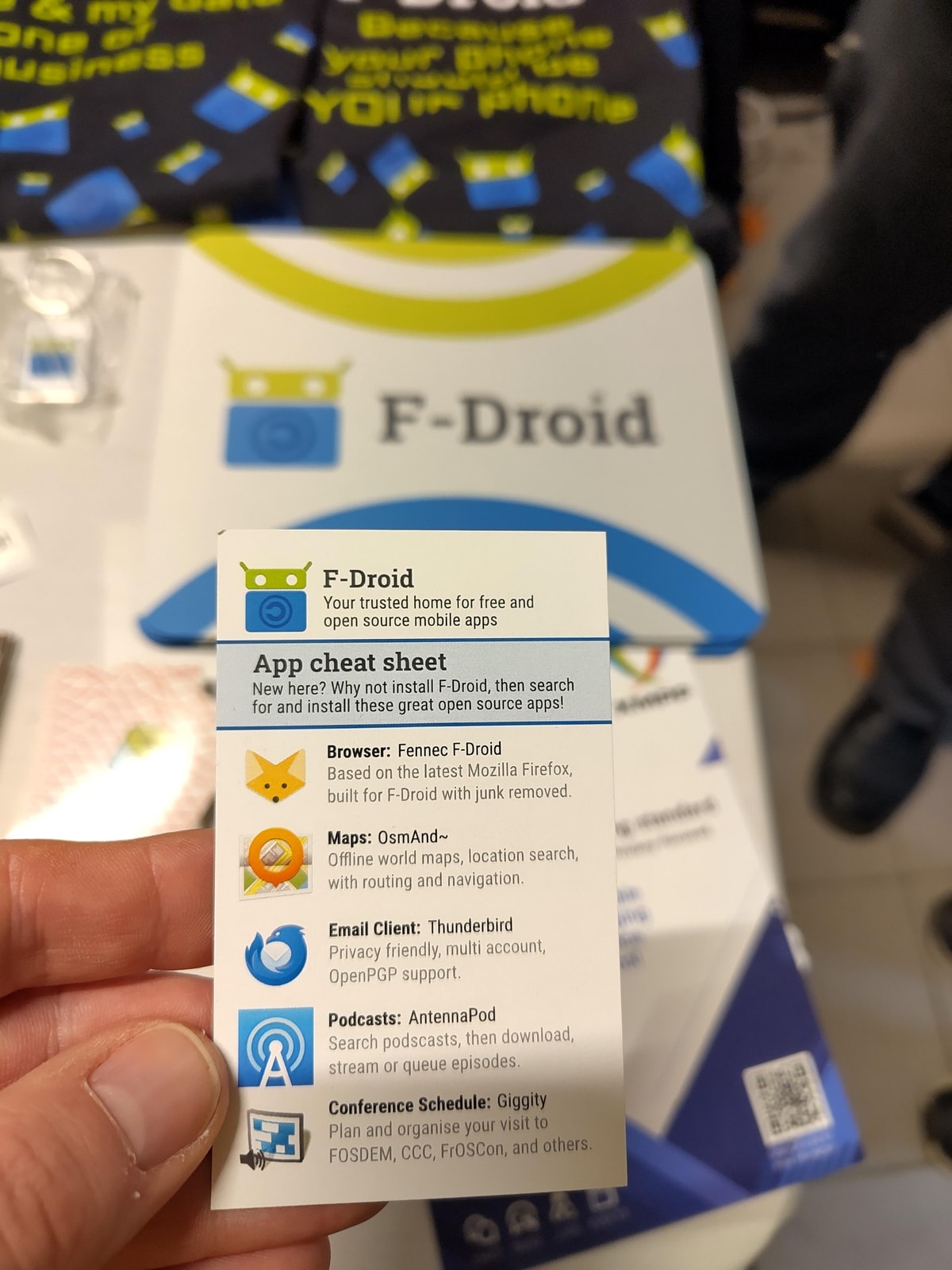
The cover photo shows an F-Droid cheat sheet at FOSDEM 2026, handed out in the dense hallway ecology where free-software projects explain themselves one conversation at a time.[8] That physical detail matters. F-Droid is not only a client app. It is a social and technical interface between upstream developers, packagers, rebuilders, repository operators, and users deciding whether an APK deserves to run on a personal device.
Start with the repository, not the app drawer
The first migration mistake is to treat F-Droid as a replacement launcher for Google Play. The actual unit of adoption is the repository. The F-Droid docs describe the project as both a repository of verified free-software Android apps and an "app store kit" with tools for setting up and running an app store; fdroidserver is the suite used to maintain the main repository and can also create additional or alternative repositories.[1]
That distinction changes the checklist. A repository operator has to own metadata, build inputs, index generation, signing, hosting, mirrors, and update expectations. The public index is not just a search feed. F-Droid's API documentation says the repo is built around a signed index of available apps and packages; with index-v2, diff files can carry changes, and the entry points include entry.jar, entry.json, and entry.json.asc.[4] There is also a signer index that maps packages to SHA-256 signer fingerprints.[4] These are boring names in the best sense: they make the update surface concrete.
For a small community repository, this is liberating because the trust path can be explained. For a casual team without release discipline, it is a warning. If nobody owns the repo signing key, update cadence, metadata review, mirror health, and rollback plan, F-Droid will not magically make Android distribution safe. It will only give the weak process a more formal shape.
Metadata is the release contract
F-Droid's build metadata is where app distribution becomes reviewable. The build metadata reference says fdroid update compiles the public index from APKs and repository files, per-package files in metadata/, localizable assets, and texts embedded in app source code. Those metadata files are YAML, named after package IDs, and structured so tools can process and rewrite them predictably.[2]
That matters because Android distribution otherwise tends to blur three separate questions: what is the app, what source created this APK, and what policy should users see before installing it? In F-Droid, those answers live closer to the repository. Metadata can point at source, define build steps, mark versions, capture package descriptions, and expose the reviewable recipe. A good F-Droid migration therefore starts with metadata hygiene, not with uploading binaries.
The practical pattern is to create a packaging review lane before publication. Treat the metadata file like a release manifest: package ID, source URL, version code, build recipe, signing expectation, Anti-Features, and known update caveats should all be reviewed before the app reaches users. This is more work than direct APK distribution. It is also the work that makes the repository more trustworthy than a download folder.
Builds are isolated because APKs are executable supply chain
F-Droid's build-server documentation is blunt about why isolation exists. Building thousands of apps in automated processes is risky because a compromised upstream source repository could execute custom build steps, access a keystore, alter built APKs or source tarballs for other apps, or modify metadata that itself includes executable build scripts. F-Droid limits that blast radius by using clean, isolated, throwaway virtual machines, separated from signing.[5]
That is the core security posture: every app build is treated as potentially hostile until the process narrows what it can touch. The documented setup uses a dedicated fdroid user, fdroidserver, fdroiddata, and QEMU/KVM/libvirt-based build boxes in the official infrastructure path.[5] Those details are not incidental ops trivia. They tell adopters what kind of maturity F-Droid assumes: release engineering, virtualization, key separation, reproducible environments, and patience for dependency oddities such as old Android NDK requirements.[5]
The boundary condition is clear. If your app estate cannot be rebuilt from source, F-Droid-style distribution will expose that weakness quickly. That exposure can be useful. It turns "we have an APK" into a harder but better question: can an outside builder produce the same artifact from public source, pinned dependencies, and declared tooling?
Reproducible builds change who has to sign
The most important F-Droid adoption improvement is not cosmetic. Reproducible builds can let F-Droid publish APKs signed by the upstream developer after verifying that the downloaded signed binary matches an APK rebuilt from the F-Droid recipe. The reproducible-builds docs describe using the Binaries or Builds.binary directive, plus AllowedAPKSigningKeys, so publication happens only when the rebuilt result matches the expected signed APK.[6]
That changes the trust chain. In the older pattern, a repository signs the APK it builds, so users trust the repository's key for that app. In the reproducible pattern, the upstream developer's signature can stay intact while F-Droid adds an independent rebuild check. The repository is no longer asking users to ignore the developer's identity; it is adding evidence that the developer-signed artifact corresponds to the published source and recipe.[3][6]
This is where teams should be precise. Reproducible builds are not a magic purity badge. The docs point out that Android SDK versions, NDK builds, timestamps, paths, platform differences, and signing formats can all affect whether an APK reproduces cleanly.[6] The right adoption target is incremental: make simple Java/Kotlin apps reproducible first, document exceptions, and treat native-heavy or toolchain-sensitive apps as a separate migration track.
Anti-Features make compromise visible
F-Droid's most user-facing policy mechanism is also one of its best engineering lessons. Anti-Features mark apps with traits many users may not want even when the app is still free software. The docs list labels such as Ads, Known Vulnerability, Non-Free Dependencies, Non-Free Network Services, Tethered Network Services, Tracking, and No Source Since; the F-Droid client can hide some marked apps by default or let users choose what to accept.[7]
This is not just ideology. It is a distribution-interface design choice. Most app stores collapse policy into a binary accept/reject decision controlled by the store. F-Droid often needs a third state: this app may be allowed, but the compromise must be visible at install time. That third state is useful for open-source ecosystems because real software has messy edges: optional crash reporting, proprietary map dependencies, network services that cannot be self-hosted, or upstreams that disappear.
For repository operators, Anti-Features should become part of release review. Do not bury these decisions in issue comments. If an app needs a proprietary network service, mark it. If source availability breaks, mark it. If tracking is opt-out rather than opt-in, mark it. The label is not a punishment; it is a promise that users are allowed to make informed choices.
The Android platform boundary is getting tighter
F-Droid also matters because Android distribution is no longer only a technical packaging question. Google says Android developer verification will require apps in select regions to be registered by verified developers starting in September 2026, with a September 30, 2026 rollout in Brazil, Indonesia, Singapore, and Thailand and broader expansion planned for 2027 and beyond.[9] Google's June 2026 update also says app registration becomes required for participating stores in those first countries, while unregistered apps can still use ADB or an advanced flow.[9]
Independent coverage of the original announcement captured the pressure point: the change primarily affects developers distributing outside Google Play, including direct downloads and third-party app stores, because identity verification becomes part of installation on certified Android devices.[10] That does not make F-Droid obsolete. It makes F-Droid's boundary sharper. A repository can still provide source-based review, signed metadata, reproducibility checks, Anti-Feature labels, and community governance. But it may also have to coexist with platform-level developer identity gates that it does not control.
For adopters, the conclusion is practical. If you use F-Droid to distribute public Android apps, track both trust systems: the F-Droid repository trust path and the certified-Android installation rules. If you use F-Droid-compatible tooling for private or regional distribution, know which devices, countries, ROMs, and install paths your users actually have. F-Droid can make your repository auditable; it cannot guarantee that every certified Android device will treat every install path equally.
A sane rollout
Adopt F-Droid when the problem deserves its machinery. A good fit looks like this: you have free-software Android apps, public source, maintainers willing to fix build reproducibility, a release engineer who can own metadata and signing, and users who benefit from visible trust labels. A weak fit looks like this: closed-source internal APKs, no rebuild path, no key-rotation plan, no policy owner, and a vague hope that "alternative store" means lower operational burden.
The smallest useful rollout is not a giant catalog. Start with one or two apps. Write clean metadata. Build in an isolated environment. Decide whether the repository signs the app or whether reproducible developer-signed publishing is achievable. Check Anti-Features honestly. Publish through a signed repository index. Then test updates on real devices, including the exact Android versions and installation paths your users run.
The failure modes are predictable. A metadata shortcut becomes a stale package. A repo key becomes a single-person secret. A reproducible-build exception becomes permanent folklore. Anti-Features become political and stop being applied. Platform verification rules change the user install path while the repository operator is still arguing about catalog design. These are not reasons to avoid F-Droid. They are reasons to treat it as release infrastructure.
F-Droid is strongest when it is read that way. It is not only a place to find apps outside Google Play. It is a working model for how mobile software distribution can expose its trust chain: source, recipe, build isolation, signature, index, policy label, and client update. If those are the boundaries you need, F-Droid is worth adopting carefully. If they are not, calling it an app store will keep hiding the part that actually matters.
Sources
- F-Droid, "Docs" - overview of F-Droid as a repository, app-store kit, and
fdroidservertoolchain. - F-Droid, "Build Metadata Reference" - metadata sources, YAML structure, and
fdroid updateindex inputs. - F-Droid, "Security Model" - signed metadata, repository keys, app signing, mirrors, initial installs, and reproducible-build security rationale.
- F-Droid, "All our APIs" - signed repository indexes, index-v2 diffs, entry files, signer index, verification data, and transparency log references.
- F-Droid, "Build Server Setup" - isolated throwaway build VMs, QEMU/KVM/libvirt setup, keystore separation, and build-server risk model.
- F-Droid, "Reproducible Builds" - signature copying, upstream-signed APK publication,
Binaries,Builds.binary, andAllowedAPKSigningKeys. - F-Droid, "Anti-Features" - user-facing labels for ads, tracking, known vulnerabilities, non-free dependencies, network-service dependencies, and unavailable source.
- AntennaPod, "AntennaPod @ FOSDEM 2026" - FOSDEM report and real photograph of the F-Droid app cheat sheet used for the article image.
- Android Developers Blog, "Android developer verification: Building a safer ecosystem together," June 2026 - rollout dates, first countries, participating stores, APIs, and advanced-flow notes.
- Jess Weatherbed, "Google will verify Android developers distributing apps outside the Play store," The Verge, August 26, 2025 - independent summary of developer-verification impact on third-party distribution.