A library can pay someone to keep its catalog running and still depend on work that no support contract fully covers: coordinating a release, welcoming a new tester, or keeping documentation useful across institutions. Evergreen, the open-source library system, has given that shared work a more explicit institutional home. Its membership program, opened for the 2026 calendar year, lets people qualify through contributions as well as through dues. The governance question is practical: who gets a voice in sustaining the software everybody uses?[1][2]
Evergreen manages cataloging, circulation, and the public catalog through which readers find materials. Its GNU General Public License permits downloading, using, modifying, and sharing the software. Membership belongs to the nonprofit supporting the project; it is a separate relationship from permission to use the code.[1][3] That distinction makes the new model worth examining beyond the library world.
The work between institutions
The project's 2025–28 strategic plan describes a familiar open-source problem with unusual directness. Its earlier model relied on volunteers, donated institutional effort, and financing arranged as needs arose. Developer feedback from a 2023 focus group called for mentorship, stronger documentation, and a dedicated project manager. The plan, adopted on January 16, 2025, proposed membership revenue alongside a more deliberate staffing and contributor structure.[4]
These are coordination needs. A developer may know how to fix a bug while still needing someone else to reproduce it, review the change, explain it, and help carry it into a release. If each institution budgets only for its own immediate problem, the connections between those tasks can depend on whoever happens to have time.
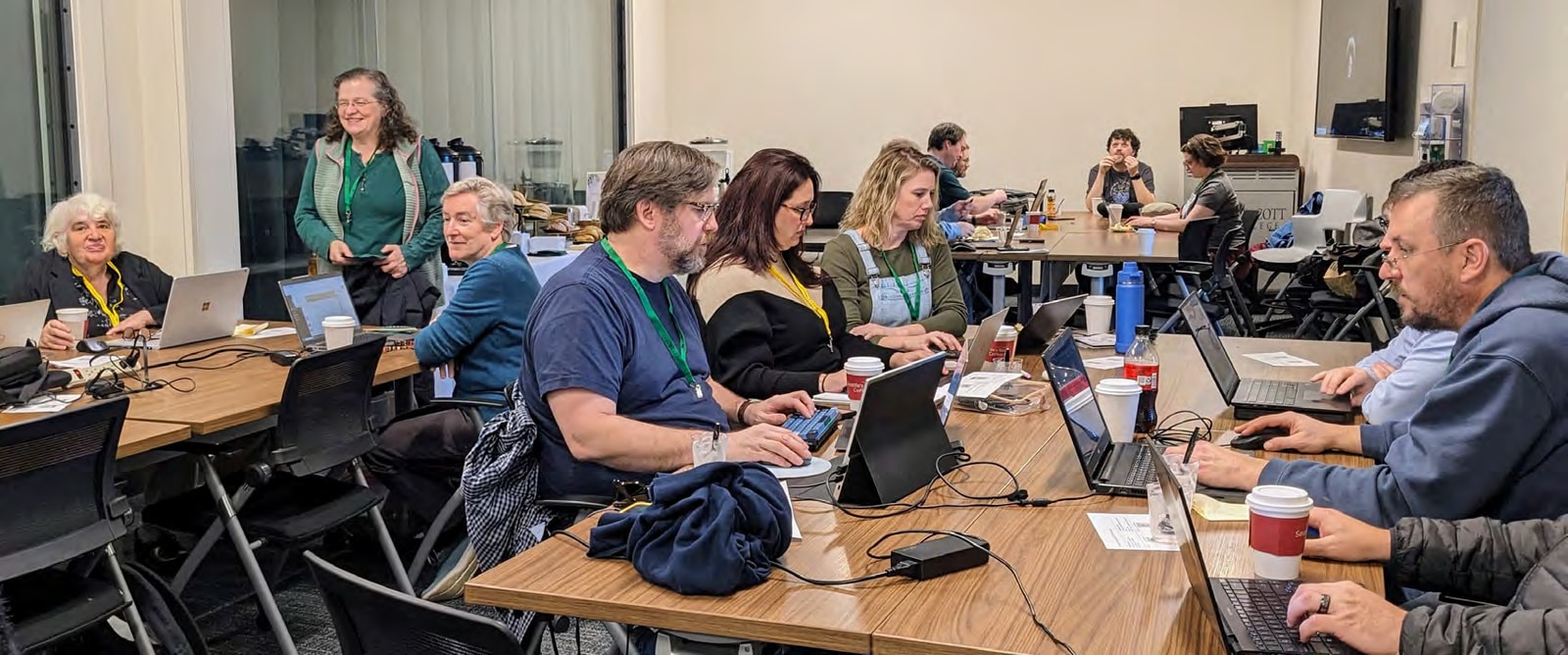
Evergreen's record makes that work visible. Its 2024 annual report counted 760 commits from 35 authors, with documentation accounting for 22 percent of commits. It also recorded 25 people from 12 organizations attending that year's Hack-A-Way in person. Discussions included translation handling for monthly releases, infrastructure, and accessibility work.[5] The photograph shows laptops and tables; the accompanying report shows why gathering their owners matters.
Commit counts cannot measure the quality of a review or the patience required to teach a newcomer. Read alongside the strategic plan, however, they reveal the scale of the coordination task. A distributed project needs ways to make shared responsibilities predictable without assuming that contributors all have the same employer.
Contribution earns membership
The published 2026 schedule sets an individual membership at US$100. Its contributor program provides a route in place of that fee: eligibility is assessed using qualifying participation in the preceding calendar year, and applicants must submit an application. Recognized activities include code and documentation contributions, bug commenting and testing, release work, and participation in community groups.[2]
The breadth of that definition matters. Someone who turns an obscure failure into a reproducible bug report is helping the software improve even if their name never appears as a patch author. Recognizing that person alongside developers makes the membership model better reflect how usable software is produced. That is an interpretation of the program's design, not evidence that every kind of contribution already receives equal attention.
The bylaws restated in July 2025 establish the connection to authority. Individual members in good standing can vote in board elections and stand for a board seat; individual membership may come through purchase, an institutional allocation, or the contributor program. The board is responsible for the nonprofit's business, assets, and fiscal conduct.[3] These provisions concern governance of the organization. They do not establish that purchasing membership buys acceptance of a patch or priority for a feature.
The institution still matters
There is a tension inside this inclusive design. Institutional tiers include different numbers of individual memberships: the published Copper tier includes one, Gold includes three, and Platinum includes five.[2] Because votes belong to individual members, the relevant question is who can take part, including people whose membership is supplied by an employer.[3]
Larger institutions can also afford staff time for meetings, testing, and documentation. A contributor route removes the annual fee for eligible participants, but it cannot supply that time. A small library whose staff are constantly covering the circulation desk may struggle to participate even when the formal door is open. The model therefore deserves evaluation through participation as well as revenue: whether contributors enroll, whether they use their votes, and whether new people can find a manageable first responsibility.
That is also the limit of what the founding documents demonstrate. The strategic plan sets out a route toward dedicated organizational capacity; it does not, by itself, prove that staffing is funded or that maintenance bottlenecks have disappeared.[4] Those outcomes need evidence from subsequent budgets, appointments, and project work.
Three responsibilities behind one catalog
The distinction becomes clearer at a working library. BC Libraries Cooperative's Sitka service supplies Evergreen hosting, support, backups, maintenance, and upgrades. It also describes pooling member requests and coordinating development with the wider Evergreen community.[6] A library can obtain day-to-day operational help through that arrangement while shared development continues across organizational boundaries.
Independent industry reporting supports this picture of a service ecosystem. In his 2025 Library Systems Report, Marshall Breeding describes Equinox Open Library Initiative as both an Evergreen support provider and a major contributor to its development. He places open-source services within a library technology market whose consolidation has reduced the range of competing suppliers.[7] Maintaining a usable alternative consequently involves more than keeping a repository downloadable.
For a library without a local systems team, membership does not replace an operating arrangement with someone responsible for recovery, upgrades, and support. For a consortium with technical staff, it also does not replace protected time for contributing. The useful budgeting distinction is between running a particular installation, developing changes, and sustaining the organization that helps the wider community work together.[3][6]
Evergreen's experiment makes the third responsibility easier to name. It recognizes that a tester, documentation writer, or community organizer can help maintain a public resource and deserve a formal place in its governance. The next test is whether that recognition gives more people the time, continuity, and support to keep doing the work.
Sources
- Evergreen Documentation, “About Evergreen” — software scope and GNU GPL permissions.
- The Evergreen Project, “Membership” — 2026 dues, institutional allocations, and contributor eligibility; checked October 25, 2026.
- The Evergreen Project, Bylaws, restated and amended July 17, 2025 — Articles II and III on membership, voting, and board responsibilities.
- The Evergreen Project, 2025–28 Strategic Plan, adopted January 16, 2025 — stakeholder feedback, resource model, and staffing proposals.
- Evergreen Outreach Committee, 2024 Annual Report, published 2025 — commit statistics on pages 10–11 and Hack-A-Way account and photograph on page 14.
- BC Libraries Cooperative, “Sitka & Evergreen ILS” — hosted operations, pooled development requests, and consortium participation.
- Marshall Breeding, “2025 Library Systems Report,” American Libraries, May 2025, pages 16–26 — independent industry analysis; see pages 17 and 24 for consolidation and Evergreen services.